
Few archaeological sites reveal the story of an ancient city as completely as Ephesus. Rather than preserving a single monument or temple, Ephesus allows visitors to walk through an entire Roman city where marble streets, marketplaces, theatres, bathhouses, libraries, and private homes still follow the original urban plan established nearly two thousand years ago.
Located near the modern town of Selçuk on Türkiye’s Aegean coast, Ephesus grew from an important port settlement into the capital of the Roman province of Asia. Merchants, governors, pilgrims, craftsmen, and travellers from across the Mediterranean shaped the city’s development, creating one of antiquity’s greatest commercial, political, and cultural centres.
The city’s significance extends well beyond the Roman period. Ephesus also became one of the most important centres of early Christianity through its connections with Saint Paul, Saint John, and the House of the Virgin Mary, while nearby monuments such as the Temple of Artemis, the Basilica of Saint John, and the Ephesus Archaeological Museum together preserve more than three thousand years of continuous history.
Our Ephesus Travel Guide introduces the wider historical landscape surrounding the ancient city, while this guide focuses specifically on exploring Ephesus Ancient City, its monuments, visitor experience, and practical planning advice.
Explore More of Ephesus
Planning to visit Ephesus Ancient City? These guides will help you better understand the region’s archaeological sites, Christian heritage, nearby attractions, and suggested itineraries before your visit.

Plan Your Visit
Private Tours
- Private Ephesus Tour
- Best of Turkey Tour
Discover Nearby Landmarks
- House of the Virgin Mary
- Basilica of Saint John
- Temple of Artemis
- Ephesus Archaeological Museum
- Ephesus Experience Museum
- Şirince Village
Why Is Ephesus Ancient City So Important?
Ephesus Ancient City is regarded as one of the world’s greatest archaeological sites because it preserves far more than individual monuments. It offers an exceptionally complete picture of how one of the Roman Empire’s largest cities functioned, allowing visitors to understand the relationship between politics, commerce, religion, engineering, and everyday life within a single urban landscape.
Its importance began with geography. Situated beside the ancient harbour at the mouth of the Kaystros River, Ephesus became one of the busiest commercial gateways in the eastern Mediterranean. Merchant ships connected the city with ports across the Roman world, while roads extending inland linked western Anatolia with the wider empire. This strategic position transformed Ephesus into one of Roman Asia’s wealthiest and most influential cities.
Commerce, however, was only part of the story. As the capital of the Roman province of Asia, Ephesus became an administrative centre where governors, civic officials, merchants, philosophers, and travellers gathered every day. Public buildings such as the State Agora, the Prytaneion, and the Great Theatre formed the civic heart of a city that influenced political and economic life across western Anatolia.
Religion gave Ephesus another layer of significance. The Temple of Artemis attracted pilgrims for centuries before the city later emerged as one of early Christianity’s most influential centres through its association with Saint Paul, Saint John, and the House of the Virgin Mary. These successive religious traditions shaped the city’s identity long after its commercial importance began to decline.
Today, visitors experience something that few archaeological sites can offer: the opportunity to walk through an entire Roman city where streets, monuments, public spaces, and private residences remain connected by their original urban plan. This exceptional preservation explains why Ephesus continues to be recognised as one of the most significant archaeological destinations in the Mediterranean.
Many travellers combine Ephesus Ancient City with nearby landmarks such as the House of the Virgin Mary, the Basilica of Saint John, and the Temple of Artemis, creating a full-day exploration of one of Türkiye’s richest historical landscapes. Our Private Ephesus Tour brings these sites together with the insight of licensed local guides, helping visitors understand how each monument contributes to the wider story of Ephesus.
Where Is Ephesus Ancient City?
Ephesus Ancient City is located near the modern town of Selçuk in İzmir Province, western Türkiye, approximately 80 kilometers (50 miles) south of İzmir and about 20 kilometers (12 miles) from today’s Aegean coastline. In antiquity, however, the city stood directly beside the mouth of the Kaystros (Küçük Menderes) River, where its natural harbor connected the interior of Anatolia with maritime trade routes across the Mediterranean.
Although the archaeological site now lies several kilometers inland, Ephesus originally developed around a sheltered natural harbor that made it one of the busiest commercial ports of the ancient Mediterranean. Over centuries, sediment carried by the Kaystros River gradually filled the harbor and pushed the coastline farther west. As ships could no longer reach the city as easily, maritime trade declined, reducing Ephesus’ economic importance and contributing to its gradual abandonment. This geographical transformation explains both the city’s remarkable prosperity and its eventual decline.
Today, reaching Ephesus is remarkably straightforward, making it one of the most accessible archaeological sites in western Türkiye. The ancient city is just a few minutes from Selçuk, around 25 minutes from Kuşadası, approximately one hour from İzmir city center, and 45 to 60 minutes from İzmir Adnan Menderes Airport. Many travelers also combine their visit with nearby attractions such as the House of the Virgin Mary, the Temple of Artemis, Şirince Village, or Pamukkale, making Ephesus an ideal destination for both day trips and multi-day cultural itineraries.
Its location explains why Ephesus became one of the Mediterranean’s greatest cities, but geography alone cannot account for its long history. Over many centuries, successive civilizations transformed a favorable harbor settlement into the political, commercial, and religious center that visitors explore today. Understanding that evolution begins with the city’s earliest origins.

A Brief History of Ephesus Ancient City
The history of Ephesus spans more than ten thousand years, making it one of the longest continuously occupied landscapes in the eastern Mediterranean. While most visitors associate Ephesus with its remarkably preserved Roman monuments, the city’s origins stretch back thousands of years before the Roman Empire. Successive civilizations, from prehistoric communities and the Hittites to the Greeks, Romans, Byzantines, and Seljuks, each reshaped the landscape, leaving behind layers of history that still define the region today.
Archaeological excavations at nearby Çukuriçi Höyük have uncovered evidence of human activity dating to around 8200 BC. During the second millennium BC, Hittite records refer to a city called Apasas, widely believed to be the predecessor of Ephesus. Its fertile surroundings, access to the Aegean coast, and position along regional trade routes gave the settlement strategic importance long before the rise of the Greek world.
A new chapter began when Ionian Greeks established Ephesus as one of the twelve cities of the Ionian League. Maritime trade expanded rapidly, attracting merchants from across the Aegean and transforming the city into an important commercial and cultural center. At the same time, the sanctuary of Artemis grew into one of the most celebrated religious destinations of the ancient world. Pilgrims, craftsmen, merchants, and local communities all contributed to the city’s prosperity, creating an economy in which religion and commerce developed side by side.
The city’s modern layout took shape during the Hellenistic period. In the third century BC, Lysimachus, one of Alexander the Great’s successors, relocated Ephesus after repeated flooding threatened the earlier settlement. The new city was carefully planned with broad streets, defensive walls, public spaces, and residential districts, creating an urban framework that later allowed Roman architects to expand Ephesus into one of the empire’s greatest cities.
Under Roman rule, Ephesus reached its golden age. As the capital of the province of Asia, it became one of the Roman Empire’s foremost administrative, commercial, and cultural centers, with a population estimated at more than 200,000 people. Monumental public buildings came to define the city’s skyline, including the Library of Celsus, the Great Theatre, expansive bath complexes, fountains, marketplaces, and the elegant Terrace Houses that reflected the wealth and status of Ephesus’ elite citizens. During the same period, Ephesus also emerged as an important center of early Christianity through the ministry of Saint Paul and later traditions associated with Saint John and the Virgin Mary.
The same geography that had once fueled Ephesus’ success eventually contributed to its decline. Over centuries, sediment carried by the Kaystros River gradually filled the harbor, moving the coastline farther west and reducing maritime access. As trade diminished, political priorities shifted, and repeated earthquakes damaged the city, Ephesus slowly lost its prominence. By the late medieval period, much of the once-thriving metropolis had been abandoned.
Interest in Ephesus revived during the nineteenth century, when systematic archaeological excavations began revealing the true scale of the ancient city. Research continues today, and archaeologists estimate that substantial sections of Ephesus still remain buried beneath the ground. New discoveries continue to refine our understanding of the city’s street network, residential quarters, public infrastructure, and daily life, demonstrating that the history of Ephesus is still unfolding.
From Ancient Metropolis to UNESCO World Heritage Site
Centuries after its decline, Ephesus remains one of the most significant archaeological landscapes of the ancient world. Its exceptional state of preservation provides an unusually complete picture of Roman urban planning while also preserving evidence from earlier Greek, Byzantine, and later historical periods.
In recognition of its Outstanding Universal Value, Ephesus was inscribed on the UNESCO World Heritage List in 2015. The World Heritage property extends beyond the archaeological city itself to include Ayasuluk Hill, the Basilica of St. John, the Temple of Artemis, and the House of the Virgin Mary, together illustrating more than three thousand years of continuous cultural development within the same historical landscape.
Today, UNESCO World Heritage status supports the long-term conservation of this remarkable cultural landscape while ongoing archaeological research continues to reveal new insights into one of the Mediterranean’s greatest ancient cities.

How Large Was Ephesus Ancient City?
At its height during the Roman period, Ephesus was home to an estimated 200,000 to 250,000 people, making it one of the largest cities in the eastern Mediterranean. Comparable in size to Alexandria and Antioch, it ranked among the Roman Empire’s principal urban centers. Yet the true scale of Ephesus was measured not only by its population but by the complexity of urban life that unfolded within its streets each day. Government officials, merchants, artisans, sailors, priests, teachers, laborers, enslaved people, and pilgrims all shared the same urban landscape, creating a dynamic city that operated almost continuously from sunrise until nightfall.
Every arrival at the harbor set the city in motion. Cargo was unloaded onto the quays, customs officials collected duties, merchants negotiated prices, and goods moved toward warehouses, workshops, and marketplaces before continuing inland along Roman roads. Around this commercial activity, bankers financed transactions, craftsmen supplied both local and international markets, while countless laborers kept the city’s economy functioning. Rather than serving simply as a port, Ephesus operated as a highly organized commercial network where transportation, administration, manufacturing, and trade worked together to sustain one of the Roman world’s most prosperous cities.
Roman engineering supported nearly every aspect of daily life. Aqueducts supplied fresh water to fountains, bathhouses, and private residences, while underground drainage channels carried wastewater away from densely populated neighborhoods. Marble-paved streets organized movement across the city, public latrines reflected advanced standards of sanitation, and carefully planned public spaces encouraged commercial, political, and social interaction. The Great Theatre alone accommodated tens of thousands of spectators for theatrical performances, civic assemblies, and later gladiatorial spectacles, illustrating how architecture served both practical and ceremonial functions within the city.
Despite its impressive size, only part of ancient Ephesus is visible today. The archaeological site represents the city’s ceremonial and civic core, while extensive residential districts, commercial quarters, industrial areas, and sections of the ancient harbor remain either unexcavated or buried beneath centuries of sediment. Ongoing archaeological excavations continue to reveal new information about neighborhoods, public infrastructure, workshops, and daily life, steadily expanding our understanding of how one of antiquity’s largest urban centers actually functioned.
Walking through Ephesus today means exploring only part of what was once a vast and remarkably sophisticated city. Every marble street, monument, marketplace, and public square formed part of an interconnected urban system designed to support hundreds of thousands of residents. Understanding these individual landmarks reveals not only their architectural significance but also the daily routines, social relationships, and civic organization that allowed Ephesus to flourish for centuries. The best way to appreciate this remarkable urban landscape is to explore the monuments that once shaped everyday life within the city.

Religion and Cultural Significance of Ephesus
Few cities in the ancient world matched the religious importance of Ephesus. For more than a thousand years, the city served as a meeting point of different beliefs, traditions, and cultures. From the worship of Artemis to the spread of Christianity, Ephesus experienced profound religious transformations that shaped not only western Anatolia but also the wider Mediterranean world. Temples, shrines, synagogues, churches, and pilgrimage sites coexisted across different periods, reflecting the city’s constantly evolving spiritual landscape.
The Cult of Artemis
For centuries, Ephesus was renowned as the center of the cult of Artemis, whose sanctuary attracted pilgrims from across the ancient Mediterranean. Unlike the Greek Artemis worshipped elsewhere, the Ephesian Artemis represented a unique fusion of Anatolian fertility traditions and Greek religious beliefs. The Temple of Artemis became one of the Seven Wonders of the Ancient World and established Ephesus as one of antiquity’s foremost pilgrimage destinations. Religious festivals, offerings, and pilgrimages supported local craftsmen, merchants, priests, and civic institutions, making the sanctuary not only a place of worship but also a major driver of the city’s economy.
The Rise of Christianity
During the first century AD, Ephesus became one of the earliest and most influential centers of Christianity. According to the New Testament, Saint Paul spent several years preaching in the city, where his teachings challenged the economic influence of the Artemis cult and helped establish one of the first Christian communities in Asia Minor. Christian tradition also associates Ephesus with Saint John the Apostle, who is believed to have lived and preached in the region, as well as with the House of the Virgin Mary, located in the nearby hills. These associations transformed Ephesus into an important Christian pilgrimage destination that continued to attract believers long after the decline of the Roman Empire.
A City of Religious Transformation
Religious change in Ephesus was gradual rather than sudden. Pagan sanctuaries, the imperial cult, Jewish communities, and Christian congregations all formed part of the city’s social fabric at different stages of its history. This process reached a defining moment in AD 431, when the Council of Ephesus gathered bishops from across the Christian world to debate the nature of Christ and formally recognized Mary as Theotokos, meaning “Mother of God.” The council confirmed Ephesus as one of the most influential religious centers of Late Antiquity and reinforced its lasting place in Christian history.
Today, the religious heritage of Ephesus extends far beyond its archaeological remains. The Temple of Artemis, the Basilica of St. John, the House of the Virgin Mary, and the ancient city together illustrate how successive civilizations transformed the same landscape while leaving behind traditions that continue to shape its cultural identity.
What to See Inside Ephesus Ancient City
One of the reasons Ephesus Ancient City is considered among the world’s finest archaeological sites is the remarkable preservation of its urban landscape. Rather than presenting isolated monuments, the site allows visitors to explore an entire Roman city where streets, public spaces, religious buildings, marketplaces, and private residences still follow the original urban plan established nearly two thousand years ago.
Walking through Ephesus is unlike visiting most archaeological sites. Every street leads naturally to another public space, revealing how politics, commerce, religion, education, entertainment, and everyday life were woven together within a carefully planned urban environment. Understanding this organization makes each monument far more meaningful than viewing it in isolation.
How Was Ephesus Designed as a Working City?
Unlike many ancient cities that expanded gradually over centuries, Roman Ephesus followed a carefully organized urban plan. Streets, marketplaces, temples, administrative buildings, bathhouses, and residential districts were positioned to function as parts of a single urban system. Rather than developing randomly, the city was designed to support the continuous movement of people, goods, water, and information across its neighborhoods.
Curetes Street formed the city’s principal urban axis, connecting the administrative center with commercial areas, religious monuments, and residential quarters. More than a road, it guided how people experienced the city, linking political, economic, and social spaces into a continuous sequence. Walking along its marble pavement today still reveals the logic behind Roman urban planning.
Movement through the city was carefully managed. The Heracles Gate restricted wheeled traffic entering the upper city, separating carts from pedestrians and helping regulate circulation through some of Ephesus’ busiest public spaces. This deliberate organization allowed commercial activity, civic life, and everyday movement to coexist without disrupting one another.
Infrastructure supported every aspect of urban life. Aqueducts supplied fresh water throughout the city, fountains distributed it to public spaces, underground channels removed wastewater, and public latrines formed part of an advanced sanitation system. These engineering achievements supported one of the largest urban populations in the Roman world while maintaining public health and daily comfort.
Private residences reflected the same level of planning. The Terrace Houses were equipped with running water, drainage systems, hypocaust heating, interior courtyards, and richly decorated living spaces, demonstrating that Roman engineering extended beyond public monuments into everyday domestic life. Together, these elements reveal why Ephesus remains one of the world’s finest surviving examples of Roman urban planning, where every monument belonged to a larger, interconnected city.
The following landmarks illustrate how this remarkable urban system functioned and why Ephesus continues to be regarded as one of the greatest cities of the ancient world.
Library of Celsus
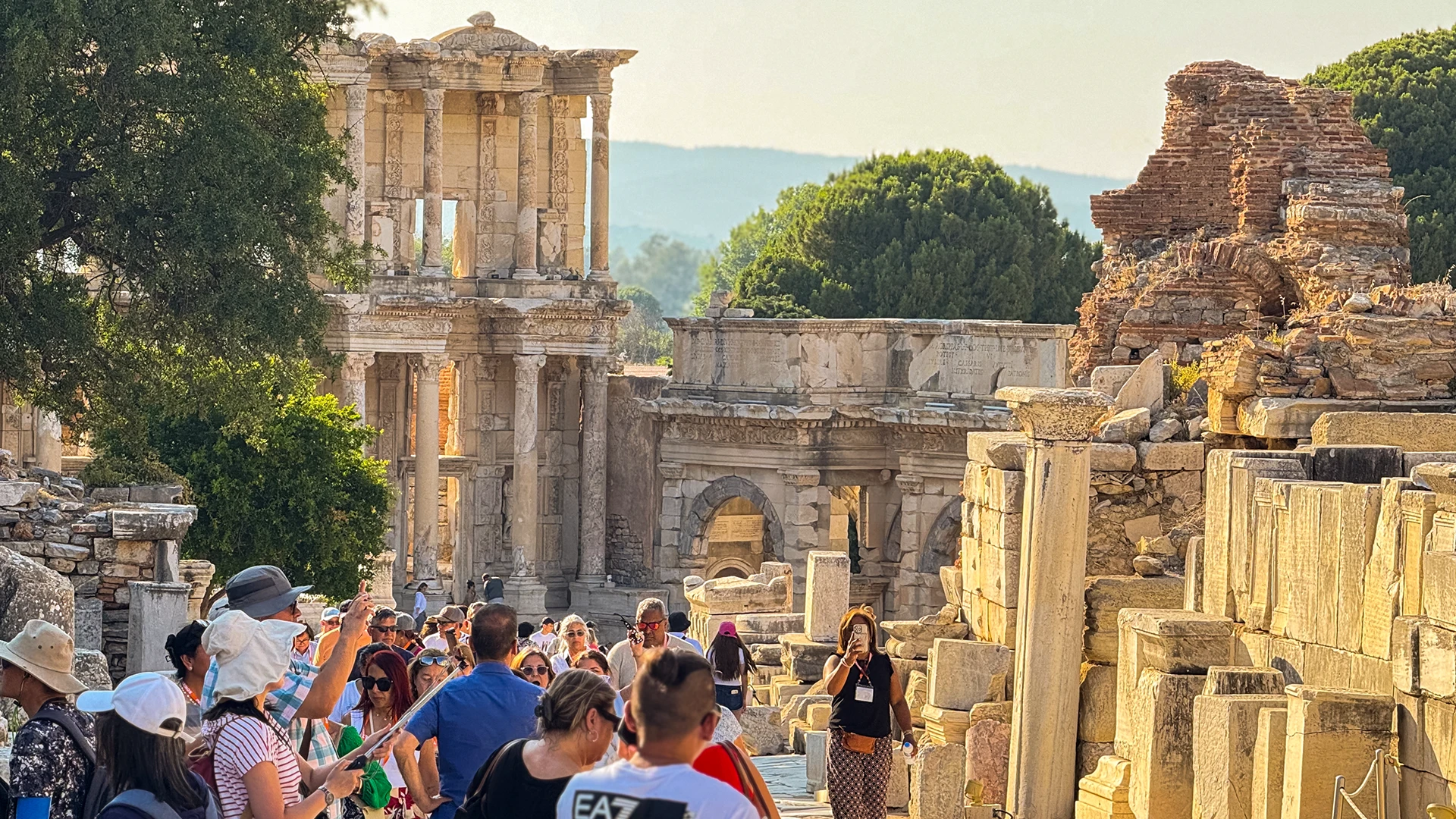
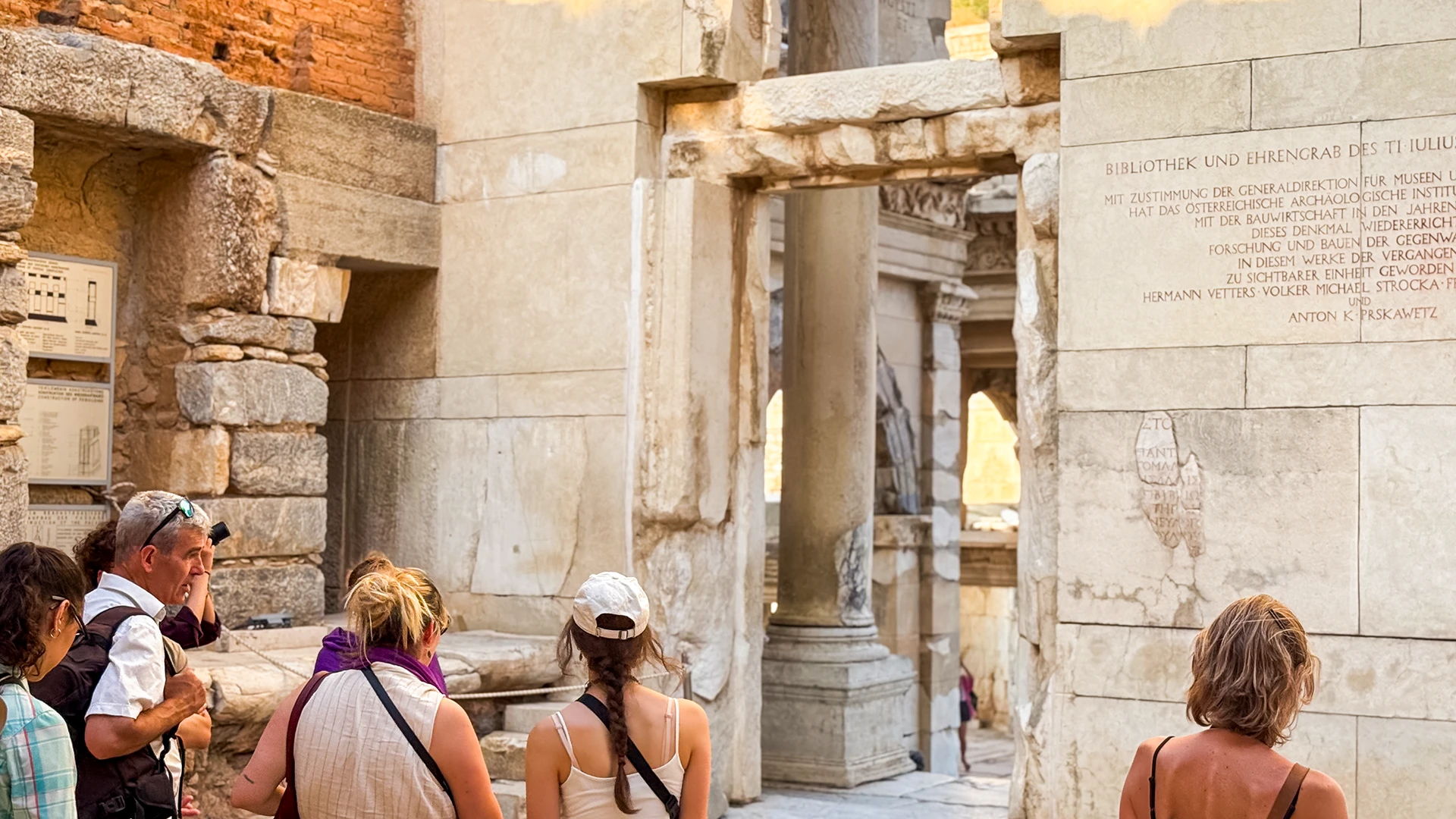
The Library of Celsus is the most recognizable monument in Ephesus and one of the finest surviving examples of Roman civic architecture. Constructed in the early second century AD, it served both as a public library and as the monumental tomb of the Roman governor Tiberius Julius Celsus Polemaeanus. Originally housing an estimated 12,000 scrolls, it ranked among the largest libraries of the Roman Empire.
Its elegant two-story façade, reconstructed from original architectural fragments, demonstrates the sophistication of Roman engineering and decorative design. Today, it has become one of Türkiye’s most photographed archaeological landmarks and a defining symbol of Ephesus.

Great Theatre
With seating for approximately 25,000 spectators, the Great Theatre was one of the largest entertainment venues in the Roman Empire. First established during the Hellenistic period and substantially enlarged under Roman rule, it hosted theatrical performances, civic assemblies, religious ceremonies, concerts, and later gladiatorial contests.
The theatre also occupies an important place in Christian history. According to the New Testament, it was here that a large public disturbance erupted after Saint Paul’s preaching challenged the influence of the Artemis cult, illustrating how religion, politics, and public life often intersected within Ephesus.
Curetes Street
Curetes Street formed one of the principal arteries of Ephesus, linking the Upper Agora with the Library of Celsus and the commercial districts below. Lined with marble paving, monumental gateways, fountains, statues, and colonnades, it guided both ceremonial processions and the daily movement of residents through the city.
Walking along Curetes Street today offers one of the clearest impressions of how a prosperous Roman city was experienced nearly two thousand years ago.

Terrace Houses
The Terrace Houses offer one of the most remarkable insights into everyday life in ancient Ephesus. Built on the slopes opposite Curetes Street, these luxurious residences belonged to some of the city’s wealthiest families and preserve an extraordinary level of architectural and artistic detail. Access requires a separate admission ticket, but they are widely considered one of the highlights of the archaeological site.
The houses were carefully arranged in terraces that followed the natural hillside, allowing each residence to benefit from light, ventilation, and efficient access while remaining integrated into the surrounding street network. Their design demonstrates that Roman urban planning extended well beyond monumental public buildings into private residential life.
Inside, visitors encounter beautifully preserved frescoes, intricate mosaics, marble-clad reception rooms, interior courtyards, and advanced engineering systems. Running water, underground drainage, and hypocaust heating provided a level of comfort rarely associated with the ancient world. These homes also reveal how architecture reflected social status, family life, and Roman cultural identity.
More than impressive residences, the Terrace Houses complete the story of Ephesus by revealing how its elite actually lived. Together with the city’s streets, markets, baths, and public monuments, they help visitors understand Ephesus not simply as an archaeological site, but as a sophisticated city where public and private life formed part of a carefully planned urban system.

Temple of Hadrian
Despite its relatively modest size, the Temple of Hadrian is one of the finest examples of Roman decorative architecture preserved in Ephesus. Its elegant Corinthian columns, richly carved reliefs, and distinctive arched entrance reflect the artistic sophistication achieved during the city’s second-century golden age.
Among its most famous decorations is the relief traditionally interpreted as depicting the legendary foundation of Ephesus, making the monument significant for both its artistic and historical value.
State Agora
The State Agora served as the political and administrative heart of Roman Ephesus. Government officials gathered here to conduct civic affairs, hold official ceremonies, and manage the administration of the provincial capital.
Surrounded by important public buildings, the square symbolized the authority of Roman government and remained one of the city’s most important civic spaces.
Commercial Agora
Located closer to the ancient harbor, the Commercial Agora functioned as the economic center of Ephesus. Merchants from across the Mediterranean traded agricultural products, textiles, ceramics, luxury goods, and imported merchandise within its spacious colonnaded marketplace.
Its location between the harbor and the city center illustrates how commerce was carefully integrated into Ephesus’ urban plan.
Prytaneion
The Prytaneion served as the ceremonial headquarters of the city’s government. Here, the sacred civic fire burned continuously as a symbol of the city’s identity and continuity.
Official guests were welcomed within the building, while important religious and civic ceremonies reinforced the close relationship between political authority and public life in Ephesus.
Harbor Street (Arcadiane)
Stretching between the Great Theatre and the ancient harbor, Harbor Street, also known as Arcadiane, formed the city’s grand ceremonial entrance for visitors arriving by sea. Approximately 530 meters long and lined with impressive colonnades, it offered a spectacular first impression of one of the Mediterranean’s busiest port cities.
Historical evidence suggests that Arcadiane was illuminated after dark, making it one of the earliest monumental streets in the Roman world designed for nighttime use.
Together, these monuments reveal far more than architectural achievement. They demonstrate how Ephesus functioned as a complete urban system where government, commerce, religion, education, entertainment, engineering, and domestic life were carefully integrated within a single city. Exploring these landmarks in context allows visitors not only to admire individual buildings but also to understand why Ephesus remains one of the greatest surviving examples of Roman urban planning anywhere in the world.
Planning Your Visit to Ephesus Ancient City
A little planning can make a significant difference when visiting Ephesus Ancient City. Choosing the right entrance, allowing enough time, and visiting during the most comfortable hours will help you appreciate one of the world’s best-preserved Roman cities at a relaxed pace.
Choosing the Right Entrance
Ephesus has two main entrances: the Upper Gate (South Entrance) and the Lower Gate (North Entrance).
Most visitors choose to enter through the Upper Gate and walk downhill toward the Lower Gate. This route follows the natural sequence of the archaeological site, passing many of its most important landmarks, including the State Agora, Curetes Street, the Terrace Houses, the Library of Celsus, the Great Theatre, and Harbor Street.
If you are traveling independently, taxis and local shuttle services operate between the two entrances, making it easy to return to your starting point.
How Long Does It Take to Visit?
Most visitors spend between two and four hours exploring Ephesus. Those wishing to visit the Terrace Houses, stop frequently for photography, or explore the monuments in greater depth should allow at least half a day.
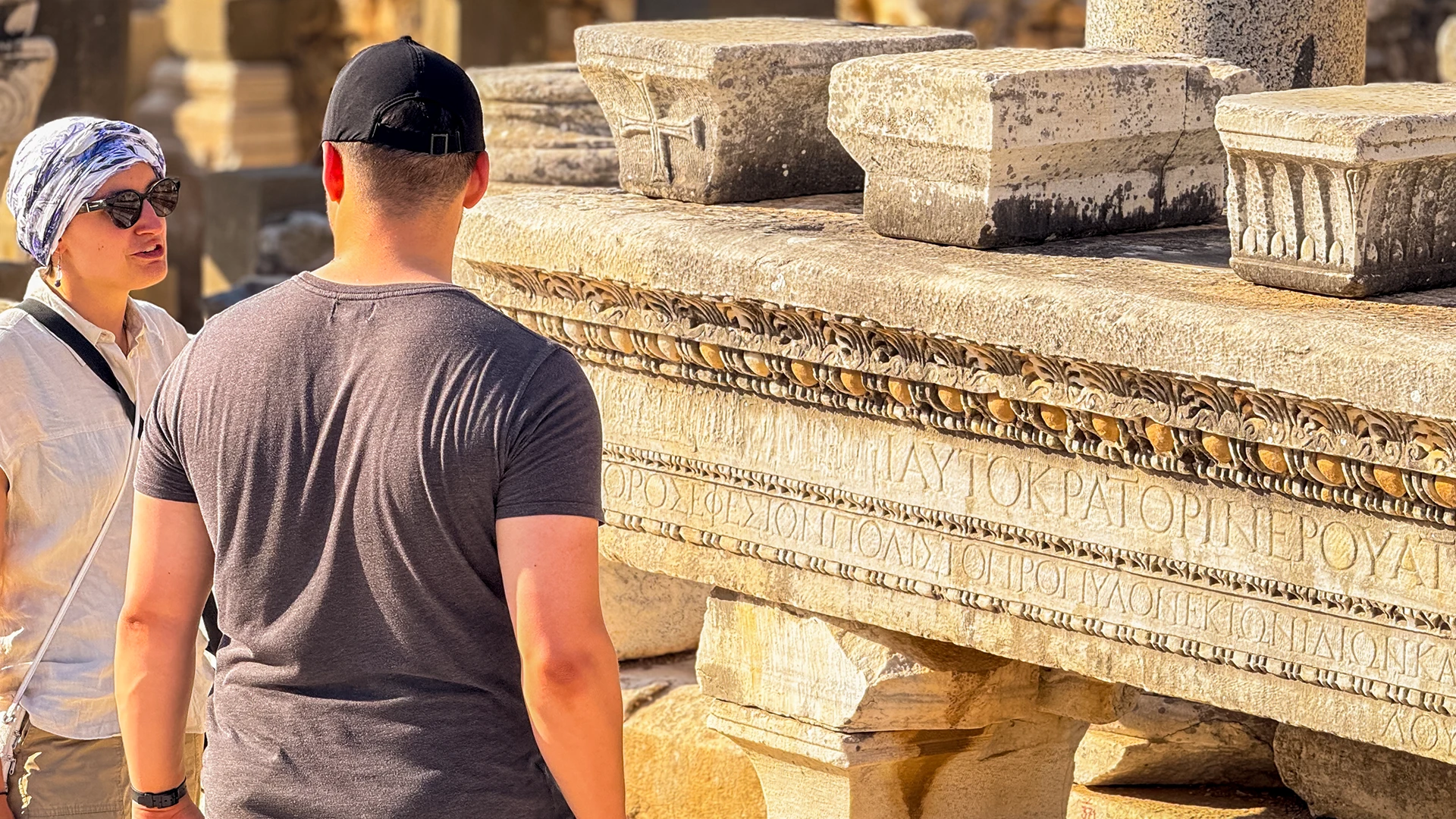
Although the main walking route is straightforward, Ephesus is best experienced at an unhurried pace. Taking time to observe its streets, inscriptions, public spaces, and architectural details reveals how one of the Roman Empire’s greatest cities functioned as a complete urban system.
When Is the Best Time to Visit?
Ephesus is open throughout the year, although spring (April to June) and autumn (September to November) generally provide the most comfortable weather for exploring the open-air archaeological site.
During the summer months, temperatures often exceed 35°C (95°F) by midday. For a more enjoyable visit, consider arriving shortly after opening or later in the afternoon when temperatures are lower, crowds are smaller, and the softer light creates excellent conditions for photography.
Visiting Ephesus at Night
One of the most distinctive ways to experience Ephesus is through the official Night Museum program. During the summer season, selected sections of the archaeological site remain open after sunset, allowing visitors to explore illuminated Roman streets and monuments in a cooler and significantly quieter atmosphere.
Seeing landmarks such as the Library of Celsus, Curetes Street, and the Great Theatre under carefully designed architectural lighting offers a very different perspective from a daytime visit. With fewer visitors and lower temperatures, many travelers find the evening experience more relaxed and immersive, particularly during the peak summer months.
Night visits are currently available on Wednesdays, Thursdays, Fridays, and Saturdays between 7:00 PM and 11:00 PM, while the main ticket office closes at 10:00 PM.
If you plan to visit the Terrace Houses during the evening program, please note that admission ends at 9:00 PM, and a separate or combined ticket is required depending on your ticket option.
As opening days, admission policies, and seasonal schedules may change, we recommend checking the latest information on the official Turkish Museums website before planning your visit.
Ephesus Experience Museum
Located opposite the Great Theatre near the Lower Gate of the archaeological site, the Ephesus Experience Museum complements a visit to Ephesus through immersive digital storytelling, large-scale projections, and spatial audio that recreate the city’s appearance and atmosphere in antiquity.
For most daytime visitors entering from the Upper Gate, the museum naturally appears at the end of the archaeological route, just before leaving the site through the Lower Gate. During the Night Museum program, access to Ephesus is provided only through the Lower Gate, placing the museum at the beginning of the evening visit. Although the museum generally remains open until around 10:30 PM on Night Museum days, admission is organized through timed sessions rather than continuous entry. Visitors should therefore check the next available session at the museum upon arrival, as immediate entry may not always be possible.

Nearby Attractions Around Ephesus
Although Ephesus Ancient City is the region’s best-known landmark, it forms part of a much larger historical landscape. Within a short distance, visitors can explore important Christian pilgrimage sites, Byzantine monuments, museums, Seljuk architecture, and traditional Aegean villages. Together, these places reveal how the Ephesus region continued to evolve long after the Roman period.
House of the Virgin Mary
Located on Mount Koressos (Bülbül Mountain), the House of the Virgin Mary is one of the world’s most important Christian pilgrimage sites. According to Christian tradition, Mary spent her final years here under the care of Saint John the Apostle. Today, many visitors combine the sanctuary with Ephesus as part of the same itinerary.
Temple of Artemis
The Temple of Artemis once stood as the religious heart of ancient Ephesus and was recognized as one of the Seven Wonders of the Ancient World. Although only limited remains survive today, its historical significance continues to make it an essential stop for visitors interested in the ancient city.
Basilica of St. John
Standing on Ayasuluk Hill, the Basilica of St. John was constructed during the reign of Emperor Justinian and is traditionally believed to mark the burial place of Saint John the Apostle. The site also offers panoramic views across Selçuk and the surrounding landscape.
Ephesus Archaeological Museum
Located in nearby Selçuk, the Ephesus Archaeological Museum displays many of the sculptures, inscriptions, and everyday objects discovered during excavations. It provides valuable context for understanding the monuments preserved within the ancient city.
Isa Bey Mosque
Completed in 1375, Isa Bey Mosque is one of the finest surviving examples of early Anatolian Turkish architecture. Its location beside Ayasuluk Hill reflects the region’s transition from the Byzantine world to the Seljuk period.
Şirince Village
Just fifteen minutes from Ephesus, Şirince is known for its restored stone houses, narrow streets, local wines, and traditional Aegean character. It offers a relaxing contrast to the archaeological site and is a popular destination for visitors spending a full day in the region.
Each of these places represents a different chapter in the history of the Ephesus region. Exploring them together provides a broader understanding of how this landscape evolved from classical antiquity through the Byzantine, Seljuk, and Ottoman periods.
Planning to explore beyond the Ancient City? Our comprehensive Ephesus Region Travel Guide brings together these landmarks, practical travel information, and suggested itineraries to help you experience the wider historical landscape.
Experience Ephesus with Adventus
Ephesus is one of the few archaeological sites where understanding the city’s layout is just as important as seeing its monuments. A licensed guide helps connect the Library of Celsus, the Great Theatre, Curetes Street, the Terrace Houses, and the surrounding landmarks into a single historical narrative, revealing how one of the Roman Empire’s greatest cities actually functioned.
At Adventus, our private Ephesus experiences are designed around your interests rather than a fixed itinerary. Whether your focus is Roman history, archaeology, early Christianity, architecture, or the wider Ephesus region, our licensed local guides provide the historical context that brings each site to life.
For travelers wishing to explore beyond the Ancient City, our itineraries can also include nearby landmarks such as the House of the Virgin Mary, the Basilica of St. John, the Ephesus Archaeological Museum, Isa Bey Mosque, or the traditional village of Şirince, creating a well-rounded introduction to one of Türkiye’s richest historical regions.
Frequently Asked Questions About Ephesus Ancient City
Is Ephesus suitable for visitors with limited mobility?
Parts of Ephesus are accessible, but many original Roman streets are paved with uneven marble and include slopes, steps, and worn surfaces. Visitors with limited mobility should expect some challenges while exploring the site.
What should I wear when visiting Ephesus?
Comfortable walking shoes are essential due to the uneven stone streets. During warmer months, lightweight clothing, a hat, sunscreen, and a reusable water bottle are highly recommended, as much of the site is exposed to direct sunlight.
Are there restrooms inside Ephesus?
Yes. Restroom facilities are available near the entrances and at designated locations within the archaeological site.
Is there food or a café inside the archaeological site?
There are small refreshment facilities near the entrances, but food options inside the archaeological area are limited. Many visitors choose to have lunch in nearby Selçuk after their visit.
Can I bring water into Ephesus?
Yes. Bringing drinking water is strongly recommended, especially during the summer months when temperatures can become very high.
Is photography allowed inside Ephesus?
Yes. Photography for personal use is permitted throughout most of the archaeological site. Commercial photography and drone flights generally require prior permission from the relevant authorities.
Is the Terrace Houses ticket included with the main entrance ticket?
No. The Terrace Houses require either a separate admission ticket or a combined ticket, depending on the ticket option you purchase.
Can I visit Ephesus as a day trip from Kuşadası?
Yes. Ephesus is approximately 20 minutes from Kuşadası Cruise Port, making it one of the most popular shore excursions for cruise passengers visiting Türkiye.
Can I visit Ephesus from İzmir?
Yes. Ephesus is about one hour by car from İzmir city center and İzmir Adnan Menderes Airport, making it an easy day trip.
Is Ephesus suitable for children?
Yes. Families regularly visit Ephesus, although parents should be aware that the archaeological site involves extensive walking on uneven surfaces and offers limited shade during the summer.
Are guided tours worth it?
Yes. While Ephesus can certainly be explored independently, a licensed guide helps explain how the city’s monuments, infrastructure, religion, and daily life were connected, providing a much deeper understanding of the archaeological site.
Can I combine Ephesus with other nearby attractions in one day?
Yes. Many visitors combine Ephesus with the House of the Virgin Mary, the Basilica of St. John, the Ephesus Archaeological Museum, or Şirince Village. With good planning, these sites can comfortably be visited within a full-day itinerary.
WRITTEN BY

Nisa Buket Dağdelen
Operations Director & Tour Guide
LinkedIn Profile

Hüseyin Pekgöz
Founder & Managing Partner
LinkedIn Profile


