

Mardin Turkey: Stone, Memory and the Architecture of Continuity
Mardin Turkey stands as one of the most structurally preserved cities in southeastern Anatolia, where geography and human settlement operate in direct continuity. Mardin Turkey is part of a broader regional structure that can be explored in detail through the Southeastern Turkey Travel Guide, where geography, history, and cultural continuity are examined across connected destinations. This structure also positions Mardin Turkey within a broader mardin travel guide framework, where individual sites gain meaning through connection rather than isolation.
On the northern edge of Mesopotamia, Mardin rises along a limestone ridge at approximately 1,000 meters above sea level, facing the vast plains that stretch toward modern-day Syria. This elevation defines everything. The city receives uninterrupted sunlight from the south, while its stepped urban form allows each structure to access light, air, and view without blocking the next. What appears visually striking from afar is, in practice, a carefully resolved settlement logic.
The material that shapes Mardin is local limestone, quarried from the surrounding terrain. This stone responds to climate. It absorbs heat during the day and releases it slowly at night, stabilizing interior temperatures in a region where summers are long and intense. Narrow streets create shade. Courtyard-centered plans regulate airflow. Thick walls, small openings, and terraced roofs are not stylistic choices but direct environmental solutions developed over centuries.
Mardin presents a built environment where material, climate, and spatial organization remain inseparable components of the same system.
Mardin’s historical structure reflects a continuity of governance and knowledge production. This continuity defines mardin history not as a sequence of isolated periods, but as an uninterrupted system of adaptation and development. During the 12th and 13th centuries, the city came under the control of the Artuqids, a Turkic dynasty that ruled parts of southeastern Anatolia and northern Mesopotamia. This period marked a significant phase of architectural and intellectual development, during which major religious and educational buildings were constructed, including mosques and madrasahs that functioned as centers of learning.
In the late 14th and 15th centuries, control passed to the Akkoyunlu, a Turkmen confederation whose political center extended across eastern Anatolia, Iran, and Azerbaijan. Rather than replacing the existing urban system, they continued and expanded it. The Kasımiye Madrasa stands as a clear example of this continuity, where architectural planning, symbolic elements, and spatial organization reflect both inherited knowledge and ongoing adaptation.
Mardin reflects a model where governance systems reinforce spatial continuity rather than disrupt it.

Artuqid and Akkoyunlu Architecture in Mardin Turkey
From the 12th century onward, Mardin developed as a center of organized knowledge production under the Artuqids. This period marks a shift from settlement to structured intellectual life, where architecture becomes a tool for education, theology, and administration. Madrasahs and mosques functioned together, forming an integrated system in which learning, worship, and governance operated within the same spatial framework.
The Zinciriye Madrasa, commissioned in the late 14th century by Artuqid Sultan Isa Bey, reflects this system with clarity. Positioned at a higher elevation within the city, the structure establishes both physical and intellectual oversight. Its symmetrical plan, central courtyard, and domed spaces are designed to regulate movement and concentration. Muqarnas details and carved stone elements contribute to its visual identity, yet the primary function remains educational. Instruction in theology, astronomy, and mathematics took place within a spatial order that supported discipline and continuity.
This architectural and institutional logic continues into the Akkoyunlu period. The Kasımiye Madrasa, completed in the late 15th century under Kasım Bey, demonstrates how inherited systems were expanded rather than replaced. Built on a larger scale, the madrasa introduces a more articulated spatial hierarchy while maintaining the core principles of courtyard-centered planning.
Within Kasımiye, the relationship between architecture and meaning becomes more explicit. The water channel running through the courtyard operates as a controlled sequence. Water emerges at the entrance, flows through narrow channels, gathers in a central pool, and exits the structure. This sequence has been interpreted as a representation of human life, from birth to maturity and eventual end. Beyond symbolic reading, the system also reflects technical control of water within an arid environment, integrating function and interpretation within the same design.
Mardin demonstrates how architecture becomes a medium of both knowledge and symbolic interpretation.
The structure itself is built using two types of limestone. Hard yellow stone forms the main load-bearing system, while softer reddish stone is used in decorative elements and the monumental portal. This material distinction allows both structural durability and refined surface detail, demonstrating an advanced understanding of local resources and construction techniques.
Parallel to these educational institutions, the Mardin Ulu Mosque represents the religious and social center of the city. Originally constructed during the Artuqid period and modified over time, the mosque anchors urban life through its scale and visibility. Its minaret, decorated with Kufic inscriptions and geometric patterns, serves both as a call to prayer and as a marker within the city’s skyline. The mosque functions as a gathering space where religious practice, daily interaction, and communal identity converge.
Across these structures, a consistent pattern emerges. Architecture in Mardin operates as an extension of institutional life. Madrasahs produce knowledge. Mosques organize social and religious rhythm. Material, proportion, and spatial arrangement are calibrated to support these functions over long periods. The result is a built environment where education, belief, and daily life are continuously reinforced through design.
Mardin, Turkey maintains this institutional continuity through architecture that remains active and functional.
Sacred Continuity: Syriac Christianity and Mardin, Turkey
To the east and southeast of Mardin, the plateau known as Tur Abdin preserves one of the oldest continuous Christian traditions in the world. The name itself, meaning “Mountain of the Servants of God,” reflects a landscape shaped by monastic life, where theology, language, and daily discipline developed together over centuries.
The communities here belong primarily to the Syriac Orthodox Church, whose liturgical language is Syriac, a direct continuation of Aramaic. This linguistic continuity carries historical weight. It connects present-day practice to a much earlier intellectual and religious tradition that predates many later institutional structures in the region.
The Mor Gabriel Monastery, founded in 397 CE, stands as the most prominent monastic center in Tur Abdin. For more than sixteen centuries, it has functioned as a place of worship, education, and manuscript production. Monks trained here in theology, philosophy, and liturgical practice, contributing to a written tradition that preserved religious texts through periods of political and social change. The architectural form of the monastery reflects this continuity, with enclosed courtyards, prayer halls, and living quarters organized to support a disciplined communal life.
Closer to the city, the Deyrulzafaran Monastery served for centuries as the seat of the Syriac Orthodox Patriarchate. Its construction layers extend from late antiquity into the medieval period, incorporating earlier religious structures into a continuously used complex. The use of local stone, barrel vaults, and controlled light within interior spaces creates an environment aligned with monastic practice, where architecture supports both ritual and study.
Within Mardin itself, the Kırklar Church reflects the urban presence of this tradition. Active to this day, the church anchors a living community where liturgy continues in Syriac, maintaining a direct link between language, belief, and place. This continuity is not symbolic. It is practiced, spoken, and sustained through daily use.
Mardin, Turkey reflects a rare coexistence of religious systems operating within the same geographical and cultural structure.
Things to Do in Mardin Turkey
In practical terms, things to do in Mardin Turkey are not limited to visiting individual sites. The experience is built through movement across terraces, courtyards, religious structures, and surrounding landscapes such as Dara and Tur Abdin. Each location contributes to a wider system where architecture, belief, and daily life remain connected.
Mardin’s urban fabric develops along a south-facing slope, organized through a terraced system that follows the natural topography. Each structure is positioned with calculated precision, ensuring that light, airflow, and open views remain accessible across levels. This arrangement allows the city to expand vertically without disrupting environmental balance or spatial continuity.
The primary construction material is locally quarried limestone. Its thermal properties play a central role in regulating interior conditions. During the day, the stone absorbs heat; at night, it releases it gradually, stabilizing temperature fluctuations in a region defined by long, dry summers. Thick load-bearing walls reinforce this effect, while small, carefully placed openings limit direct solar exposure.
Street networks are intentionally narrow and irregular. These passages reduce solar gain, create continuous shaded zones, and channel airflow through the urban fabric. Movement through the city follows these shaded corridors, where temperature differences between sunlit and shaded areas become immediately perceptible.
Residential layouts are organized around internal courtyards. These courtyards function as climatic regulators, social spaces, and light wells simultaneously. Air circulation improves through vertical and horizontal movement, while controlled light enters surrounding rooms. The iwan, a semi-open vaulted space facing the courtyard, provides a transitional zone that adapts to seasonal use, offering shade in summer and sun exposure in cooler months.
Roofs operate as active extensions of living space. Flat terraces serve multiple functions, from food preparation and drying to social gathering. At an urban scale, these terraces visually connect the city, reinforcing the stepped composition of Mardin’s skyline.
Things to do in Mardin include experiencing this architectural system directly through movement, observation, and spatial awareness.
Mardin allows visitors to understand how urban design evolves from environmental necessity. This makes Mardin Turkey one of the few places where travelers can observe a complete urban system rather than isolated historical landmarks.
Dara and Mardin, Turkey: Frontier Strategy
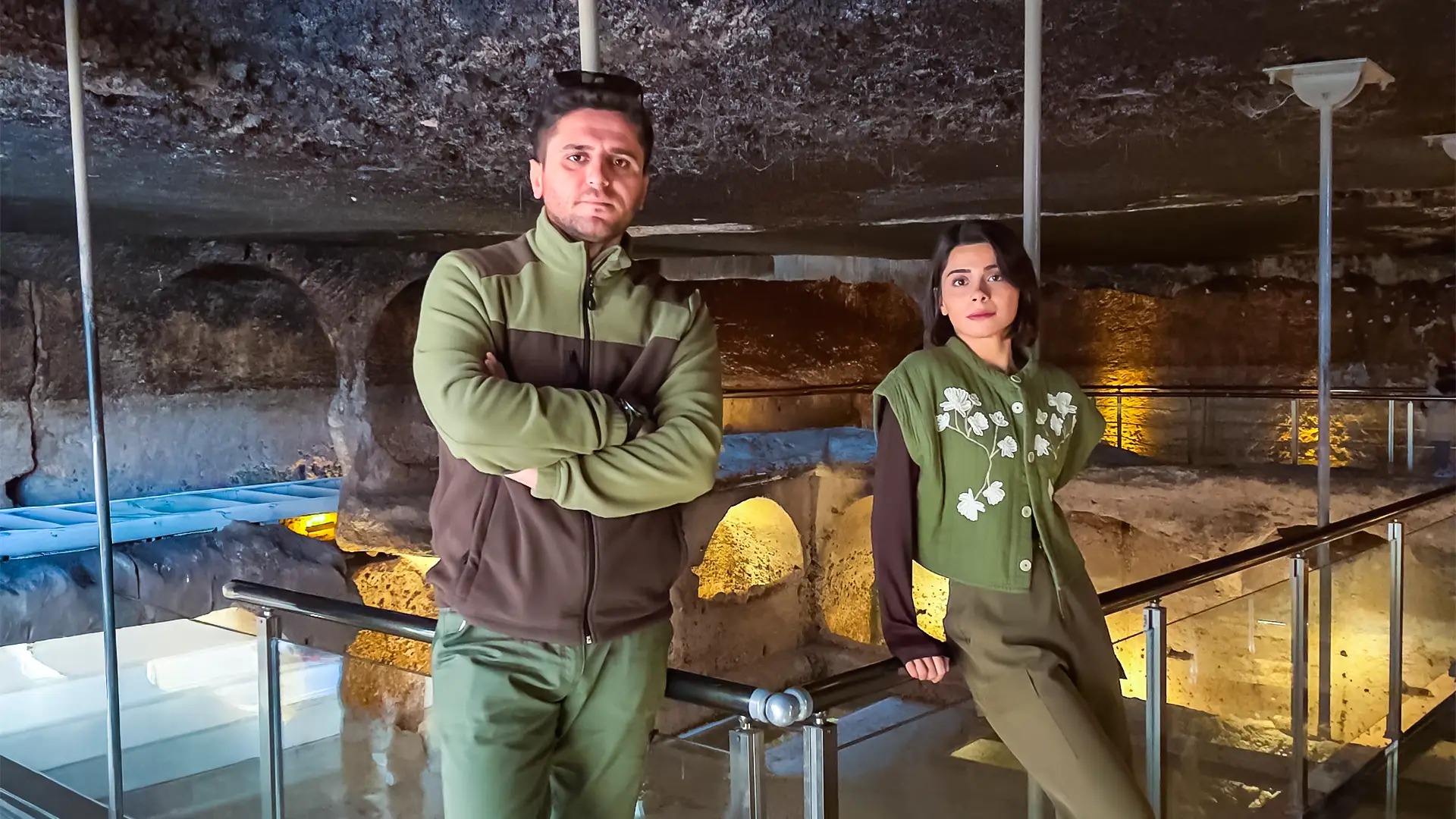
Approximately 30 kilometers southeast of Mardin, near the modern village of Oğuz, the ancient city of Dara was established in the early 6th century CE under the Byzantine Empire. Its foundation followed a clear geopolitical objective: to serve as a fortified frontier city against the Sassanian Empire. Unlike organically developed settlements, Dara was conceived as a planned military and administrative center, where defense, logistics, and infrastructure were integrated from the outset.
The city’s defensive system reflects this strategic role. Massive walls, reinforced with towers, enclosed the settlement, while the elevated terrain enhanced visibility across the surrounding plains. Control over movement and surveillance formed the basis of its military function, positioning Dara as a key node along the eastern frontier of the Byzantine world.
Water management stands at the core of Dara’s engineering achievement. In a region where surface water is limited, the city developed an advanced system of channels, cisterns, and reservoirs carved directly into bedrock. Rainwater and seasonal flows were collected, stored, and distributed through a controlled network, ensuring long-term sustainability during both daily life and potential siege conditions. The scale of these underground cisterns demonstrates a high level of technical planning, where hydraulic knowledge directly supported military resilience.

The necropolis further illustrates the city’s structured design. Rock-cut tombs, organized across a defined area, reflect both population scale and burial practices within a planned urban environment. These spaces were not peripheral additions but integral components of the city’s layout.
Dara operates within the same regional logic that shapes Mardin. While Mardin organizes knowledge, belief, and urban life along its ridge, Dara addresses control, defense, and resource management across the plains. Together, they form complementary elements within a broader system, where settlement, infrastructure, and strategy align with geography.
Mardin and Dara together reveal how different systems of organization coexist within the same regional framework.
What is Mardin Famous For: Cuisine and Craft in Mardin Turkey
Daily life in Mardin extends beyond architecture and institutions through practices of production. Food and craftsmanship carry forward knowledge refined across generations, shaped by climate, trade routes, and cultural interaction. This answers the question of what is mardin famous for through systems of production that remain active rather than preserved as static heritage.
Mardin cuisine reflects a structured relationship between available resources and inherited techniques. Grains, meat, and spice blends form the foundation of many dishes, with flavors built through balance rather than intensity. Kaburga dolması requires coordinated preparation, where stuffing, sealing, and slow cooking transform a single ingredient into a complex dish. Sembusek represents a more direct form of daily production, combining practicality with consistent flavor.
Spice mixtures play a defining role. Cumin, coriander, allspice, and regional herbs are combined in measured proportions, creating layered profiles that support both preservation and taste. In the Tur Abdin region, wine production continues within Syriac Christian communities, where small-scale vineyards maintain techniques passed down through generations.
Craft production follows a parallel continuity. Across the Tur Abdin region, manual skill remains central to material culture. Within this system, Midyat functions as a key center of artisanal production, where techniques are preserved through workshop practice and apprenticeship.
Telkari silverwork reaches its most refined form in Midyat. The process involves drawing silver into extremely fine wires, then twisting, shaping, and assembling these elements into dense, lace-like compositions. Each piece is constructed through repetition and precision, where control at the millimeter scale determines the final outcome. This method demands time, stability of hand, and accumulated experience, placing value on process rather than speed.
Alongside silverwork, copper craftsmanship continues within Mardin’s historic urban core. Hammering and engraving techniques produce both functional and decorative objects, maintaining a tradition where utility and surface detail operate together.
Across cuisine and craftsmanship, production in Mardin and its surrounding regions remains tied to continuity. Knowledge is transferred through practice, materials are sourced locally, and output reflects a balance between necessity and refinement. These processes extend the city’s identity beyond its architectural form, embedding it into daily life through taste and material.
Mardin reflects a production culture where craftsmanship and cuisine remain integral to identity.
This perspective aligns with a structured mardin travel guide approach, where the city is not visited through isolated landmarks but understood through its continuity of architecture, belief, and daily life.
Conclusion: Reading Mardin Turkey Through Structure and Continuity
Mardin’s form is tied directly to its position above the Mesopotamian plains. Built along a south-facing ridge at approximately 1,000 meters, the city develops through terraces that regulate light, airflow, and visibility. Limestone construction stabilizes interior conditions, while narrow streets and internal courtyards reduce heat exposure. These decisions define a settlement shaped by necessity rather than ornament. Understanding this structure on-site changes how the city is perceived, revealing relationships that are not visible through images or summaries alone.
Over time, this physical structure supported different forms of organization without losing coherence. Educational institutions, places of worship, and monastic communities developed within the same spatial order, each extending the use of the city rather than altering its foundation. Craft production and food culture continue this pattern at a smaller scale, where knowledge is carried through practice.
Within Adventus Travel, Mardin is approached through this continuity. For travelers who prefer structured interpretation instead of surface-level visits, this approach ensures that each site is understood within its full regional and historical context.
This approach extends into our Southeastern Turkey Cultural Tour • Göbeklitepe, Mardin & Mount Nemrut, where Mardin is experienced as part of a dedicated regional route connecting Gaziantep, Halfeti, Şanlıurfa, Göbeklitepe, Dara, Midyat, the Syriac heritage of Tur Abdin, and the Kingdom of Commagene.
For travellers who want Mardin to form part of a broader journey across Turkey, the 15-Day Turkey Tour • Istanbul, Cappadocia & Mesopotamia follows a longer progression from Istanbul and Cappadocia into Southeastern Turkey. Mardin is given time for its historic city, Zinciriye and Kasımiye madrasahs, while the following day extends the experience beyond the city to Dara Ancient City, Deyrulzafaran Monastery and Mor Gabriel Monastery before the journey continues toward Mount Nemrut.
Adventus Travel builds these routes through direct field knowledge, ensuring that interpretation follows the same continuity as the region itself.
For a wider understanding of how Mardin Turkey connects with Şanlıurfa, Gaziantep, and the surrounding regions, refer to the Southeastern Turkey Travel Guide, where the full regional structure is presented.
The result is a reading of Mardin that moves from isolated sites to connected meaning, where each location gains clarity through its relation to the others.
Mardin stands as a complete system where geography, belief, architecture, and production remain interconnected.
FAQ: Visiting and Understanding Mardin, Turkey
Where is Mardin located?
Mardin is located in southeastern Turkey, near the Syrian border. The city is positioned on a limestone ridge at approximately 1,000 meters above sea level, overlooking the Mesopotamian plains.
What is Mardin famous for?
Mardin is famous for its limestone architecture, terraced urban structure, and cultural continuity. The city is also known for its religious diversity, including Islamic institutions and Syriac Christian monasteries, which have coexisted for centuries.
What are the best things to do in Mardin, Turkey?
Things to do in Mardin include visiting Mardin Ulu Mosque, Kasımiye Madrasa, Dara ancient city, and Mor Gabriel Monastery. Exploring the historic streets, terraces, and traditional houses is also essential to understanding the city’s structure.
What is the history of Mardin, Turkey?
Mardin history reflects a continuous system of governance and knowledge production. The city developed under the Artuqids and Akkoyunlu, where architecture, education, and religion were integrated into a unified urban structure.
What makes Mardin city Turkey different from other cities?
Mardin city Turkey is defined by continuity rather than change. Its urban layout, architecture, and cultural systems have developed within the same geographical framework over centuries, creating a highly coherent city structure.
Is Mardin, Turkey safe to visit?
Mardin is generally safe for visitors. The city is welcoming and well-suited for travelers, especially when visited through structured itineraries or private tours.
What food is Mardin Turkey known for?
Mardin is known for dishes such as kaburga dolması, sembusek, and a cuisine built on balanced spice combinations including cumin, coriander, and allspice.
What is Tur Abdin in Mardin Turkey?
Tur Abdin is a historical region surrounding Mardin, known for its Syriac Christian heritage. It preserves one of the oldest continuous monastic traditions, where Syriac, a form of Aramaic, is still used in liturgy.
What is telkari and where is it produced?
Telkari is a traditional silver filigree technique produced primarily in Midyat near Mardin, Turkey. It involves shaping fine silver wires into intricate patterns through precise manual craftsmanship.
What wine is Mardin Turkey known for?
Mardin is known for Syriac wine, also referred to as Assyrian wine, produced in the Tur Abdin region. This tradition continues through small-scale vineyards maintained by local communities.
How far is Dara from Mardin Turkey?
Dara is located approximately 30 kilometers southeast of Mardin and can be reached by car in about 40 minutes.
Can Mardin, Turkey be visited with a private tour?
Yes, Mardin, Turkey can be visited through structured private tours. These tours typically include Dara, Tur Abdin, Midyat, and key architectural sites, offering a comprehensive understanding of the region.
Don’t hesitate to contact us to plan a tour in Southeastern Turkey!
WRITTEN BY

Nisa Buket Dağdelen
Operations Director & Tour Guide
LinkedIn Profile

Hüseyin Pekgöz
Founder & Managing Partner
LinkedIn Profile
Adventus Travel Company


