
A Mediterranean Turkey Travel Guide naturally begins with the coast, where Antalya, Kaş, Fethiye and Ölüdeniz bring together turquoise water, long summers, historic harbours and some of the country’s best-known seaside landscapes. Yet the region changes quickly once you leave the shoreline.
Behind the coast, the Taurus Mountains rise sharply above the Mediterranean. Ancient cities appear on mountain slopes, forests surround deep canyons, caves extend beneath limestone landscapes, and traditional villages preserve a very different rhythm of life. Within a relatively short distance, it is possible to move from a Roman harbour to a mountain city, from a beach to a cedar forest, or from a lively old town to an underground lake.
History adds another layer. Lycia, Pamphylia and Pisidia developed across different parts of the region, leaving behind ancient ports, theatres, temples, monumental streets and cities adapted to very different landscapes. Roman, Byzantine, Seljuk and Ottoman periods added further layers that remain visible in Antalya and throughout the wider Mediterranean region.
This variety is what makes planning a trip here so interesting, but it can also make choosing a route difficult. Antalya and Fethiye work well as major gateways, while Kaş, Kekova, Olympos, Patara and smaller coastal communities reward a slower pace. Inland, places such as Termessos, Sagalassos, Göynük Canyon and Altınbeşik Cave reveal a side of Mediterranean Turkey that many coastal itineraries miss.
This guide brings those different landscapes together. It covers the main destinations, ancient cities, natural areas, sections of the Lycian Way, local food, coastal experiences and practical route planning, with links to our more detailed destination guides where you can explore each place in greater depth.
Mediterranean Turkey is only one part of a much larger country shaped by distinct regions, landscapes and cultural traditions. If your plans extend beyond the Mediterranean coast, our Turkey Travel Guide provides the broader framework for exploring the country and connecting this region with Cappadocia, Central Anatolia, Istanbul, the Aegean, the Black Sea and Southeastern Turkey.

Where Is Mediterranean Turkey?
Mediterranean Turkey stretches along the southern edge of Anatolia, with Antalya at its centre and the coastline continuing west towards Kaş and Fethiye and east towards the broader eastern Mediterranean. The region is often associated with the Turkish Riviera, but its geography extends well beyond beaches and coastal towns.
The Taurus Mountains form the defining backdrop. In many places they rise close to the sea, creating a landscape where coastal roads, valleys, mountain passes and settlements follow the natural terrain. This relationship between mountain and sea has influenced where cities developed, how people travelled and how different parts of the region remain connected today.
Along the western coast, the landscape is closely associated with ancient Lycia. Places such as Fethiye, Patara, Kaş, Myra and the coastline around Kekova preserve traces of a civilisation whose cities were connected by both land and sea. The modern Lycian Way follows much of this historic landscape and remains one of the best ways to experience the relationship between ancient settlements and Mediterranean geography.
Around Antalya and further inland, the historical geography changes. Perge and Side belonged to ancient Pamphylia, while Termessos and Sagalassos introduce the mountain landscapes associated with Pisidia. These distinctions help explain why archaeological sites across Mediterranean Turkey can feel so different despite being relatively close to one another.
Nature follows the same pattern of variation. Göynük Canyon cuts into the mountains close to the coast, Saklıkent Canyon forms a dramatically different gorge near Fethiye, and Altınbeşik Cave leads into the karst landscape of the Western Taurus. Further west, Butterfly Valley and Kabak Bay show another expression of the same relationship between steep mountains and the Mediterranean Sea.
Understanding this geography makes route planning considerably easier. Rather than treating Antalya, Kaş, Fethiye and the surrounding ancient sites as unrelated stops, the region becomes a series of connected landscapes that can be explored gradually from east to west, west to east, or as part of a longer overland route through Turkey.

Best Time to Visit Mediterranean Turkey
Mediterranean Turkey can be visited throughout the year, but the experience changes considerably with the seasons. For most travellers, spring and autumn offer the best balance of comfortable temperatures, warm weather, manageable crowds and good conditions for combining archaeological sites with coastal towns and outdoor activities.
The best period depends on what you want from the trip. Swimming and boat trips favour the warmer months, while ancient cities, hiking routes, canyons and mountain destinations are generally more comfortable outside the peak summer heat.
Spring: April to June
Spring is one of the best seasons for exploring Mediterranean Turkey. Daytime temperatures generally range between 18°C and 28°C (64°F to 82°F), the landscape remains green, and conditions are comfortable for walking through archaeological sites or spending time outdoors.
April and early May are particularly good for places such as Perge, Side, Termessos and Sagalassos, where much of the visit takes place outside. Mountain landscapes are also at their freshest, making this a strong period for Göynük Canyon, Altınbeşik Cave and selected sections of the Lycian Way.
Swimming becomes increasingly comfortable towards the end of May and into June. By early summer, coastal towns are fully active without yet reaching the visitor levels of July and August.
Summer: July and August
Summer brings the hottest weather and the busiest period along the Turkish Riviera. Temperatures frequently exceed 34°C (93°F), particularly around Antalya and lower-elevation archaeological sites.
The sea is at its warmest, usually around 27°C to 29°C (80°F to 84°F), creating excellent conditions for swimming, boat trips and long days around Kaş, Kekova, Ölüdeniz and the bays near Fethiye.
Heat becomes the main consideration when planning archaeological visits. Perge, Side and other exposed sites are much more comfortable early in the morning or later in the afternoon, while midday can be demanding. Mountain destinations such as Termessos and Sagalassos offer different conditions because of their higher elevations, although sun protection and drinking water remain important.
July and August also bring the highest demand for accommodation, boat trips and popular coastal experiences. Advance planning becomes more useful during this period, particularly around Antalya, Kaş, Ölüdeniz and Fethiye.
Autumn: September to Early November
For travellers who want to combine the coast with archaeology, autumn is one of the strongest periods of the year.
September still feels like summer along much of the coastline, but visitor numbers gradually begin to ease. Sea temperatures often remain between 24°C and 27°C (75°F to 81°F), allowing swimming and boat trips to continue well into the season.
October is particularly well balanced. Days are generally comfortable for ancient cities, the sea often remains warm enough for swimming, and destinations such as Kaş, Patara, Olympos and Fethiye retain much of their coastal atmosphere without peak summer pressure.
As the season progresses into November, conditions become less predictable, but cultural trips and archaeological routes remain possible.
Winter: December to March
Winter offers a quieter side of Mediterranean Turkey. Coastal cities remain active throughout the year, and archaeological sites can be particularly enjoyable on clear days when temperatures are much lower than in summer.
Antalya is especially suitable for a winter city break, with Kaleiçi, museums, restaurants and nearby archaeological sites remaining accessible. Fethiye and Kaş also continue to function as year-round towns, although some tourism-focused businesses operate on reduced schedules.
Mountain destinations require more flexibility. Weather can change quickly at higher elevations, and conditions around Termessos, Sagalassos and the Western Taurus may differ considerably from the coast.
Winter is not the best season for travellers whose priority is swimming or boat trips, but it can work very well for archaeology, local life and slower regional travel.
When Is the Sea Warm Enough for Swimming?
For most travellers, comfortable swimming conditions begin around late May and continue through October.
- May: The sea begins warming, particularly towards the end of the month.
- June: Swimming conditions become consistently comfortable.
- July and August: The warmest sea temperatures of the year.
- September: Warm water with gradually lower visitor numbers.
- October: Swimming often remains possible, particularly during the first half of the month.
The exact experience varies by location and weather conditions, but September and early October are particularly attractive for travellers who want warm water without the intensity of peak summer.

How Do Crowds Affect Your Trip?
Visitor numbers peak during July and August, particularly in Antalya, Kaş, Ölüdeniz and Fethiye. Popular beaches, boat routes and accommodation fill more quickly, while road traffic and parking can add time to otherwise short journeys.
Spring and autumn allow more flexibility. Archaeological sites are easier to explore at a comfortable pace, coastal towns feel less congested, and it is usually easier to combine sightseeing with spontaneous stops along the route.
Crowds also vary considerably by destination. A summer afternoon around Ölüdeniz can feel very busy, while inland sites such as Sagalassos or mountain landscapes away from the coast may offer a much quieter experience on the same day.
For most first-time visitors who want a combination of archaeology, coastal scenery, local food and time by the sea, May, June, September and October provide the best overall balance.
How Many Days Do You Need in Mediterranean Turkey?
A short trip of four or five days can cover one part of the region, but trying to combine Antalya, Kaş and Fethiye within that timeframe usually means spending too much time moving between destinations.
For a more balanced first trip, seven to ten days allows enough time to combine ancient cities, coastal towns, natural landscapes and at least one slower day by the sea.
The key is not simply adding more stops. Mediterranean Turkey works best when the route follows geography. Antalya can anchor the eastern section, Kaş provides a natural base along the Lycian coast, and Fethiye works well for the western end of the route. Inland destinations can then be added according to interests rather than treated as mandatory detours.
Travellers with more time can extend the route into Central Anatolia or Cappadocia, turning the Mediterranean coast into part of a longer overland trip through Turkey.
How to Plan a Mediterranean Turkey Route
Mediterranean Turkey covers a much larger area than it first appears on a map. Antalya, Kaş and Fethiye can form the backbone of a coastal trip, but some of the region’s most rewarding destinations lie away from the main shoreline. Ancient cities, mountain roads, canyons and traditional villages often require short inland detours, so trying to see everything in a few days usually creates more driving than experience.
For a first visit, it helps to think of the region in three broad sections. Antalya provides the strongest base for the eastern and central part of the route, including major archaeological sites and the Taurus Mountains. Kaş works naturally for the Lycian coast, with access to Kekova, Demre, Myra and Patara. Fethiye anchors the western section around Ölüdeniz, Kayaköy, Saklıkent Canyon, Butterfly Valley and Kabak Bay.
The route does not need to include every destination. Travellers interested primarily in archaeology may spend more time around Antalya and the mountainous interior, while those prioritising swimming, boat trips and coastal life may prefer a slower progression through Kaş and Fethiye. Combining both creates the most complete picture of the region, but only when enough time is allowed between stops.
This east-to-west structure also works in reverse. The important point is to follow the geography rather than repeatedly crossing the same part of the region.
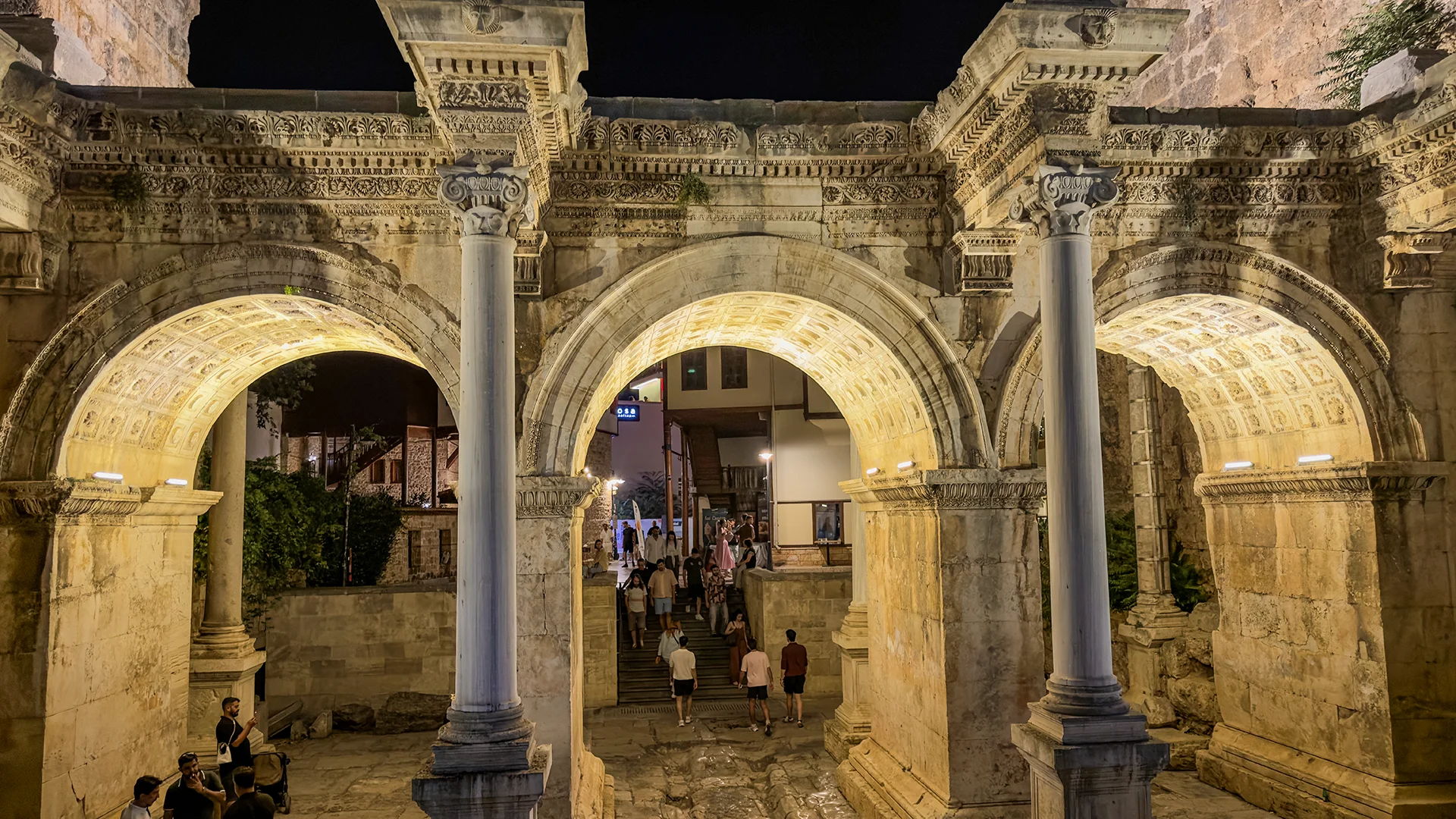
Antalya: The Main Gateway to Mediterranean Turkey
Antalya is the most practical starting point for exploring Mediterranean Turkey. Its international airport, accommodation range and position between the coast and Taurus Mountains make it possible to combine city life, archaeology, nature and beaches without changing base every day.
The city itself deserves time before continuing into the wider region. Antalya Kaleiçi preserves the historic centre around the old harbour, where Roman, Byzantine, Seljuk and Ottoman layers remain integrated into a neighbourhood of narrow streets, restored houses, cafés, restaurants and small hotels. Hadrian’s Gate provides one of the clearest surviving connections with ancient Attaleia, while the harbour below still defines the shape of the old city.
Kaleiçi also works particularly well at different times of day. Early mornings are quiet enough for walking and photography, while evenings bring a completely different atmosphere as restaurants, meyhanes and bars fill the streets around the old town and harbour.
From Antalya, the landscape changes quickly. Within a relatively short drive, visitors can reach the Roman cities of Pamphylia, climb into the Pisidian mountains, walk through protected national parks or continue south along the Lycian coast.
Ancient Cities Around Antalya
One of Antalya’s greatest advantages is the concentration of archaeological sites within the surrounding region. These are not interchangeable Roman ruins. Each developed within a different landscape and reveals a different part of Mediterranean Turkey’s ancient history.
Perge Ancient City
Around 17 kilometres east of Antalya, Perge Ancient City offers one of the clearest examples of Roman urban planning in southern Turkey. Monumental gates lead into broad colonnaded streets, while an open water channel, public baths, agoras, fountains, a theatre and one of the largest surviving ancient stadiums reveal the scale of a city that became one of Pamphylia’s leading centres.
Perge is particularly useful for understanding how a Roman city functioned as a connected urban system. Streets, water infrastructure, public buildings and entertainment spaces remain easy to read within the archaeological landscape, making it a strong first ancient-city visit from Antalya.

Side Ancient City
Further east, Side Ancient City presents a very different experience. Instead of entering an isolated archaeological park, visitors walk through ancient streets that continue into a modern Mediterranean town.
Roman remains, the commercial agora, theatre and museum eventually lead towards the ancient harbour and the Temple of Apollo beside the sea. Cafés, restaurants and shops remain woven into the historic centre, allowing archaeology and contemporary coastal life to occupy the same peninsula.
Side works particularly well for travellers who want to combine history with time by the Mediterranean rather than dedicate an entire day exclusively to an archaeological site.

Termessos Ancient City
Northwest of Antalya, Termessos Ancient City leaves the coastal plains behind entirely. The city stands more than 1,000 metres above sea level within Güllük Mountain National Park, where ancient streets and monuments remain scattered through pine forest and rugged limestone terrain.
Termessos was shaped by its mountain setting. The Solymoi who inhabited the city used the surrounding landscape as a natural defence, a geographic advantage that became famous when Alexander the Great chose not to attack the city during his campaign through Anatolia.
Visiting Termessos requires more walking than Perge or Side, but the experience is also very different. The uphill route passes monumental tombs, civic buildings and the remains of the gymnasium before reaching a theatre overlooking the Taurus Mountains. Here, the landscape is not simply a backdrop to the archaeology. It is part of the reason the city existed as it did.

Sagalassos Ancient City
Further inland near Ağlasun, Sagalassos Ancient City reveals another side of ancient Pisidia. Built high in the Western Taurus Mountains, the city developed around abundant natural springs that supplied homes, baths, fountains and public spaces.
Water remains central to the experience today. The reconstructed Antonine Fountain still flows in the Upper Agora, while the Roman Baths, Neon Library, theatre, monumental squares and surrounding mountain views reveal the prosperity of one of Pisidia’s leading cities.
Sagalassos requires a longer drive from Antalya than Perge, Side or Termessos, but it rewards travellers interested in archaeology beyond the coastal corridor. It can also be combined with Burdur Museum, where many of the original sculptures discovered during excavations are preserved.

Which Ancient Cities Should You Choose?
If time is limited, choosing archaeological sites according to their character works better than trying to visit all of them.
Perge is the strongest choice for Roman urban planning and engineering.
Side combines archaeology with a living coastal town and harbour.
Termessos offers the most immersive combination of archaeology, mountain walking and protected nature.
Sagalassos stands apart for its mountain setting, flowing water, archaeological restoration and the Antonine Fountain.
With more time, visiting several of them reveals how differently cities developed across Pamphylia and Pisidia despite belonging to the same wider Mediterranean region.
Exploring the Lycian Coast: From Antalya to Kaş and Patara
Southwest of Antalya, the road begins to follow one of the most rewarding sections of Mediterranean Turkey. The Taurus Mountains move closer to the sea, forested slopes descend towards small bays, and ancient settlements appear beside beaches, harbours and fertile coastal plains.
This is the landscape most closely associated with the Lycian coast. Yet the route is more varied than its name suggests. Ancient harbour cities, Byzantine churches, mountain villages, beaches and modern coastal towns all share the same corridor, while sections of the Lycian Way continue through the hills above the sea.
Rather than moving quickly between Antalya and Fethiye, this part of the coast rewards a slower route. Phaselis, Olympos, Demre, Myra, Kekova, Kaş and Patara each reveal a different relationship between history and the Mediterranean.

Phaselis: Ancient Harbours Between Forest and Sea
South of Antalya, Phaselis occupies a narrow peninsula surrounded by pine forest and three natural harbours. Its location explains much of its history. Founded as a maritime settlement, the city developed around trade routes connecting the Mediterranean with the interior of Anatolia.
Today, the relationship between archaeology and coastline remains unusually clear. The main street runs between the ancient harbours, passing baths, an agora, theatre and other remains before reaching the water. Few ancient cities in Mediterranean Turkey allow visitors to move so easily between archaeological ruins and the sea.
Phaselis works particularly well as a stop when travelling south from Antalya rather than as an isolated excursion. Its forested setting also marks the beginning of a noticeable transition away from the urban coast towards the mountains and smaller settlements further west.

Olympos and Çıralı: Ancient Ruins, Forest and the Mediterranean
Further along the coast, Olympos Ancient City offers a completely different experience. Instead of broad Roman streets or monumental urban squares, the ruins are scattered through a wooded valley where a stream once connected the ancient settlement with the sea.
Stone paths pass through vegetation, tombs, churches, baths and other remains before eventually reaching the beach. The setting gives Olympos a character that feels less formal than Perge or Side, with archaeology gradually appearing between trees rather than dominating the landscape.
Nearby Çıralı provides a quieter base on the coast. Its long beach, small hotels, restaurants and proximity to both Olympos and the surrounding mountains make it well suited to travellers who want to slow the route down rather than continue driving every day.
Together, Olympos and Çıralı show how closely the natural and archaeological landscapes of the Lycian coast remain connected.

Demre and Myra: Lycian Heritage and St. Nicholas
As the route continues west, Demre becomes one of the most important historical stops on the Lycian coast. The modern town sits within a fertile plain shaped by agriculture, while the surrounding area preserves some of the region’s most important Lycian and early Christian heritage.
At Myra Ancient City, rock-cut tombs rise dramatically from the cliffs behind the Roman theatre. Their façades imitate timber architecture in stone and remain among the most recognisable examples of Lycian funerary tradition.
Myra later became an important centre of early Christianity and is closely associated with St. Nicholas, who served as bishop here during the fourth century. The Church of St. Nicholas in Demre preserves that later chapter of the region’s history and continues to attract visitors and pilgrims from around the world.
Demre therefore works as more than a stop between Olympos and Kaş. Within a relatively compact area, it connects Lycian burial traditions, Roman urban life, Byzantine Christianity and the agricultural landscape of the modern Mediterranean coast.

Kekova: Exploring History from the Water
West of Demre, the relationship between archaeology and the sea becomes even stronger around Kekova.
The protected waters surrounding Kekova Island preserve the remains of ancient coastal settlements affected by earthquakes and changes in sea level. Walls, foundations, stairways and harbour structures can still be seen along the shoreline and beneath the clear water.
Because the archaeological area is protected, the best way to understand Kekova is from a boat. Routes typically pass the submerged remains before continuing through sheltered bays and towards the small settlement of Kaleköy, ancient Simena.
At Simena, houses and restaurants sit among ancient remains beneath a hilltop castle. Lycian sarcophagi appear beside paths and along the water, including one of the region’s most photographed tombs standing partly surrounded by the sea.
A day around Kekova is therefore not simply a boat trip. It is one of the clearest examples on the Mediterranean coast of how ancient settlement, geological change and modern coastal life continue to occupy the same landscape.

Kaş: A Base for the Lycian Coast
After the archaeological landscapes around Demre and Kekova, Kaş introduces a different rhythm. Built between steep mountains and the sea, the town is compact enough to explore on foot but active enough to work as a base for several days.
Swimming platforms, small beaches, restaurants and cafés line the coast, while the old streets around the centre remain lively into the evening. The water deepens quickly around Kaş and is known for its clarity, supporting swimming, diving and boat trips throughout the warmer months.
History remains visible within the modern town. A well-preserved Lycian sarcophagus stands near the centre, while the ancient theatre overlooks the Mediterranean within walking distance of the harbour.
Kaş is also strategically useful. Kekova can be explored by boat, Patara lies further west, and several sections of the Lycian Way pass through the surrounding landscape. Rather than treating Kaş as another sightseeing stop, allowing two or three nights creates space for slower coastal days between archaeological visits.

Patara: Ancient City and Mediterranean Beach
Further west, Patara Ancient City brings together two sides of the Lycian coast particularly well.
Patara was one of the principal cities of ancient Lycia and an important maritime centre. It also played a central role in the Lycian League, the federation of cities whose political structure remains one of the most interesting aspects of Lycian history.
The archaeological site preserves a theatre, bouleuterion, monumental streets, baths, temples and the remains of the ancient harbour. Excavations have also revealed the importance of Patara during the Roman and Byzantine periods, extending its story far beyond the Lycian era.
Beyond the ruins lies Patara Beach, a long stretch of protected Mediterranean coastline. The transition from archaeological site to dunes and open sea makes Patara particularly rewarding because history and landscape can be experienced within the same visit.
Patara also provides a natural transition towards the western end of the route. From here, the coast continues towards Xanthos, Saklıkent and eventually Fethiye, where the character of the journey changes once again.

How Much Time Should You Allow for the Lycian Coast?
Trying to cover this entire section in one or two days misses much of what makes it worthwhile.
Three to five days between Antalya and Kaş allows time for selected archaeological sites, a Kekova boat trip and at least one slower coastal day. Continuing towards Patara and Fethiye works better with additional time, particularly if Olympos, the Lycian Way or natural areas are part of the plan.
A balanced route might include Olympos or Çıralı for the forested coast, Demre and Myra for archaeology and early Christian heritage, Kekova for a day on the water, and Kaş as a base before continuing west towards Patara.
The objective is not to stop everywhere. The strength of the Lycian coast lies in the transitions between ancient cities, mountain landscapes, small towns and the Mediterranean itself.
Fethiye and the Western Mediterranean Coast
As the route continues west from Patara, the landscape gradually opens towards Fethiye. Mountains still define the horizon, but the coastline becomes increasingly varied, with sheltered bays, islands, beaches, valleys and small settlements spread around the Gulf of Fethiye.
Fethiye works particularly well as the western base of a Mediterranean Turkey itinerary. Ölüdeniz, Kayaköy, Butterfly Valley, Kabak Bay and Saklıkent Canyon are all accessible from the area, while the harbour provides connections to boat trips and coastal experiences. The town itself also deserves time, particularly around the waterfront, old streets and local food scene.
Unlike a destination built around one major attraction, Fethiye works through variety. A day can begin in an abandoned Greek village, continue beside a lagoon or mountain canyon, and end around the harbour over a long dinner. This makes the area especially useful at the end of a longer coastal route, when slowing down becomes as important as sightseeing.
Fethiye: Harbour Life and a Base for the Region
Modern Fethiye spreads around a broad natural harbour surrounded by mountains. The waterfront is central to daily life, with fishing boats, yachts, cafés and restaurants extending along the bay and a promenade that becomes particularly enjoyable towards the end of the day.
The town also preserves traces of ancient Telmessos. Lycian rock tombs rise above the modern streets, while the remains of the ancient theatre stand close to the harbour. These monuments are not separated from contemporary Fethiye but remain integrated into a town that has continued to develop around them.
For travellers, Fethiye’s greatest advantage is its location. Rather than changing accommodation every night, it can serve as a base for exploring several very different landscapes across the western Mediterranean coast.
Fethiye Fish Market: An Evening Around the Table
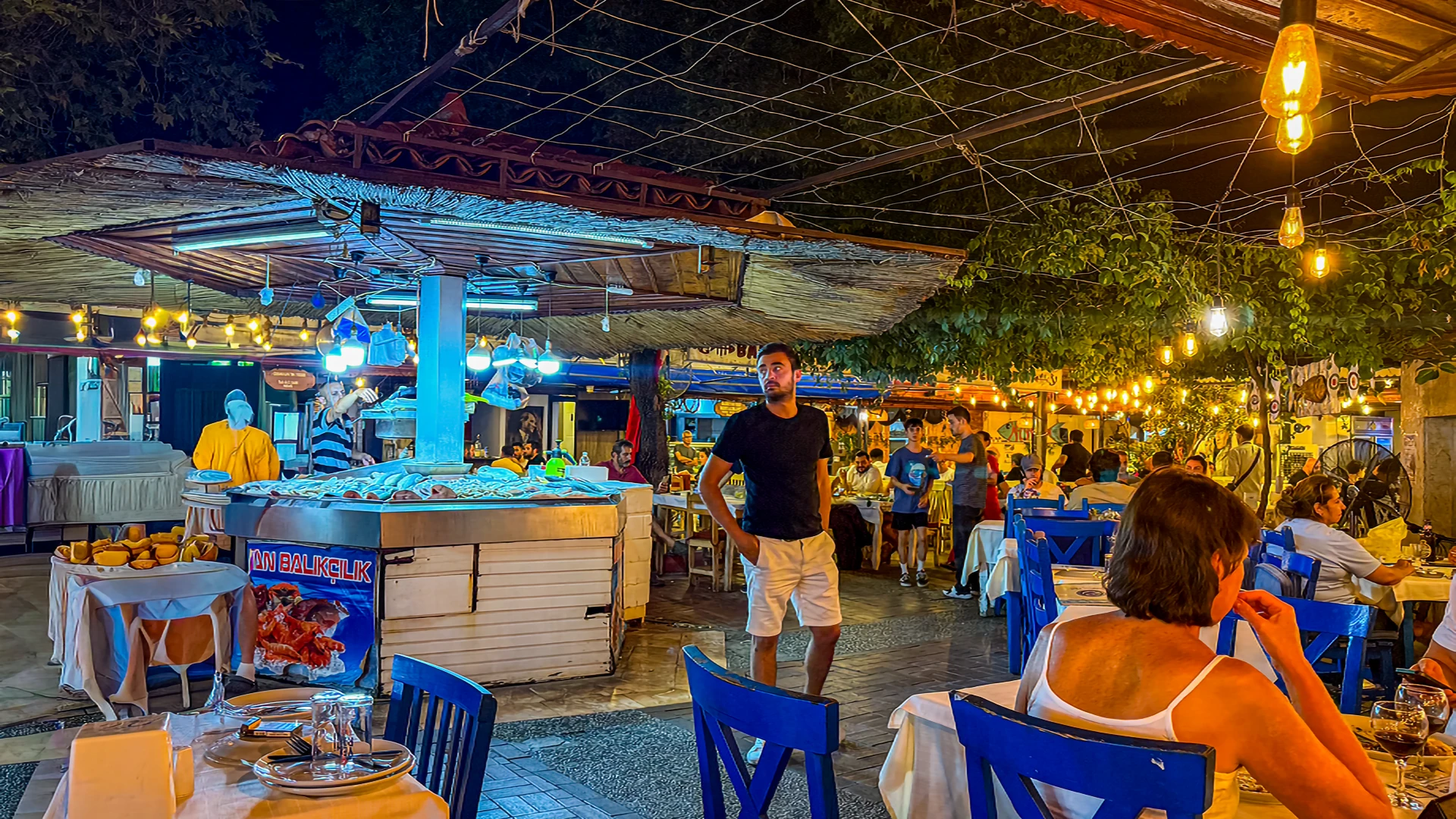
Fethiye Fish Market offers one of the most distinctive dining experiences in town. Rather than choosing from a conventional restaurant menu, visitors select seafood from the fishmongers at the centre of the market before taking it to one of the surrounding restaurants to be prepared.
The experience is as much about the setting as the food. Tables fill the courtyard around the market, meze arrives before the main course, and dinner often extends well into the evening. The atmosphere is social and informal, particularly during the warmer months.
For travellers interested in local food, the market provides a useful contrast to the archaeological and natural landscapes encountered elsewhere along the route. Mediterranean Turkey is not experienced only through ancient cities and beaches. Markets, shared meals and evening routines are part of the region’s character as well.
Kayaköy: A Different Chapter of the Fethiye Region
A short drive from Fethiye, Kayaköy introduces a very different landscape. Hundreds of abandoned stone houses cover the hillside above the modern village, together with churches, chapels, schools and streets that once belonged to a predominantly Greek Orthodox community.
The settlement was largely abandoned following the population exchange between Greece and Turkey in the 1920s. Today, walking through Kayaköy reveals a difficult chapter of modern history through the remains of homes and community buildings rather than monumental ancient architecture.
Allowing time to walk through the upper sections gives a much clearer sense of the scale of the former settlement. The surrounding countryside also makes Kayaköy easy to combine with Ölüdeniz or other destinations around Fethiye without dedicating an entire day to the visit.

Ölüdeniz and the Blue Lagoon
Few landscapes are more closely associated with Turkey’s Mediterranean coast than Ölüdeniz. Mountains rise directly behind the shoreline, while the protected Blue Lagoon forms a calm body of water separated from the open Mediterranean by a narrow strip of land.
Swimming is the main attraction at sea level, but the landscape is equally impressive from above. Babadağ rises behind Ölüdeniz and has become one of the world’s best-known locations for tandem paragliding, with flights descending from the mountain towards the coast.
For travellers interested in seeing the coastline from the air, our Paragliding Experience in Ölüdeniz provides more detailed information about the flight, Babadağ, conditions and what to expect.
Ölüdeniz becomes extremely busy during summer, particularly in the middle of the day. Early mornings and later afternoons provide a different atmosphere, while travellers staying several nights around Fethiye have more flexibility to choose their timing.

Butterfly Valley: A Coastal Landscape Best Seen from the Sea
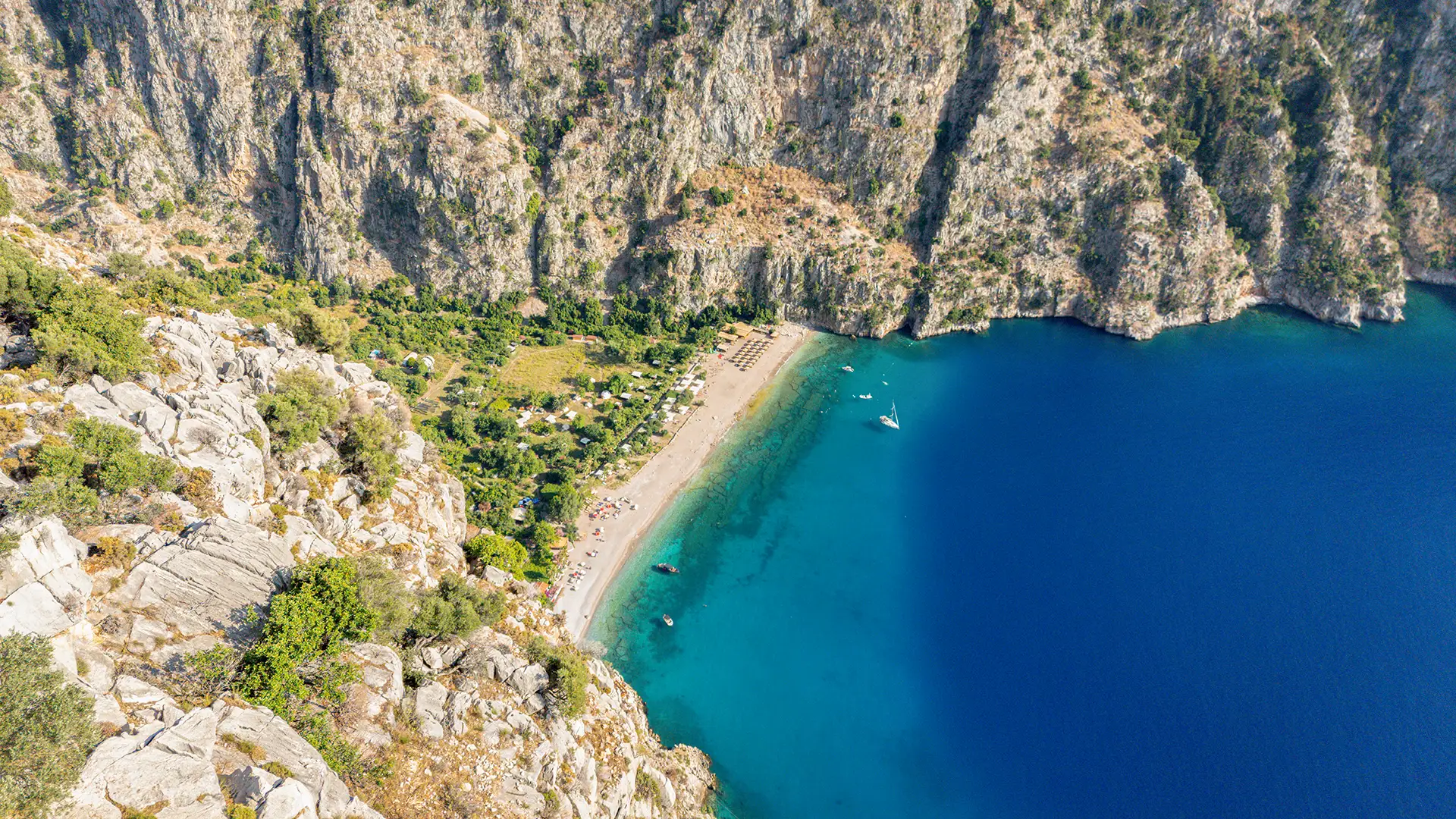
South of Ölüdeniz, Butterfly Valley sits between steep cliffs that descend almost directly into the Mediterranean. The geography limits road access and has helped preserve the valley’s distinctive sense of separation from the more developed parts of the coast.
For most visitors, arriving by boat is part of the experience. From the water, the scale of the cliffs becomes much clearer, while the beach provides access to the lower part of the valley.
Despite its name, the experience should not be built around expecting large numbers of butterflies at all times of year. Season, temperature and environmental conditions affect what visitors may see. The landscape itself is the stronger reason to include the valley: a narrow strip of coast enclosed by mountains and reached most naturally from the Mediterranean.
Butterfly Valley works particularly well as part of a boat day rather than as another destination to rush through by road.
Kabak Bay: Where the Mountains Reach the Sea
Further south, Kabak Bay offers another expression of the mountainous coastline around Fethiye. Steep forested slopes descend towards a small bay, while limited road access has restricted the scale of development compared with larger resort areas.
The landscape is the main attraction. Kabak is better suited to travellers who value quiet surroundings, walking and time by the sea than those looking for a conventional beach resort.
Sections of the Lycian Way pass through the surrounding hills, creating a natural connection between hiking and coastal travel. Even for travellers who are not completing a long-distance trek, the area demonstrates why walking remains one of the best ways to understand the geography of this part of Mediterranean Turkey.
Kabak does not need to appear on every itinerary. Its value lies precisely in allowing the route to slow down.
Saklıkent Canyon: From the Coast Into the Mountains
Around an hour from Fethiye, Saklıkent Canyon shifts the experience away from beaches and harbours into a narrow gorge cut deep into the mountains.
The canyon extends for approximately 18 kilometres, although visitors explore only part of its length. Cold mountain water runs through the gorge, and the accessible route changes depending on water levels and seasonal conditions.
Summer is the most popular time to visit, when the cooler environment offers a noticeable contrast to the heat along the coast. Walking conditions can be wet and uneven, so footwear suitable for water and slippery surfaces is more useful than ordinary sandals.
Saklıkent works well as a half-day or longer excursion from Fethiye and can be combined with other stops in the surrounding countryside. More importantly, it adds another landscape to the Mediterranean route, showing how quickly the environment changes once the road turns inland.

How Many Days Should You Spend Around Fethiye?
Three nights provide a useful minimum for Fethiye, particularly if Ölüdeniz and one additional excursion are priorities. Four or five nights create considerably more flexibility.
A balanced stay might include time in Fethiye itself, an evening at the Fish Market, Ölüdeniz and Kayaköy on one day, and either a boat experience, Butterfly Valley, Kabak Bay or Saklıkent Canyon on another.
Trying to include all of these places simply because they are nearby can make the itinerary unnecessarily busy. The Fethiye region works best when at least one day contains very little planning beyond the coast, a meal and enough time to enjoy where you are.
For travellers arriving after several days of archaeological sightseeing through Antalya, Pisidia and the Lycian coast, that slower pace can be particularly welcome.
Exploring Mediterranean Turkey on a Private Tour
Mediterranean Turkey can be travelled independently, but combining its ancient cities, mountain landscapes, coastal towns and boat routes within a limited amount of time requires careful planning. Driving distances can look short on a map while mountain roads, archaeological visits and coastal stops make the actual pace of a trip considerably slower.
Our Private Turkey Tours provide the broader framework for tailor-made travel across the country, with routes designed around the destinations, pace and experiences that matter most to each traveller.
For travellers who want to concentrate specifically on the Antalya region, the Antalya Signature Tour • Ancient Cities & Turquoise Coast combines ancient Pamphylia and Pisidia with the Taurus Mountains and Mediterranean coast. Over five days, the route connects Antalya and Kaleiçi with Selge, Köprülü Canyon, Perge, Aspendos, Çıralı, Olympos, a private boat experience, and Tahtalı Mountain.
For a route focused primarily on Antalya and the western Lycian coast, the Lycian Coast Tour from Cappadocia • Antalya, Kaş & Fethiye connects cultural sites with Kaleiçi, Phaselis, Patara, Kekova, Kayaköy, Saklıkent and Ölüdeniz.
For travellers who want to combine a deeper overland heritage route with the Mediterranean, Cappadocia to Fethiye: Heritage & Turquoise Coast follows a different path, linking Central Anatolia with Sagalassos, Termessos, Olympos, Patara and the coast before reaching Fethiye.
The two routes are designed around different priorities. One places greater emphasis on the Lycian coast, while the other connects the Mediterranean with the archaeological and cultural landscapes of inland Anatolia.
Beyond the Coast: Canyons, Caves and the Taurus Mountains
The Mediterranean coast may define the region at first glance, but some of its most interesting landscapes begin where the road turns inland. The Taurus Mountains rise behind much of the shoreline, creating canyons, forests, limestone plateaus, underground water systems and valleys that feel very different from the beaches only a short distance away.
These landscapes are not separate from the Mediterranean experience. They explain much of the region’s geography, influence local climate and agriculture, and have shaped where communities developed for centuries. They also provide a useful change of pace between archaeological sites and coastal towns.
Göynük Canyon and Altınbeşik Cave reveal two very different sides of this mountain environment, while places such as Saklıkent Canyon, Butterfly Valley and Kabak Bay show how water and steep terrain continue to shape the western coast.
Göynük Canyon: From the Mediterranean Into the Mountains
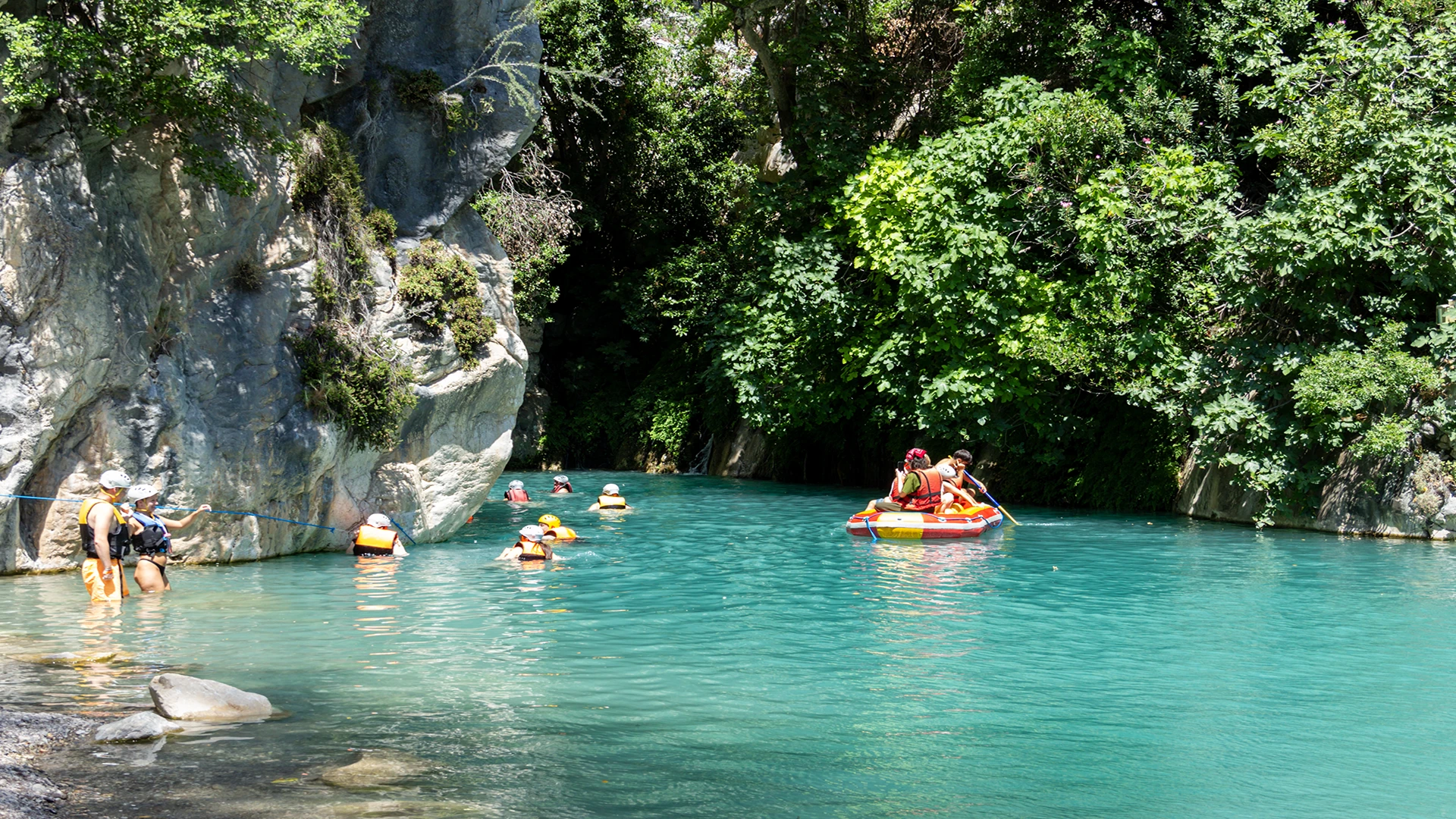
Close to the coastline between Antalya and Kemer, Göynük Canyon provides one of the easiest ways to experience the mountain landscape without travelling deep into the Taurus range.
The approach quickly leaves the developed coast behind. Forested slopes rise around the valley as the route follows the canyon towards clear mountain water, rocky pools and increasingly narrow sections between the cliffs.
Walking is part of the experience, but Göynük is not simply a hiking destination. Depending on conditions and the activities available, visitors may combine the trail with time in the water and canyon-based experiences. The character of the visit changes with the season, water levels and weather, so it is better approached as an outdoor landscape than as a fixed sightseeing route.
Its location also makes Göynük useful within a coastal itinerary. It can provide a nature-focused contrast between time in Antalya and the archaeological or seaside destinations further south, without requiring a major detour from the main route.
For travellers who have spent several days moving between ancient cities, the combination of forest, cold water and mountain scenery offers a very different side of Mediterranean Turkey.
Altınbeşik Cave: The Underground Landscape of the Western Taurus
Further inland, Altınbeşik Cave reveals a landscape shaped by water beneath the mountains rather than between them.
Located near Ürünlü and Ormana in Antalya’s İbradı district, the cave forms part of an extensive karst system within Altınbeşik Cave National Park. Visitors enter the accessible section by boat, crossing an underground lake while the deeper levels continue far beyond the public route.
The cave is only one part of the experience. Limestone plateaus, cedar forests, underground rivers and traditional mountain villages surround the national park, creating a landscape that feels far removed from Antalya’s beaches and resort areas.
Nearby Ürünlü and Ormana add a cultural layer to the visit. Both villages preserve examples of the region’s traditional button houses, built using local stone and cedar timber. Together, the cave and villages show how geology, natural resources and rural life developed within the same Western Taurus landscape.
Altınbeşik requires more travel time than Göynük, so it works best as a dedicated day rather than a short stop between coastal destinations. For travellers interested in nature, geology and traditional villages, however, it reveals one of the least expected sides of Mediterranean Turkey.

How Do These Landscapes Fit Into a Mediterranean Route?
Not every Mediterranean itinerary needs to include a canyon or cave. Their value comes from providing contrast.
Göynük works naturally when travelling between Antalya and the Kemer coastline. Altınbeşik is better suited to travellers willing to move inland for a full day. Saklıkent fits naturally into the Fethiye section, while Butterfly Valley and Kabak show how the same mountain geography continues all the way to the sea.
Choosing one or two of these landscapes is usually more rewarding than trying to include all of them. A route already rich in archaeological sites may benefit from a day around a canyon or forest, while a coast-heavy itinerary can use an inland destination to reveal how dramatically the region changes beyond the shoreline.
This balance between coast and mountains is one of the defining characteristics of Mediterranean Turkey. Ancient cities explain how people occupied the landscape, while the canyons, caves, forests and valleys help explain the landscape itself.
The Lycian Way: Experiencing the Coast on Foot
Driving and boat travel connect most of the Mediterranean coast efficiently, but walking reveals a different scale of the landscape. The Lycian Way follows more than 500 kilometres between the Fethiye region and Antalya, connecting ancient settlements, mountain paths, coastal villages and sections of open Mediterranean shoreline.
Despite its length, travellers do not need to hike the entire route to experience it. Many of the most rewarding sections can be incorporated into a broader coastal trip, allowing a few hours or a full day of walking without turning the holiday into a long-distance trek.
Around Fethiye, trails connect landscapes near Kayaköy, Ölüdeniz, Faralya and Kabak. Further east, sections around Patara, Kaş, Demre and the Gelidonya peninsula combine archaeological remains with mountain and coastal scenery.
The experience changes considerably from one section to another. Some paths remain close to villages and roads, while others cross exposed mountain terrain where water, footwear, weather and navigation require more preparation.
For travellers considering a longer walk or deciding which sections fit their itinerary, our Lycian Way Turkey Guide covers the route, terrain, distances and practical planning in greater detail.
The Lycian Way is therefore best understood not as a separate attraction but as another way of experiencing the same Mediterranean landscape. Ancient cities, villages and coastlines encountered by road take on a different character when approached on foot.

Do You Need to Hike the Entire Lycian Way?
No. Most visitors experience only selected sections.
Short walks can add considerable depth to a Mediterranean itinerary without requiring specialised equipment or multiple days on the trail. The right section depends on season, fitness, available time and where the rest of the trip is already taking you.
Spring and autumn provide the most comfortable conditions for longer walks. Summer heat makes exposed sections considerably more demanding, particularly during the middle of the day.
If hiking is a major priority, the route deserves dedicated planning. If it is only one part of a broader Mediterranean trip, choosing a section that naturally connects with Fethiye, Kaş, Patara or another destination usually makes more sense than creating additional transfers simply to reach a famous stretch of trail.
Food and Local Life in Mediterranean Turkey
Food along Turkey’s Mediterranean coast follows the same geography as the journey itself. The sea shapes what appears on the table, fertile coastal plains supply vegetables, citrus and herbs, while villages in the Taurus Mountains preserve dishes and ingredients connected to a very different landscape.
Olive oil is central to much of the regional kitchen. Vegetables, beans, artichokes and wild greens are often prepared simply and served as part of a wider selection of meze rather than as individual courses. Tomatoes, peppers, aubergines, citrus and fresh herbs appear frequently, particularly during the warmer months when local markets are at their most colourful.
Seafood becomes increasingly visible in coastal towns. Fish is often grilled with little more than olive oil and lemon, while calamari, octopus, prawns and stuffed mussels appear widely around harbours and seaside restaurants. The experience varies considerably from a restaurant overlooking Antalya’s Old Harbour to a small table in Kaş or an evening choosing seafood at Fethiye Fish Market.
The mountain interior introduces another side of Mediterranean cooking. Around traditional villages and higher elevations, meals tend to reflect local agriculture, seasonal produce and ingredients available away from the coast. This contrast is one of the reasons food becomes more interesting when the route extends beyond resort areas.

Eating Along the Route
One of the easiest mistakes when planning a Mediterranean trip is treating every meal as another item that needs to be researched in advance. Some places reward reservations, but much of the pleasure comes from allowing the location and time of day to influence where you eat.
In Antalya Kaleiçi, restaurants, courtyard cafés and meyhanes become part of the evening atmosphere. Meze, seafood and a cold drink fit naturally into a neighbourhood where dinner often continues long after the main sightseeing day has ended.
Kaş has a smaller and more relaxed dining scene. Restaurants are concentrated around the centre and harbour, making it easy to walk in the evening and choose according to what looks good rather than planning every meal before arrival.
Fethiye offers another experience through its Fish Market, where seafood can be selected from the central fishmongers and prepared by surrounding restaurants. The combination of market, shared meze and a long evening meal makes it as much a social experience as a place to eat.
Smaller coastal settlements such as Çıralı and villages away from the main tourism centres often provide simpler meals based on seasonal ingredients. These stops can be just as memorable as better-known restaurants because they place food within the landscape and daily life of the region.
What Should You Eat in Mediterranean Turkey?
There is no single dish that defines the entire coast, but several styles of food appear repeatedly.
Meze is one of the easiest ways to experience variety, particularly when several dishes are shared across the table.
Zeytinyağlı dishes use olive oil as the foundation for vegetables, beans and seasonal produce and are commonly served at room temperature.
Seafood is a natural choice around Antalya, Kaş, Fethiye and smaller coastal towns, although what is available changes with season and local supply.
Stuffed mussels, or midye dolma, are common along the coast and work particularly well as a simple snack rather than a formal meal.
Fresh vegetables, herbs, yoghurt, local cheeses and seasonal fruit also appear throughout the region, while citrus production remains an important part of the agricultural landscape around Antalya and other coastal plains.
For a deeper look at regional dishes, ingredients and how the coastal table changes from Antalya to Fethiye, our Mediterranean Turkey Cuisine Guide explores the food culture of the region in greater detail.

Markets, Meyhanes and Everyday Food Culture
Understanding Mediterranean food is easier when it is experienced beyond restaurant menus.
Local markets bring together vegetables, fruit, herbs, cheese, olives and other products from surrounding farms and villages. What appears on the stalls changes throughout the year, making markets one of the clearest places to see seasonality in practice.
Meyhanes reveal a different side of the food culture. Meals are built around conversation and shared plates rather than a quick sequence of courses. Meze arrives gradually, seafood or another main dish may follow, and the evening is often intended to last.
In coastal towns, harbours also shape dining habits. Fishing boats, fish markets and restaurants remain physically close to one another, keeping the relationship between the sea and the table visible even in destinations with well-developed tourism.
These everyday experiences matter because Mediterranean Turkey is not defined only by archaeological sites and beaches. The region becomes more understandable when ancient cities, landscapes, markets, villages and meals are experienced as parts of the same place.
How the Lycian Way Fits Into a Wider Mediterranean Trip
The Lycian Way can become the focus of an entire holiday, but it does not need to be. For many travellers, selected sections work better when integrated into a broader route through Antalya, Kaş and Fethiye.
A short walk near Kayaköy or Faralya can add a hiking element to several days around Fethiye. Sections around Patara, Kaş or the coastline further east can do the same without requiring a multi-day trekking itinerary.
This approach is particularly useful for travellers who want to understand the landscape on foot but also want time for archaeology, swimming, food and coastal towns.
The full trail demands considerably more planning. Distances, elevation, water availability, accommodation and seasonal temperatures all become important when walking for consecutive days. Spring and autumn are generally better suited to longer sections than the hottest part of summer.
Our Lycian Way Turkey Guide covers these practical considerations in greater detail for travellers who want hiking to play a larger role in their trip.
How to Build a Mediterranean Turkey Itinerary
The strongest Mediterranean routes are not necessarily the ones with the most stops. Distances between destinations can appear manageable on a map, but mountain roads, archaeological visits, boat trips and time by the sea quickly change the pace of a journey.
For most travellers, Antalya, Kaş and Fethiye provide the clearest structure. Antalya works as the main gateway and gives access to the archaeological sites and mountain landscapes of the eastern section. Kaş creates a natural pause along the Lycian coast, while Fethiye provides a strong base for the western end of the route.
What happens between these three bases depends on your interests. Archaeology, hiking, swimming, food, villages and nature can all fit into the same trip, but trying to prioritise everything equally usually results in too much movement.
A 4 to 5 Day Mediterranean Turkey Route
With four or five days, focus on one section of the region rather than attempting the entire coast. Around Antalya, a short itinerary could combine Kaleiçi with one or two archaeological sites such as Perge, Side or Termessos, followed by time along the coast or in the Taurus Mountains.
For travellers who want to use those four or five days entirely around Antalya, the Antalya Signature Tour • Ancient Cities & Turquoise Coast follows this regional logic in greater depth.
The route combines Kaleiçi with Selge and Köprülü Canyon, Perge and Aspendos, two nights in Çıralı, Olympos Ancient City, a private Mediterranean boat experience, and Tahtalı Mountain, balancing archaeology and the Taurus landscape with slower coastal time.
Alternatively, Fethiye can form the centre of a western route combining Ölüdeniz, Kayaköy and either Saklıkent Canyon or a day on the water. Kaş also works independently for a shorter stay, particularly when combined with Kekova and nearby archaeological or coastal destinations.
The key is choosing a geographical base and exploring around it rather than changing accommodation every night.
A 7 Day Mediterranean Turkey Route
Seven days provide enough time to begin connecting the region rather than exploring only one base.
A westbound route might begin in Antalya with Kaleiçi and a selected archaeological site before continuing towards Olympos or Çıralı. From there, the journey can move through Demre and Myra towards Kaş, with a day reserved for Kekova before continuing west through Patara towards Fethiye.
The final days can then be used around Ölüdeniz, Kayaköy, Saklıkent Canyon or another landscape near Fethiye.
Travellers more interested in archaeology can modify the same structure by including Sagalassos or Termessos and reducing the number of coastal stops. Those prioritising the sea can spend additional time around Kaş, Kekova and Fethiye instead.
Seven days is enough to experience the contrast between ancient cities, mountain landscapes and the coast, but it still requires choosing what to leave out.
A 10 Day Mediterranean Turkey Route
Ten days allow the route to breathe.
Antalya can be given two or three days for Kaleiçi, Perge, Side, Termessos or a nature-focused excursion such as Göynük Canyon. The route can then continue south towards Olympos and Çıralı before reaching Demre, Myra, Kekova and Kaş.
Two or three nights around Kaş provide time for a boat day and a slower day by the sea before continuing towards Patara and Fethiye.
Around Fethiye, the additional time creates room for Ölüdeniz, Kayaköy, Butterfly Valley, Kabak Bay or Saklıkent Canyon without turning each day into a checklist.
A ten-day trip also makes it easier to include a short section of the Lycian Way, spend longer over meals and allow occasional days where the itinerary is deliberately light.
For many first-time visitors who want both cultural depth and time by the Mediterranean, seven to ten days offers the best overall balance.
Should You Travel East to West or West to East?
Both directions work.
Starting in Antalya provides the strongest introduction to the archaeology and historical geography of the region before the route gradually becomes more coastal towards Kaş and Fethiye.
Starting in Fethiye creates the opposite experience. The trip begins with bays, beaches and the western Lycian landscape before moving through Patara, Kaş, Kekova and Olympos towards Antalya and its larger concentration of archaeological sites.
Flight connections, the rest of your Turkey itinerary and what comes before or after the Mediterranean are usually more important than the direction itself.
If the coast forms part of a longer overland route from Cappadocia or Central Anatolia, approaching through the mountains can create an especially interesting transition as the landscape gradually changes towards the Mediterranean.
Should You Rent a Car?
A rental car provides considerable flexibility, particularly for travellers who want to reach archaeological sites, canyons, villages and smaller coastal destinations independently.
The main coastal towns are connected by public transport, but destinations away from the primary routes can require additional connections. Travelling with luggage also becomes less convenient when accommodation changes frequently.
Driving brings its own considerations. Coastal and mountain roads can be slower than their distances suggest, parking becomes more difficult in busy destinations during summer, and the person driving has less opportunity to enjoy the landscape between stops.
Private transportation offers another option for travellers who want the flexibility of road travel without managing the driving, parking and daily logistics themselves.
Private Tours in Mediterranean Turkey
A private itinerary becomes most useful when the route extends beyond a simple beach holiday. Combining archaeological sites, mountain landscapes, coastal towns, boat experiences and local stops requires decisions about timing, driving distances and which destinations genuinely belong together.
Our Private Turkey Tours are built around those decisions rather than a fixed list of compulsory stops. The route, pace and balance between history, nature and the coast can be adjusted according to available time and individual interests.
For travellers who want to focus on Antalya and the western Lycian coast, the Lycian Coast Tour from Cappadocia • Antalya, Kaş & Fethiye follows a route through many of the landscapes explored in this guide, including Kaleiçi, Phaselis, Patara, Kekova, Kayaköy, Saklıkent and Ölüdeniz.
The Cappadocia to Fethiye: Heritage & Turquoise Coast follows a different idea. Rather than concentrating primarily on the coastline, it connects Cappadocia and Central Anatolia with the archaeological landscapes of Sagalassos and Termessos before continuing through Olympos, Patara and the Mediterranean coast towards Fethiye.
Both routes use the same broad geography in different ways. One places greater emphasis on the Lycian coast, while the other creates an overland connection between inland Anatolia and the Mediterranean.
For travellers planning a longer journey across several regions of the country, Mediterranean Turkey can also be incorporated into a fully tailor-made itinerary rather than treated as a separate trip.
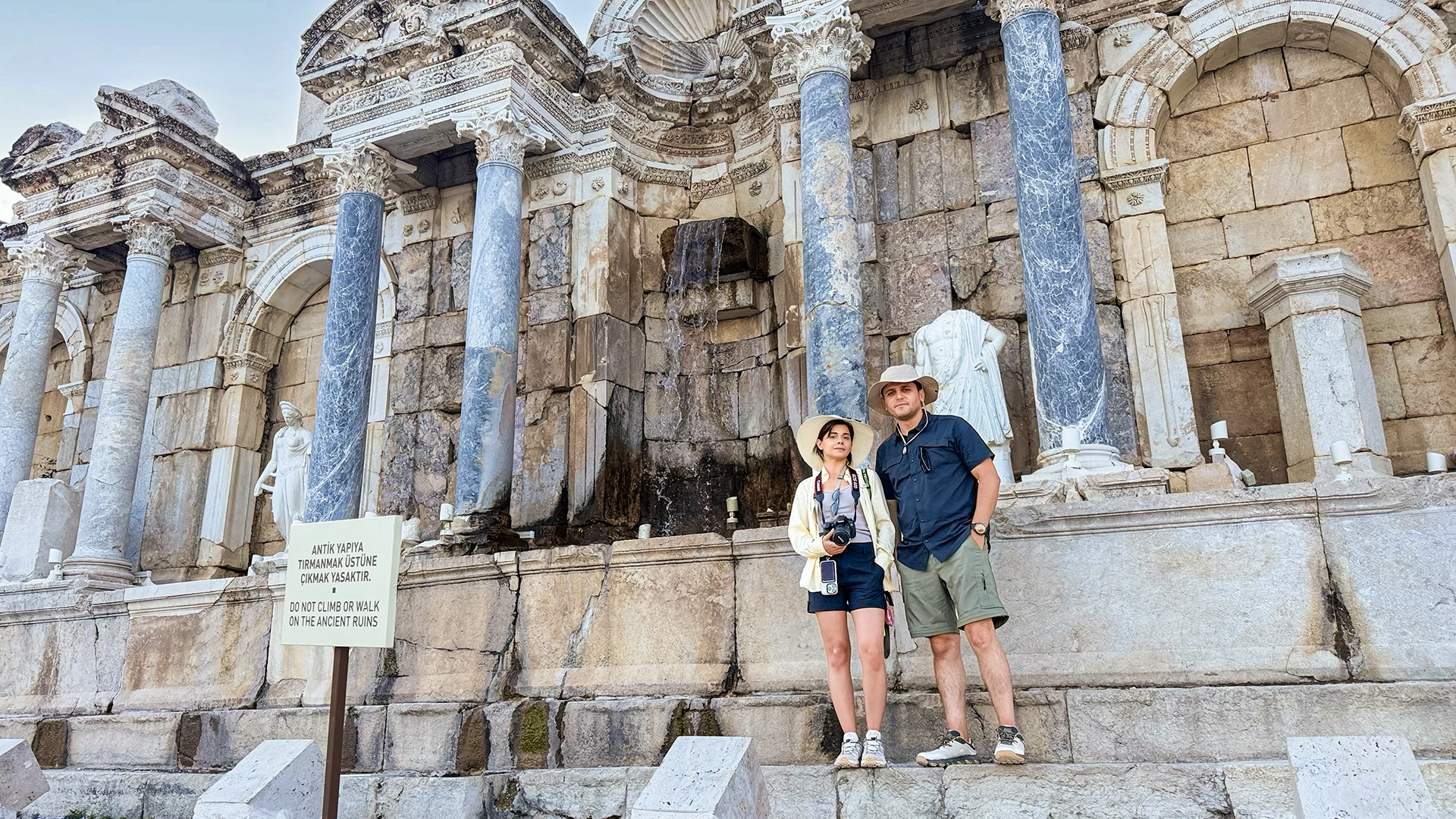
Planning Your Mediterranean Turkey Trip
Mediterranean Turkey works best when the itinerary leaves room for contrast. Ancient cities, mountain landscapes, coastal towns, boat trips, local food and time by the sea can all belong to the same journey, but they do not need to compete for every day.
For a first visit, Antalya, Kaş and Fethiye provide a practical framework. From these bases, archaeological sites, canyons, villages, beaches and sections of the Lycian Way can be added according to your interests and available time.
Seven to ten days gives most travellers enough time to experience different sides of the region without moving accommodation every night. With less time, concentrating on either Antalya and its surroundings or the western coast around Kaş and Fethiye usually creates a better trip than trying to cover the entire Turkish Riviera.
Season matters as much as route. Spring and autumn favour archaeology, walking and longer days outdoors, while summer shifts the rhythm towards swimming, boat trips, early-morning sightseeing and slower afternoons.
Most importantly, Mediterranean Turkey should not be reduced to a checklist of famous places. The region becomes far more interesting when the transitions are given time: from Antalya’s old streets to the Roman avenues of Perge, from the mountains of Termessos to the water around Kekova, or from the ruins of Patara to the beaches and valleys around Fethiye.
If the Mediterranean is one part of a longer trip across the country, our Turkey Travel Guide brings together Turkey’s major regions, practical planning information and destination guides in one place.
Frequently Asked Questions About Mediterranean Turkey
What is the best time to visit Mediterranean Turkey?
May, June, September and October offer the best overall balance for most travellers. Temperatures are generally comfortable for archaeological sites and outdoor activities, while the sea is warm enough for swimming during much of this period.
July and August are better suited to travellers prioritising beaches and boat trips, but daytime heat and visitor numbers are considerably higher.
How many days do you need for Mediterranean Turkey?
Seven to ten days is a good starting point for a route combining Antalya, the Lycian coast and Fethiye.
With four or five days, it is usually better to concentrate on one part of the region rather than trying to travel the entire coastline.
Where should first-time visitors stay?
Antalya, Kaş and Fethiye make the most practical bases for a first trip.
Antalya provides access to Kaleiçi, major archaeological sites and the Taurus Mountains. Kaş works well for Kekova and the central Lycian coast, while Fethiye provides easy access to Ölüdeniz, Kayaköy, Saklıkent Canyon and the western coastline.
Is Antalya or Fethiye better?
They offer different experiences.
Antalya is better suited to travellers who want a larger city, strong archaeological access, Kaleiçi and a wider range of day trips. Fethiye is a stronger base for Ölüdeniz, boat trips, Kayaköy, Saklıkent and the landscapes of the western coast.
Including both works well when you have at least a week.
Is Kaş worth staying in?
Yes. Kaş is particularly rewarding for travellers who prefer a smaller coastal town with swimming, diving, restaurants and easy access to Kekova.
Two or three nights also create a useful slower section between Antalya and Fethiye.
Which ancient cities should I visit near Antalya?
Perge, Side and Termessos are three of the strongest choices close to Antalya, but each offers a different experience.
Perge is particularly strong for Roman urban planning, Side combines archaeology with a coastal town, and Termessos offers a mountain setting within Güllük Mountain National Park.
Sagalassos is further inland but worth considering for travellers with additional time.
Can I combine ancient cities and beaches on the same trip?
Yes. This is one of the main advantages of Mediterranean Turkey.
Places such as Side, Phaselis, Olympos and Patara place archaeological sites close to the coast, while Antalya, Kaş and Fethiye make it easy to alternate sightseeing with swimming or boat days.
Do I need to hike the entire Lycian Way?
No. Most travellers who include the Lycian Way in a wider Mediterranean trip walk only selected sections.
Short routes around Fethiye, Faralya, Kabak, Patara, Kaş and other parts of the coast can provide a sense of the trail without committing to a multi-day trek.
Do I need a car in Mediterranean Turkey?
Not necessarily, but a car provides much greater flexibility for archaeological sites, mountain landscapes, villages and destinations away from the main coastal towns.
Public transport can connect major centres, while private transportation is another practical option for travellers who prefer not to drive.
Can Mediterranean Turkey be combined with Cappadocia?
Yes. The two regions work particularly well together on a longer overland itinerary through Central Anatolia.
The transition from Cappadocia through the Anatolian interior towards the Taurus Mountains and Mediterranean coast also allows archaeological and cultural destinations to be included along the route.
What should I not miss in Mediterranean Turkey?
There is no single list that works for everyone, but a first trip should ideally include a combination of experiences rather than only famous landmarks.
A strong introduction might include Antalya and Kaleiçi, at least one major ancient city, time around Kaş or Kekova, and several days around Fethiye or the western coast. Adding a mountain landscape, canyon or section of the Lycian Way creates a more complete picture of the region.
WRITTEN BY

Nisa Buket Dağdelen
Operations Director & Tour Guide
LinkedIn Profile

Hüseyin Pekgöz
Founder & Managing Partner
LinkedIn Profile
Adventus Travel Company


