
Sanliurfa Turkey: Where Civilization Began and Belief Took Form
Sanliurfa Turkey is one of the oldest continuously inhabited regions in the world, where Göbeklitepe, Balıklıgöl, and early belief systems reveal how human society first began to organize itself. Within Sanliurfa Turkey, this question is not abstract, but grounded in one of the earliest landscapes where belief, structure, and human organization began to take form.
Long before cities, kingdoms, or written language, early communities sought meaning not only through survival, but through what they built, what they gathered around, and what they chose to represent. These were not accidental acts. The spaces they created carried intention. They reflected identity, shared understanding, and a developing sense of belonging within a larger structure. What emerged from this process was not yet civilization as we define it today, but something equally significant: the first structured expressions of thought and collective purpose within sanliurfa turkey.
That search leads us to Göbeklitepe, one of the most important archaeological sites in gobeklitepe turkey and a key reference point in understanding early human societies.
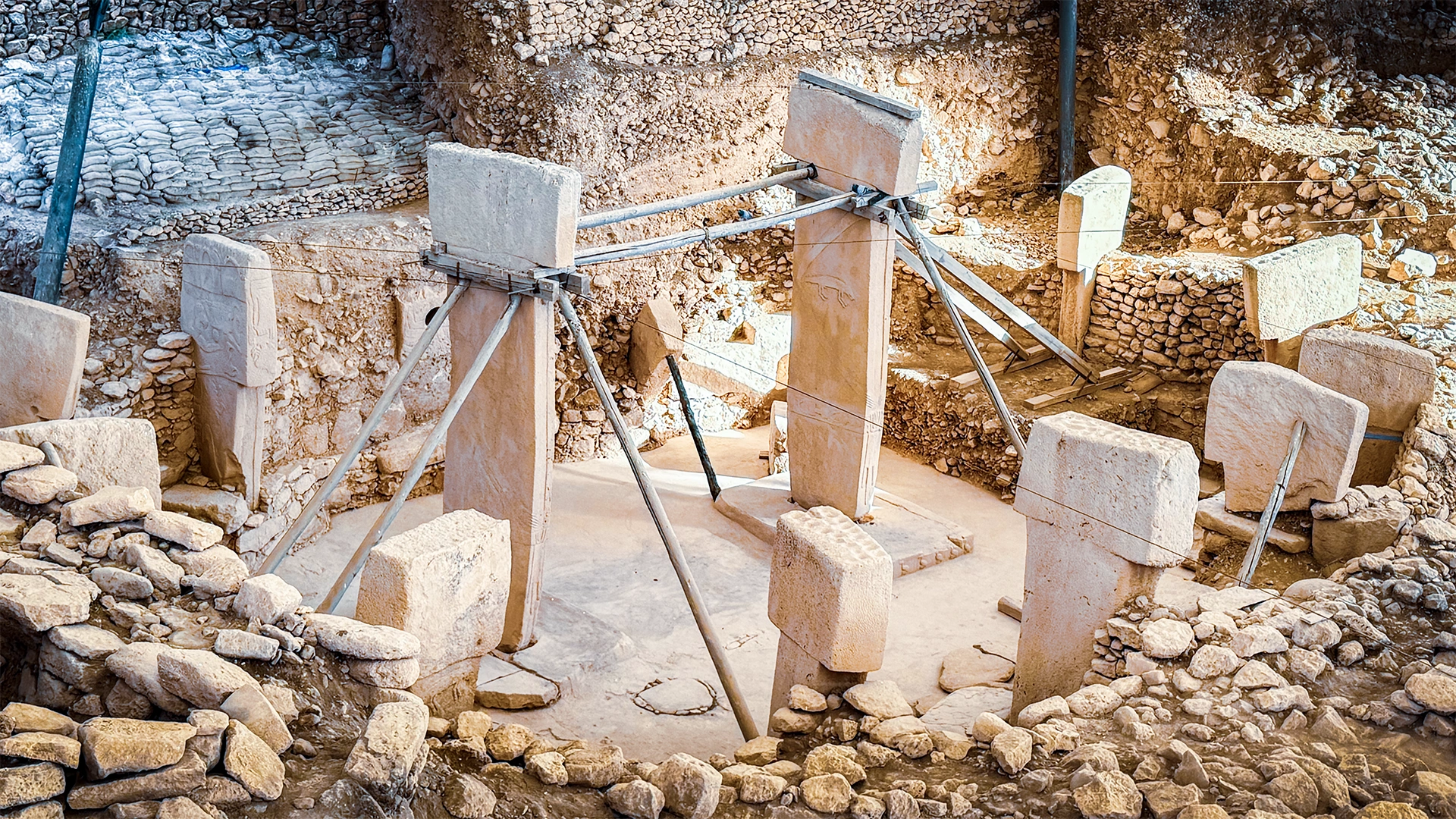
Rising above the plains of Şanlıurfa, these 11,000-year-old stone pillars mark a decisive moment in human history. They do not belong to a lost or isolated world. They belong to a phase in which human communities began to organize themselves in ways that extended beyond immediate survival. The act of building here was not simply practical. It required planning, repetition, and continuity. It required people to come together, not out of necessity alone, but around shared ideas, a process that defines the early foundations of sanliurfa turkey.
What was constructed at Göbeklitepe was not only physical. It was conceptual. Structure, intention, and belief began to take form simultaneously, shaping a new way of interacting with both the environment and one another within sanliurfa turkey.
This development did not remain confined to prehistory.
Positioned at the northern edge of Mesopotamia, Şanlıurfa represents a landscape where early forms of organization, symbolic thinking, and belief systems did not appear in isolation, but evolved in relation to one another. This regional structure is further explored within the Southeastern Turkey Travel Guide, where Sanliurfa is understood as part of a wider network of historical and cultural routes.
Mesopotamia is considered one of the earliest centers of human civilization Long before agriculture became a structured practice, communities gathered here with purpose, establishing the earliest layers of sanliurfa history.
Over time, this same geography acquired additional layers of meaning, becoming associated with the story of Prophet Abraham, a narrative that would shape the spiritual context of multiple civilizations and reinforce the importance of sanliurfa turkey within a broader historical and religious framework.
In Şanlıurfa, these layers do not replace one another. They accumulate. Prehistory and faith are not separate narratives, but part of a continuous structure in which each phase informs the next, a defining characteristic of sanliurfa turkey.
For those approaching the region with attention, sanliurfa turkey offers more than a sequence of sites. It provides a context through which the origins of society, belief, and cultural continuity can be understood together, within a single and connected landscape. For those who prefer to experience this structure through a curated route, the Southeastern Turkey Tour brings together these interconnected locations within a single, carefully planned journey.

Göbeklitepe and the First Organized Societies in Sanliurfa Turkey
Located on a limestone ridge northeast of Şanlıurfa, Göbeklitepe stands apart from what we would normally expect of an early human settlement within sanliurfa turkey. The site is positioned on an open plateau, without immediate access to water sources or arable land. From a purely functional perspective, it does not present the conditions typically associated with habitation. This alone raises an essential question: why here?
Göbeklitepe in Sanliurfa Turkey is widely recognized as the world’s oldest known monumental site, dating back over 11,000 years and reshaping our understanding of early human societies.
The answer begins to take shape through the architecture itself, a defining characteristic of gobeklitepe sanliurfa and its role in early human development.
The site is composed of a series of circular and oval enclosures, each defined by massive T-shaped limestone pillars. Some of these monoliths reach heights of up to six meters and weigh several tons. Their surfaces are carefully worked, and their placement follows a deliberate and repeated pattern. These are not stones that accumulated over time through uncoordinated activity. They are the result of sustained effort, technical knowledge, and shared intention within sanliurfa turkey.
To quarry, shape, and transport stones of this scale using only flint tools requires more than cooperation in the simplest sense. It requires continuity of labour, organization across groups, and a level of planning that extends beyond immediate needs. This is where Göbeklitepe begins to challenge earlier interpretations of prehistoric societies and contributes significantly to the understanding of sanliurfa history.
For much of the twentieth century, the dominant framework assumed that complex social organization emerged only after the development of agriculture. According to this model, settled life, food production, and surplus created the conditions necessary for hierarchy, specialization, and collective projects.
Göbeklitepe presents a different sequence within sanliurfa turkey.
Here, we encounter large-scale construction and coordinated activity in a context where there is no clear evidence of established agriculture. This suggests that the impulse to gather, organize, and build may have preceded farming, and may even have contributed to its eventual development. Rather than being a consequence of settled life, social complexity may have been one of its driving forces, particularly visible in gobeklitepe sanliurfa.
The carvings on the pillars reinforce this interpretation. Across the enclosures, we see repeated depictions of animals such as foxes, boars, snakes, birds, and vultures. These figures are not randomly distributed. Their placement follows a visual logic, indicating that they were part of a shared symbolic system. The emphasis is consistently on animals, often depicted in motion, while plant life is notably absent, reflecting an early worldview shaped within sanliurfa turkey.
This absence is as significant as the presence of animal imagery. It suggests a worldview that is not yet centered on cultivation or domestication, but on movement, interaction, and the dynamics of the natural world as experienced directly.
At the centre of each enclosure, two larger pillars stand facing one another. Their form, often interpreted as stylized human figures with arms and hands, introduces a subtle but important shift. Within a visual field dominated by animals, these central elements bring the human presence into focus, not as individuals, but as participants within a larger system of meaning shaped in sanliurfa turkey.
Göbeklitepe, in this sense, does not represent a transitional step toward civilization. It reveals that many of the elements we associate with later societies, organization, symbolism, and shared belief, were already present, structured and actively expressed, as recognized in global heritage studies. Göbeklitepe is recognized as one of the earliest monumental constructions in human history

Was Göbeklitepe a Temple or Something More in Sanliurfa Turkey
For many years, Göbeklitepe was introduced through a single, striking definition: the world’s oldest temple. The monumentality of the enclosures, the scale of the pillars, and the absence of clear domestic structures in the earliest excavations all supported this interpretation, particularly within the broader narrative of sanliurfa turkey.
The site appeared to stand apart from everyday life, as if it had been constructed for purposes beyond habitation.
This interpretation, while compelling, relies on a model shaped by much later periods.
The concept of a “temple” assumes a clear distinction between sacred and domestic space. It reflects a structured religious system in which ritual is separated from daily activity. Applying this model to Göbeklitepe introduces a risk, as it projects later categories onto a much earlier context where such divisions may not yet have existed in a defined form, especially within early societies connected to sanliurfa history.
Archaeological evidence from the site remains careful in what it confirms. There is no clear indication of permanent settlement in the immediate area of the main enclosures. At the same time, the scale of construction, the repeated architectural patterns, and the density of material remains indicate sustained and organized human activity over an extended period within sanliurfa turkey.
This combination complicates a simple classification.
The presence of large quantities of animal bones, particularly gazelle, points toward episodes of collective gathering that extended beyond subsistence. These events suggest coordinated activity, where groups came together repeatedly, not only to build, but also to interact within a shared order, a pattern clearly observed in gobeklitepe sanliurfa.
The deliberate burial of the enclosures adds another critical layer. The structures were intentionally filled with stone debris, animal remains, and other materials, rather than being left to gradual decay. This act required planning and effort, indicating that closure itself carried meaning. Whether this reflects transformation, renewal, or abandonment as a structured process remains a subject of interpretation within the broader context of sanliurfa turkey.
Taken together, these elements suggest that Göbeklitepe cannot be fully understood through a single category.
It was not simply a temple in the later sense of the word, nor does it fit the model of a permanent settlement. Instead, it reflects a stage in which social organization, symbolic expression, and repeated gathering were already established, even if the boundaries between these functions had not yet been clearly defined.
What we encounter here is not a space assigned to a single purpose, but a system in which building, gathering, and meaning were part of the same process, a defining structural characteristic of early life in sanliurfa turkey.

Balikligol Sanliurfa and the Formation of Belief
Balıklıgöl (Pool of Abraham)
Balıklıgöl in Sanliurfa Turkey is one of the most visited spiritual sites in the region, closely associated with the story of Prophet Abraham.
Balıklıgöl is located in the southwestern part of Şanlıurfa and forms the central element of a broader religious complex defined by water, courtyard space, and surrounding structures such as the Rızvaniye Mosque and its madrasa. Within sanliurfa turkey, this site represents one of the most enduring intersections between belief, space, and historical continuity.
The pool, long and rectangular in form, is not an isolated feature but part of an integrated architectural composition shaped through successive historical phases, contributing to the layered identity of sanliurfa turkey.
The significance of Balıklıgöl is grounded in a long-standing narrative associated with Prophet Abraham. According to this tradition, Abraham challenged the authority and beliefs of the ruling figure commonly identified as Nimrod. As a result, he was cast into a great fire at this location. The account describes a transformation in which the fire turned into water and the burning logs into fish, establishing the physical and symbolic foundation of the pool. The fish, therefore, are regarded as sacred, and their protection remains an essential part of the site’s meaning within balikligol sanliurfa.
This narrative is part of the shared heritage of Islam, Christianity, and Judaism. Abraham is recognized as a central figure across these traditions, and Şanlıurfa is widely associated with his early life. While details vary across sources, the continuity of this narrative has shaped the identity of the site over centuries and continues to define its role within sanliurfa turkey.
Within the same complex, Aynzeliha Lake is also connected to this account and is often associated with the location where Abraham is said to have fallen. The presence of multiple water bodies linked through the same narrative extends the spatial dimension of the story beyond a single point, reinforcing the symbolic landscape of sanliurfa turkey.
Historical evidence indicates that the area has undergone several phases of construction and reconstruction. While the existing mosque and madrasa structures reflect later architectural interventions, including Ottoman periods, earlier layers suggest continuity of use, with references to Byzantine phases preceding the current form. This layered architectural evolution contributes to the understanding of sanliurfa history.
The architectural arrangement, combining water, arcades, and enclosed courtyards, creates a coherent spatial system in which movement and perspective are directed toward the pool.
Balıklıgöl functions as an active environment where narrative, belief, and daily practice intersect. The presence of the fish, the continuity of the Abrahamic association, and the surrounding architectural framework define the site as a space where meaning is sustained through both structure and ongoing use within sanliurfa turkey.

Living Traditions: Understanding Sıra Nights in Şanlıurfa
If the sacred landscape of Şanlıurfa preserves belief through space and narrative, Sıra nights preserve it through people, voice, and shared presence.
Known locally as Sıra Gecesi, these gatherings are not performances in their original form. They developed as structured social assemblies, traditionally organized among groups of men who would meet regularly, often on a rotating basis, within a defined circle. The word sıra itself refers to this order, a sequence that determines hosting, participation, and responsibility.
Within this setting, the evening follows an internal structure, one that reflects continuity, discipline, and shared understanding.
Music is central, but it does not stand alone. The repertoire is built on Urfa’s long musical tradition, including forms of uzun hava and kırık hava, carried through memory rather than written notation. Songs are not selected casually. They follow a progression, shaped by mood, time, and the experience of those present. Transmission occurs through repetition and participation, where younger members learn by listening, observing, and gradually joining, ensuring the continuity of cultural knowledge across generations.
Alongside music, conversation holds equal weight. These gatherings historically functioned as spaces where social matters were discussed, decisions were shaped, and relationships were reinforced. Respect, listening, and timing define the interaction. Speaking out of turn, interrupting, or breaking the flow disrupts not only conversation, but the structure itself, revealing how order is embedded within social behavior.
Food forms another layer of the evening, but it is integrated into the sequence rather than treated as a separate event. Dishes are served in rhythm with the gathering, supporting continuity rather than interrupting it. What is shared reflects local culinary practices, yet the emphasis remains on the act of sharing itself, reinforcing collective identity.
In contemporary contexts, Sıra nights are often presented in adapted formats, particularly for visitors. Music, cuisine, and elements of the traditional structure are maintained, though the original function as a closed social system is necessarily transformed. What remains consistent is the underlying structure: collective presence, continuity, and a shared cultural language expressed through sound and interaction.
Sıra Gecesi, in this sense, represents more than a cultural activity. It is a living tradition.
It demonstrates how knowledge, behaviour, and identity are transmitted without formal institutions, carried instead through repetition, participation, and memory. In Şanlıurfa, where meaning has long been expressed through both built form and lived experience, Sıra nights continue this continuity in a different medium, not through stone, but through people.

The Euphrates and the Changing Landscape
To understand Şanlıurfa beyond its urban and religious layers, it is necessary to look toward the wider geography shaped by the Euphrates.
The river has long functioned as a defining element of the region, not only as a water source, but as a corridor of movement, exchange, and settlement. These connections are part of a broader regional system outlined in the Southeastern Turkey Travel Guide, where routes follow geography rather than isolated destinations.
Its course established connections between northern Mesopotamia and the interior of Anatolia, shaping patterns of trade, agriculture, and habitation over time, and influencing how communities adapted to their environment.
This landscape, however, has not remained static.
In the late twentieth century, large-scale dam projects along the Euphrates, particularly within the framework of the Southeastern Anatolia Project, altered the physical and social structure of the region. Areas that had developed over centuries were partially submerged, while new forms of settlement and infrastructure emerged in response to changing conditions.
These transformations did not erase the past, but they changed how it is experienced.
In some locations, earlier settlements remain visible only in fragments, while in others, the relationship between water and land has been entirely redefined. What was once part of a continuous terrestrial route may now exist along the edge of a reservoir, reshaping movement, access, and perception.
The result is a landscape where different time layers coexist in altered form.
Ancient routes, traditional settlements, and modern interventions are not separate phases, but overlapping conditions. The Euphrates, in this sense, is not only a geographical feature. It is a system that continues to reshape the region, linking continuity with transformation and redefining spatial experience.
Halfeti: Memory at the Edge of Water
Within this changing landscape, Halfeti offers one of the clearest examples of how transformation is experienced at a local scale.
Located along the banks of the Euphrates, Halfeti was partially submerged following the construction of the Birecik Dam. Parts of the old settlement now remain beneath the water, while the newer town developed along higher ground.
This shift did not produce a complete rupture.
Instead, it created a layered environment in which presence and absence exist together. Elements of the former settlement, stone structures, walls, and sections of buildings, remain visible at the water’s edge or just below the surface. Among these, the partially submerged minaret of the old mosque has become a defining visual marker of the site.
Movement through Halfeti today often takes place along the water.
Boat routes follow the contours of the submerged landscape, allowing the earlier settlement to be perceived not as a distant past, but as a condition still embedded within the present environment. The experience is not structured as a visit to ruins in the conventional sense. It is shaped by proximity, by the way structures emerge and recede within the water, creating a continuous visual dialogue between past and present.
Halfeti is also associated with the black rose, a variety that appears under specific environmental conditions linked to the region. While often emphasized in local narratives, its significance lies less in rarity alone and more in its connection to place.
In Halfeti, transformation is not presented as loss alone. It is a reconfiguration.
The town continues to exist, but in a different spatial and visual form. The relationship between built environment and natural setting has shifted, creating a landscape where memory is not separated from the present, but integrated into it.
Birecik and the Bald Ibis: A Fragile Continuity
Along the Euphrates, not far from Halfeti, Birecik presents a different layer of continuity, one that is not built in stone, but sustained through effort.
The town is closely associated with the Northern Bald Ibis, known locally as the kelaynak. Once widespread across parts of the Middle East and Anatolia, this species declined rapidly during the twentieth century due to habitat loss, agricultural chemicals, and changing environmental conditions. What remains today is a carefully managed population, maintained through long-term conservation work.
In Birecik, this effort takes a visible form.
Each year, the birds are released under controlled conditions, following seasonal cycles that reflect their natural patterns of movement. Their presence is not incidental. It is monitored, protected, and supported through structured programs designed to prevent further decline. The process requires continuity, not only in ecological terms, but in institutional commitment.
The significance of the bald ibis in this region extends beyond biology.
Historically, the bird has been associated with seasonal rhythms and local memory. Its arrival and departure once marked changes in time and environment, embedding it within a broader cultural awareness of the landscape. Today, even within a managed system, this connection has not entirely disappeared.
Birecik, in this sense, represents a different form of preservation.
Unlike Göbeklitepe, where meaning is reconstructed through excavation, or Balıklıgöl, where belief is sustained through narrative and practice, the continuity here depends on intervention. It is not self-sustaining. It requires ongoing attention, coordination, and care.
What remains is not only a species, but a relationship.
The presence of the bald ibis reflects how continuity can persist under changing conditions, not as an unbroken line, but as something maintained through deliberate action.
Conclusion: Continuity Formed by Land, Climate and Settlement
Şanlıurfa reflects a continuity shaped over thousands of years under specific environmental conditions.
Set far from the sea, the region developed within a continental climate marked by long, hot summers and cold winters, where daily and seasonal temperature shifts required constant adaptation. These conditions influenced how communities settled, how they moved, and how they organized their lives long before agriculture became a stable system.
The presence of early hunter-gatherer groups, followed by structured gathering at sites such as Göbeklitepe, and later the formation of belief-centered spaces like Balıklıgöl, points to a long process in which environment and human intention evolved together. Patterns of land use, cultivation, and seasonal rhythm remain part of this continuity.
Sıra Gecesi, local food traditions, and the relationship to the Euphrates carry these patterns into the present, reflecting how social life continues to respond to the same landscape.
This continuity can be experienced across sanliurfa turkey, where different historical layers remain interconnected rather than separated.
For Adventus, approaching sanliurfa turkey means following this continuity through carefully structured routes, where each location is understood in relation to the land, the climate, and the systems of life that developed around them.
Travellers who want to experience Şanlıurfa within a broader journey across Turkey can continue through the 15-Day Turkey Tour • Istanbul, Cappadocia & Mesopotamia. After Istanbul and Cappadocia, the route moves through Gaziantep and Halfeti before reaching Şanlıurfa, where Göbeklitepe, the historic city and a traditional Sıra Gecesi form part of the experience. From here, the journey continues toward Mardin and the Kingdom of Commagene, concluding with sunrise at Mount Nemrut.
Through this perspective, sanliurfa turkey becomes not only a destination, but a structured narrative of human continuity shaped across time.
Things to Do in Sanliurfa Turkey
Visiting Sanliurfa Turkey is not limited to a single site. The region offers a structured experience across belief, archaeology, and living culture.
Key things to do in Sanliurfa Turkey include:
- Visiting Göbeklitepe to understand early human organization
- Exploring Balıklıgöl and the surrounding religious complex
- Experiencing a traditional Sıra Gecesi
- Walking through the historic bazaar and old town
- Discovering the landscapes shaped by the Euphrates River
FAQ
Where is Sanliurfa located
Sanliurfa is located in southeastern Turkey, near the northern edge of Mesopotamia.
Why is Göbeklitepe important
Göbeklitepe is one of the earliest known monumental sites, showing organized human activity before agriculture.
What can you experience in Şanlıurfa
Visitors can explore Göbeklitepe, Balıklıgöl, traditional Sıra nights, and regional landscapes shaped by the Euphrates.
What makes Şanlıurfa unique
Şanlıurfa combines prehistoric sites, religious narratives, and living cultural traditions within a single landscape.
Don’t hesitate to contact us to plan a tour in Southeastern Turkey!
WRITTEN BY

Nisa Buket Dağdelen
Operations Director & Tour Guide
LinkedIn Profile

Hüseyin Pekgöz
Founder & Managing Partner
LinkedIn Profile
Adventus Travel Company


