

Sumela Monastery in Trabzon is one of the most striking monastic complexes in Turkey, but its importance extends far beyond its cliffside appearance. Built into the steep landscape of the Altındere Valley, the monastery brings together geography, Orthodox Christian belief, imperial patronage, architecture, and centuries of continuous adaptation.
Understanding Sumela Monastery therefore requires more than seeing it as an isolated monument. Its location, frescoes, water system, monastic spaces, and long history all belong to the wider landscape of northeastern Turkey. For the regional context connecting Trabzon, Rize, mountain valleys, highlands, and the Kaçkar landscape, continue with our Black Sea Turkey Travel Guide.
The monastery developed gradually rather than through a single building campaign. A natural cave became the religious heart of the complex, while chapels, living quarters, kitchens, guest spaces, a library, water infrastructure, and later additions transformed the cliff into a functioning monastic community.
Its history is equally layered. Tradition places its beginnings in Late Antiquity, while the surviving monastery is more clearly documented through the medieval Empire of Trebizond, especially under imperial patronage in the fourteenth century. It then continued under Ottoman rule before the upheavals of the early twentieth century brought monastic life to an end.

Continue Exploring the Black Sea
Understand the Region
Explore the Black Sea with Adventus
Sumela Monastery Overview: Location, Setting and Identity
Sumela Monastery rises from the steep slopes of Karadağ above the Altındere Valley in the Maçka district of Trabzon. Located within Altındere Valley National Park at approximately 1,150 meters above sea level and around 300 meters above the valley floor, the monastery appears almost suspended against the mountain when viewed from below.
Its position is fundamental to understanding the site. Sümela belongs to a long monastic tradition in which withdrawal from cities and ordinary settlement was associated with spiritual discipline. Mountains, caves, forests, springs, and difficult-to-reach landscapes offered both physical separation and an environment suited to contemplation and communal religious life.
In Sümela, however, isolation did not mean simplicity. Over centuries, the cliffside developed into a substantial religious community. The complex eventually included the main rock church, several chapels, monks’ and student rooms, guest accommodation, a kitchen, library, sacred spring, service spaces, and an aqueduct that supplied water to a settlement built in exceptionally difficult terrain.
The natural cave at the heart of the monastery is particularly important. Rather than imposing an entirely new architectural form onto the mountain, the builders incorporated the existing rock formation into the religious core of the complex. Later structures accumulated around it, extending outward and downward through terraces, stairways, corridors, and buildings anchored against the cliff.
This gradual development explains why Sümela should not be understood as a building completed at one moment. It is a monastic complex created in layers, with different generations responding to changing religious, residential, and practical needs. The dramatic façade visible today, especially the large residential block facing the valley, represents only one phase in a much longer architectural history.

What Does the Name Sümela Mean?
The origin of the name Sümela is not completely certain, but it is traditionally connected with the Greek word melas, meaning “black” or “dark.”
One explanation associates the name with the dark appearance of Karadağ, the “Black Mountain,” into whose rock face the monastery was built. Another tradition connects it with the dark-toned representation of the Virgin Mary associated with the monastery. Both explanations have remained part of the site’s historical interpretation, although neither can be established conclusively as the single origin of the name.
The monastery is also widely known as the Monastery of the Virgin Mary, reflecting the central Marian devotion around which its religious identity developed.
Even before its history or frescoes are considered, Sümela therefore reveals something essential about monastic life in the eastern Black Sea. Geography was not simply the setting around the monastery. The mountain, cave, water source, forest, and extreme elevation became part of how the religious community understood and organized its existence.
History of Sumela Monastery: Power, Patronage and Continuity
The history of Sumela Monastery is not defined by a single founding moment. It developed through successive periods of religious devotion, imperial patronage, reconstruction, expansion, and political change, with each generation adding another layer to the complex.
The Traditional Foundation of Sumela Monastery
According to the traditional account, the monastery was founded during the reign of the Byzantine emperor Theodosius I in the late fourth century by two monks from Athens, Barnabas and Sophronios. The story places their arrival at the natural cave that would become the religious heart of Sümela and associates the site with devotion to the Virgin Mary.
Later tradition also connects the monastery with Emperor Justinian I in the sixth century, when the complex is said to have been repaired and enlarged. These accounts are important because they preserve how the monastery understood its own antiquity, but they belong to a partly legendary early history rather than to the most securely documented phase of the surviving complex.
The clearer architectural and documentary history of Sümela emerges much later.

Sumela and the Empire of Trebizond
The monastery becomes far more visible in the historical record from the thirteenth century onward, during the period of the Empire of Trebizond.
Founded in 1204 after the fragmentation of the Byzantine world, the Empire of Trebizond controlled much of the southeastern Black Sea coast. Sümela stood within this political and religious landscape, close enough to Trabzon to receive imperial support but sufficiently isolated to preserve the character of a mountain monastery.
Its most important period of medieval patronage came under Emperor Alexios III Komnenos, who ruled from 1349 to 1390. Earlier members of the Komnenian dynasty had already supported the monastery, but Alexios III strengthened its position through financial patronage, privileges, and imperial decrees.
A foundation decree from his reign regulated the monastery’s property, income, and institutional rights. An inscription once positioned above the entrance even identified Alexios III as the monastery’s ktetor, or founder-benefactor, reflecting the scale of his role in rebuilding and supporting the institution rather than necessarily claiming that he established the first monastery on the site.
His son, Manuel III, and later rulers of Trebizond continued this relationship. Manuel is recorded as presenting the monastery with a valuable reliquary cross, while subsequent imperial decrees confirmed or expanded Sümela’s holdings.
By the late medieval period, the monastery had therefore become more than a remote place of prayer. It was an established religious institution supported by imperial authority, property, income, and a growing physical complex.
What Happened After the Ottoman Conquest of Trabzon?
The Ottoman conquest of Trabzon in 1461 did not bring monastic life at Sümela to an end.
Like several established Christian monasteries elsewhere in the Ottoman domains, Sümela retained important rights and privileges under the new administration. Ottoman sultans issued decrees confirming these protections, allowing the monastery to maintain its religious function and property relationships across several centuries.
This continuity is one of the most significant aspects of Sümela’s history. Political authority changed from the Komnenian Empire of Trebizond to the Ottoman Empire, but the monastery remained active.
Traditions preserved around the monastery also connect Ottoman rulers personally with the institution. Sultan Selim I, who had served as governor in Trabzon before becoming sultan, was associated with gifts to Sümela, while decrees attributed to successive Ottoman rulers reaffirmed aspects of its protected status.
Sümela therefore cannot be understood through a simple Byzantine-versus-Ottoman division. Much of its history is instead a story of institutional continuity across political change.
Expansion in the 18th and 19th Centuries
The monastery visible today is not principally the product of one medieval construction campaign.
During the eighteenth century, substantial restoration took place and important surfaces were decorated or redecorated with frescoes. These later interventions are particularly important when interpreting the paintings at Sümela, since the surviving fresco program contains several chronological layers rather than a single medieval phase.
The complex expanded further during the nineteenth century. Large residential and communal buildings were added against the cliff, providing additional accommodation for monks, students, pilgrims, and visitors.
These additions gave Sümela much of the dramatic architectural profile recognizable today. By this period, the monastery had become prosperous enough to attract foreign travelers as well as pilgrims, and descriptions of the site increasingly appeared in travel accounts.
What visitors see today is therefore the result of centuries of accumulation: a natural cave transformed into a sacred space, medieval imperial patronage, Ottoman-period continuity, later fresco campaigns, and major nineteenth-century construction.
The Early 20th Century and the End of Monastic Life
The twentieth century brought the most decisive rupture in Sümela’s long institutional history.
During the Russian occupation of Trabzon between 1916 and 1918, the monastery existed within a region undergoing profound political and military upheaval. The decades-old continuity of monastic life became increasingly difficult to sustain as the demographic and political structure of the eastern Black Sea changed.
Following the population movements between Greece and Turkey in the early 1920s, the monastery was abandoned in 1923. The religious community that had maintained the site for centuries no longer remained at Sümela.
A fire in 1930 caused further damage to parts of the abandoned complex, while exposure and neglect affected additional structures and painted surfaces.
The monastery that survives today is therefore both a monument and a record of interruption. Its walls preserve the results of Byzantine and Trebizond patronage, Ottoman protection, eighteenth and nineteenth-century rebuilding, and the profound political transformations that ended its original religious function in the twentieth century.
Understanding this continuity is essential to understanding Sümela itself. The monastery survived not because it remained unchanged, but because successive communities and political authorities repeatedly adapted, protected, restored, and reinterpreted it.
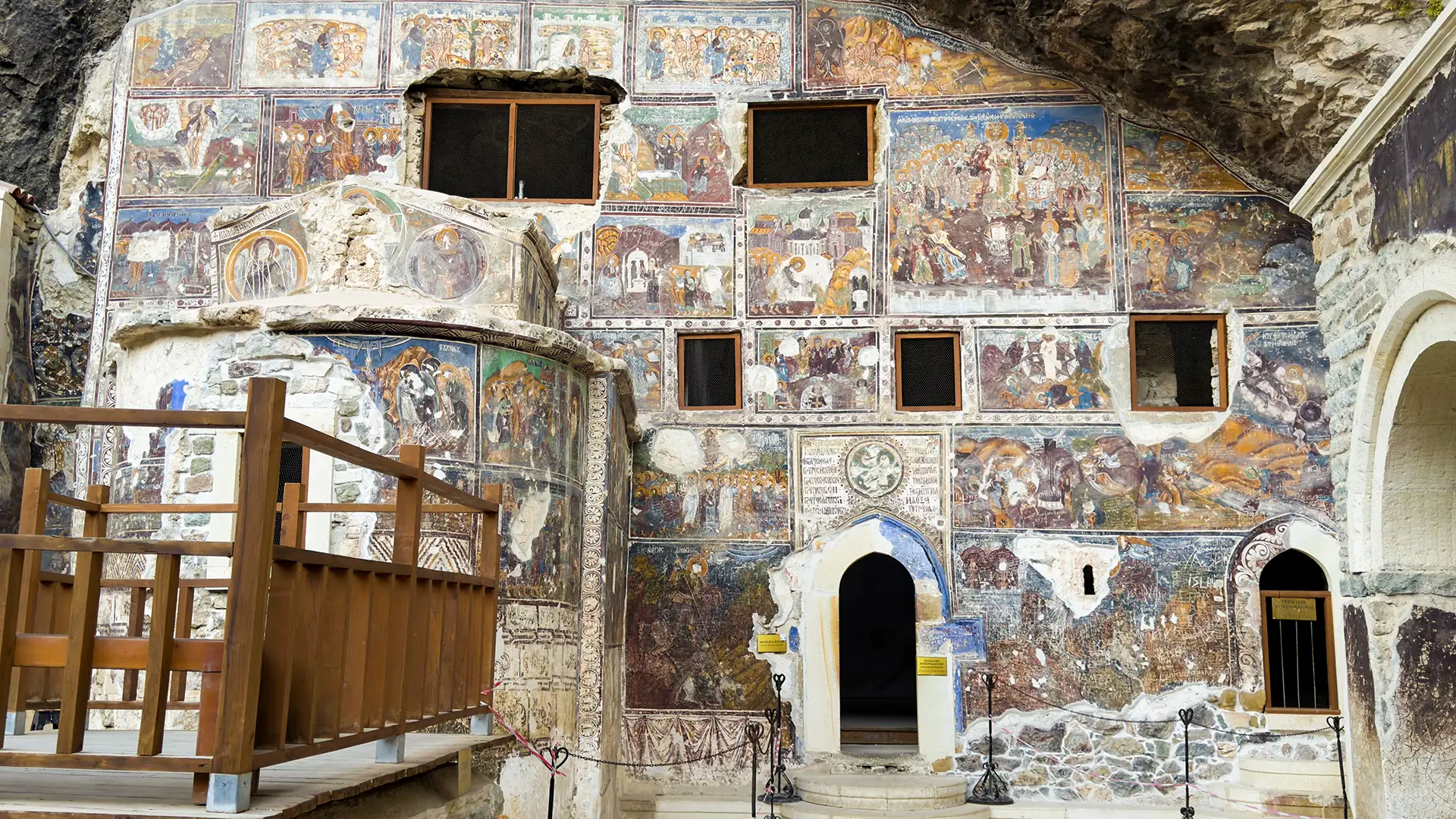
Architecture of Sumela Monastery: A Cliffside Monastic System
The architecture of Sumela Monastery is best understood not as a single building, but as a monastic system assembled around a natural cave and adapted to an exceptionally difficult cliffside environment.
Nothing about the site allowed for conventional planning. There was no broad plateau on which a monastery could simply expand outward. Instead, successive builders worked with narrow ledges, vertical rock, existing cavities, and the limited space available between the mountain and the valley below.
The result is an architectural complex in which movement, water, worship, accommodation, and protection were all organized vertically.
The Approach and Entrance
Historically, reaching Sümela was itself part of the separation between the monastery and the outside world.
A steep forest path led toward a long and narrow staircase approaching the principal entrance. Beside the entrance were guard or gatekeeper rooms, creating a controlled threshold between the mountain route and the enclosed monastic community.
This sequence matters. Visitors did not enter directly into the religious heart of the complex. They passed through a narrow, defensible approach before descending toward the inner courtyard.
The architecture therefore reinforced the monastery’s physical isolation without completely cutting it off from pilgrims, guests, students, and the wider religious networks on which an institution of this scale depended.

The Aqueduct: Bringing Water to the Cliff
One of the clearest demonstrations of Sümela’s engineering is the aqueduct built against the mountainside near the entrance.
A community living hundreds of meters above the valley floor could not function without a dependable water system. The multi-arched aqueduct carried water toward the monastery, transforming an apparently inaccessible cliff into a place capable of supporting permanent communal life.
Old descriptions and photographs show the aqueduct extending along the mountainside with a series of broad arches. Although sections suffered extensive deterioration over time, the structure remains an important reminder that Sümela was not simply a place of prayer. It required the same practical systems as any enduring settlement.
Water appears again inside the complex through the sacred spring, or ayazma, where water emerging from the mountain acquired both practical and devotional significance.
The Inner Courtyard
After passing through the entrance, stairs descend into the main courtyard, the organizing space around which many of Sümela’s principal functions developed.
This courtyard does not resemble the symmetrical cloisters associated with many Western European monasteries. Its irregular arrangement reflects the limitations of the mountain itself. Buildings occupy whatever usable space the rock permitted, creating an environment shaped by accumulation rather than a single master plan.
The courtyard connected sacred and domestic functions. From here, monks and visitors could reach the cave church, chapels, accommodation spaces, library, sacred spring, and the large residential structures extending along the cliff.
This irregularity is one of the most revealing aspects of Sümela. The monastery adapted itself to the mountain rather than attempting to impose geometric order upon it.
The Rock Church: The Architectural and Spiritual Core
At the heart of the monastery lies the main rock church, created around the natural cave associated with Sümela’s earliest religious tradition.
The interior rock was worked to create a more usable sacred space, while the open side of the cave was enclosed architecturally. A small chapel was built adjoining the principal church, creating a compact religious center around which the remainder of the monastery gradually expanded.
This distinction is important because the enormous cliffside residential building that dominates modern photographs is not the oldest or most significant part of Sümela.
The cave church is the true core.
It represents the point at which natural landscape became sacred architecture. Rock was not merely a foundation beneath the church. It became part of the church itself.
Both the interior and exterior surfaces were subsequently covered with frescoes, creating an unusual relationship between natural stone, built walls, and painted theology that we will examine separately.
Chapels and Smaller Sacred Spaces
Several smaller chapels developed around the principal church and elsewhere within the monastery.
Their existence indicates that religious practice at Sümela was not confined to one central liturgical space. Different chapels could support private devotion, particular commemorations, smaller services, or the spiritual needs of different groups within the community.
Some retain traces of paintings from different periods, reinforcing the evidence that Sümela’s religious spaces were repeatedly renewed rather than decorated only once.
Approximately one hundred meters north of the main monastery, historical descriptions also record another rock-cut chapel associated with the wider sacred landscape surrounding the complex.
Sümela therefore extended conceptually beyond the walls visible within the central courtyard.

The Sacred Spring
The ayazma, or sacred spring, adds another dimension to the relationship between landscape and belief.
Water emerging naturally from the mountain collected within the monastery and became associated with devotional traditions surrounding the Virgin Mary. Historical accounts describe visitors attributing healing qualities to this water.
The spring illustrates a pattern found at many religious sites in Anatolia and the wider Christian world, where natural features could acquire sacred meaning through long periods of ritual use and collective memory.
At Sümela, this relationship is particularly powerful because the sacred water does not exist separately from the monastery’s geography. It emerges directly from the same mountain into which the religious complex was constructed.
Library, Kitchen, Student Rooms and Guest Accommodation
A monastery capable of surviving for centuries needed spaces extending far beyond churches and chapels.
Official descriptions of Sümela identify a library, kitchen, student rooms, guest accommodation, monastic living areas, and supporting service spaces throughout the complex.
The library reflects Sümela’s role as more than a place of secluded prayer. Monasteries were also centers where texts could be preserved, studied, copied, and transmitted.
Student rooms similarly point toward an educational dimension within the community, while accommodation for visitors reveals the monastery’s relationship with pilgrims and travelers moving through the region.
The kitchen and domestic rooms expose another side of monastic existence. Religious life required food preparation, heating, storage, water, maintenance, and the organization of everyday work.
These practical spaces are essential to understanding Sümela as a living institution rather than simply a collection of sacred interiors.

The Great Residential Building
The architectural feature most recognizable from the valley today is the enormous multi-storey structure extending along the outer cliff.
Much of this section belongs to the monastery’s nineteenth-century expansion, particularly the major building activity around 1860.
The block contained accommodation for monks and guests, together with multiple levels of rooms, galleries, storage areas, and circulation spaces. Historical photographs also show wooden balconies and verandas extending from parts of the courtyard-facing structures.
Its scale transformed the external appearance of Sümela.
From across the valley, this is the architecture that makes the monastery seem almost attached to the vertical rock face. Yet historically it represents one of the latest major additions to a religious complex whose central cave church was already centuries old.
This contrast is important when reading the site today. The most visually dominant architecture is not necessarily the oldest or the most sacred.
Architectural Layers from the Ottoman Period
Some domestic details within the buildings around the courtyard also reveal the cultural environment in which Sümela continued to develop during the Ottoman centuries.
Official architectural descriptions note features such as cupboards, wall niches, fireplaces, pointed arches, and decorative treatments showing characteristics associated with Ottoman-period domestic architecture.
These elements complicate any attempt to describe Sümela simply as a preserved Byzantine monument.
Its religious identity remained Greek Orthodox, but the buildings continued to evolve within the architectural world of Ottoman Anatolia. The monastery absorbed materials, construction practices, decorative habits, and spatial solutions from the society surrounding it.
This is another reason Sümela’s architecture should be read chronologically rather than stylistically as a single period.
Architecture Shaped by Necessity
Every major architectural feature at Sümela responds to a practical or religious problem.
The cave provided the sacred center. The aqueduct addressed water supply. Narrow stairs and controlled entrances managed access. Terraces and corridors solved circulation across the cliff. Guest rooms supported pilgrims and visitors. Monastic cells created living space where level ground barely existed.
The mountain was therefore not an obstacle that architecture eventually overcame.
It was the condition that determined the architecture.
Sümela’s most remarkable achievement lies in the way generations of builders transformed an extreme natural setting into a functioning religious community without separating the monastery from the landscape that gave it meaning.

Frescoes of Sumela Monastery: Iconography and Meaning
The frescoes of Sumela Monastery are not simply decorative surfaces added to an extraordinary building. They transform the rock church and adjoining chapel into a visual environment in which biblical narrative, theology, monastic discipline, and the passage of time coexist.
Understanding them requires one important distinction from the beginning: the paintings visible at Sümela do not belong to a single period.
Different generations painted, restored, and sometimes painted directly over earlier images. Official documentation identifies multiple layers on the walls of the adjoining chapel, with at least three distinct phases visible in places. Inscriptions associated with later campaigns record work in 1710 and 1732, while older paintings connected with the medieval monastery survive beneath or alongside later decoration.
The result is not a perfectly uniform iconographic program. It is something more revealing: a painted record of a monastery that remained active for centuries.

Christ Pantocrator and the Divine Realm
Inside the rock church, the upper surfaces direct attention first toward divine authority.
The ceiling includes Christ Pantocrator, an image of Christ as ruler and judge of the universe. His elevated position follows a fundamental principle of Byzantine church decoration: the higher parts of sacred space are associated with the heavenly realm, while narrative scenes unfold progressively below.
The placement creates a hierarchy before individual stories are even read. Christ presides over the space, while the biblical and devotional scenes beneath Him describe the history through which salvation is understood.
For the monastic community, this was not simply an artistic convention. The image established the spiritual order within which everyday prayer, discipline, and communal life took place.

The Passion, Death and Resurrection of Christ
Several of the most important frescoes concentrate on the final episodes of Christ’s earthly life.
Scenes include the Crucifixion, Descent from the Cross, Entombment, and Anastasis, the Byzantine representation of Christ’s descent into the underworld and victory over death.
Read together, these images move from suffering and death toward resurrection.
The Anastasis is particularly important within Eastern Christian visual tradition. Rather than showing Christ simply emerging from a tomb, the image presents salvation as an active triumph in which Christ enters the realm of the dead and raises humanity from it.
This gives the surrounding Passion cycle a theological progression. The Crucifixion is not treated as an isolated tragedy, but as part of a sequence leading toward resurrection and redemption.

Melchizedek, Abraham and the Eucharistic Connection
Among the more intellectually demanding images is the representation associated with Melchizedek and Abraham.
In the biblical narrative, Melchizedek, king and priest of Salem, brings bread and wine to Abraham. Christian theology later interpreted this episode as a prefiguration of the Eucharist.
Its presence among New Testament scenes therefore expands the meaning of the painted program beyond chronological storytelling.
Old Testament events are read as anticipating the Christian revelation that follows them.
This relationship between prophecy, prefiguration, and fulfillment appears repeatedly in Byzantine visual theology. At Sümela, it allows scenes separated by biblical chronology to participate in the same theological argument.
The Life of Christ
The southern and western sections of the church contain scenes associated with the life of Christ, including episodes such as the Annunciation, Nativity, Adoration of the Magi, Baptism, and Entry into Jerusalem.
These images provide a more recognizable narrative sequence.
The Annunciation introduces the Incarnation. The Nativity presents Christ entering the human world. The Magi acknowledge His significance, while the Baptism marks the beginning of His public ministry. The Entry into Jerusalem moves the narrative toward the events of the Passion.
For worshippers familiar with the biblical stories and the liturgical calendar, these images could be read not only as historical episodes but also as events repeatedly commemorated through the church year.
The walls therefore connected painted narrative with lived religious practice.

Creation, Adam and Eve, and the Beginning of Human History
On the exterior eastern surfaces, the visual narrative reaches further back into the Old Testament.
Scenes associated with the Creation of Adam and Eve and the story of Cain and Abel place the life of Christ within a much longer theological history.
This beginning is significant.
Christian visual interpretation frequently connects the Fall of humanity with the later need for redemption. Adam and Eve therefore do not represent an unrelated Old Testament story placed beside New Testament imagery. Their presence establishes the condition that the later scenes of Christ’s life, Passion, and Resurrection are understood to resolve.
The painted surface moves between creation, human failure, divine intervention, and salvation.
Other surviving subjects, including the Transfiguration, Ascension, and Dormition of the Virgin, broaden that narrative still further.
The Virgin Mary at a Monastery Dedicated to Her
Marian imagery has particular significance at Sümela because the monastery itself was dedicated to the Virgin Mary.
Scenes from her life appear throughout the painted decoration, including the Annunciation, Nativity cycle, and Dormition. They belong to a much wider devotional tradition surrounding the Virgin that was central to the identity of the monastery.
This becomes even more important when considered alongside the foundation legend.
According to monastery tradition, Barnabas and Sophronios came to the mountain in connection with a miraculous icon of the Virgin attributed to Saint Luke. Whether or not the story can be treated as historical fact, it demonstrates the depth of Marian devotion in the way Sümela understood its own origins.
The frescoes therefore did not introduce the Virgin into an otherwise unrelated visual program. They reinforced the devotional identity around which the monastery had developed.

The Last Judgment
Among the most powerful surviving themes at Sümela is the Last Judgment.
Parts of this extensive composition were painted across the rock surfaces outside the principal church. Although the scene has suffered substantial deterioration, enough survives to demonstrate its importance within the monastery’s visual world.
A recent art-historical study places Sümela’s Last Judgment within the wider Post-Byzantine painting tradition of Trabzon, comparing it with related representations at Vazelon and Kaymaklı monasteries.
For a monastic audience, the subject carried particular force.
The Last Judgment transforms abstract Christian teachings about salvation into a visual confrontation with consequence. Divine judgment, the distinction between the saved and condemned, and the expectation of the world to come were not remote theological concepts. They belonged to the spiritual discipline around which monastic life was organized.
Placed within a community structured around prayer, repentance, and preparation for salvation, the image would have functioned as both teaching and warning.
The Heavenly Ladder of Saint John Climacus
One of the most contemplative themes associated with Sümela is the Heavenly Ladder of Saint John Climacus.
The image belongs directly to monastic spirituality.
The ladder represents spiritual ascent toward God, but the movement upward is neither automatic nor secure. Monks climb while facing temptation and the possibility of falling, turning the image into a visual metaphor for the discipline required by religious life.
Its meaning is especially appropriate at Sümela.
The monastery itself demands physical ascent through mountains and steep terrain, while the image transforms ascent into an interior spiritual struggle. The connection between landscape and theology becomes unusually direct: climbing upward is both something experienced physically at the monastery and something imagined spiritually within its painted world.
Saints, Warriors and the Wider Christian Community
The painted program also includes individual saints and sacred figures rather than narrative scenes alone.
On the chapel walls, Saint George and Saint Demetrios appear as mounted military saints, imagery widely used throughout the Byzantine and Post-Byzantine Christian world.
Their presence connects Sümela with a much broader Orthodox visual tradition.
These figures also remind us that the frescoes addressed different forms of devotion simultaneously. Some paintings narrated scripture. Others presented saints as intercessors, protectors, or spiritual models.
The monastery’s painted environment therefore operated at several levels at once.
Why Are There Frescoes Painted Over Other Frescoes?
Perhaps the most revealing feature of Sümela’s paintings is the fact that new frescoes were repeatedly placed over older ones.
In some areas, three layers can still be distinguished. Official descriptions note that the lowest surviving layer is artistically stronger in certain sections, while the subjects also change from one painting campaign to another.
This should not necessarily be understood as disregard for earlier art.
Religious buildings were living institutions. Walls were repaired, devotional priorities changed, patrons funded new decoration, and damaged paintings were renewed. A sacred space used continuously for centuries naturally accumulated different artistic languages.
At Sümela, damaged plaster occasionally exposes parts of earlier images beneath later paintings. The wall itself therefore becomes archaeological evidence.
What initially appears to be a single painted surface may contain centuries of visual history.
The Lost Portraits of Alexios III and the Trebizond Dynasty
Not every important fresco recorded at Sümela survives today.
On the courtyard-facing wall of the rock church, earlier observers identified paintings dating to the reign of Alexios III of Trebizond, including representations of the emperor together with his sons Manuel III and Andronikos.
These portraits have since disappeared. Official records nevertheless preserve their existence, giving the fresco program a direct connection with the imperial patrons who supported the monastery.
Their loss is important because it reminds us that the Sümela seen today is incomplete.
Weather, fire, abandonment, deliberate damage, removal of painted surfaces, and the natural deterioration of plaster have all changed what survives. The remaining frescoes are fragments of a once much richer visual environment.
Reading the Frescoes as a Monastic Narrative
The frescoes of Sumela Monastery make the most sense when they are read together rather than treated as individual pictures.
Creation establishes the beginning of human history. Adam and Eve introduce the Fall. Old Testament figures anticipate later Christian theology. The life of Christ moves toward the Passion and Resurrection. Marian scenes reinforce the dedication of the monastery. The Last Judgment confronts the viewer with salvation and accountability, while the Heavenly Ladder translates that struggle directly into monastic life.
Yet this narrative was repeatedly repainted over centuries.
That combination is what makes Sümela particularly compelling. The frescoes preserve not a frozen moment of Byzantine art, but a continuing religious tradition in which successive communities returned to the same walls and reinterpreted the sacred stories that defined their world.
The paintings are therefore inseparable from the architecture around them. The natural cave, cliff, church, sacred spring, monastic community, and painted surfaces all belong to the same religious environment.
Without that context, the frescoes can appear as beautiful but fragmented images.
With it, they become one of the clearest surviving records of how Sümela understood belief, history, discipline, and salvation.
Visiting Sumela Monastery: Location, Access and Travel Strategy
Visiting Sumela Monastery is not simply a matter of arriving at a monument and entering through a gate. The approach through the Altındere Valley is part of understanding why the monastery was established here in the first place.
The monastery lies in the Maçka district of Trabzon Province, within Altındere Valley National Park. It is roughly 35 kilometers south of Trabzon and around 8 kilometers from Maçka, although driving time depends more on mountain roads and traffic than the distance itself.
From Trabzon, the route initially follows the road toward Maçka before turning deeper into the forested Altındere Valley. As the road climbs, urban settlement gives way to steep mountain slopes, dense vegetation, streams, and increasingly confined terrain.
This transition provides essential context. Sümela was not built beside a major city and later surrounded by wilderness. Its isolation was part of its monastic identity from the beginning.

How Do You Reach Sumela Monastery?
Visitors can reach the lower visitor area of Altındere Valley National Park by road.
Private vehicles and tour vehicles do not continue directly to the monastery entrance. Access through the upper section of the valley is managed separately, with visitors continuing toward the monastery through the designated transportation system and pedestrian route.
The final approach combines shuttle transportation, walking, inclined paths, and stairs.
This is worth understanding before arrival because Sümela is not a completely step-free archaeological site. The monastery is attached to a mountain approximately 300 meters above the valley floor, and its historical entrance was deliberately reached through restricted and steep terrain.
The modern access system makes the site considerably easier to reach than it was historically, but some physical effort remains part of the visit.
The Final Walk Through the Forest
The last approach is particularly valuable because the monastery does not reveal itself all at once.
The route continues through forest before the cliffside complex becomes increasingly visible. From certain positions, the large nineteenth-century residential façade appears almost embedded into the mountain.
This changing perspective helps explain the architecture before entering it.
From across the valley, Sümela appears as a monumental façade attached to a vertical wall. Once inside, that impression changes. The visitor discovers the much older cave church, irregular courtyard, chapels, sacred spring, stairways, domestic rooms, and other spaces accumulated behind the exterior elevation.
The approach therefore creates an architectural contrast: the monastery seen from the landscape and the monastery understood from within are two different experiences.

How Difficult Is the Visit?
Most visitors with normal mobility can visit Sümela, but the terrain should not be underestimated.
There are slopes, stairs, uneven surfaces, and sections where walking is unavoidable. Comfortable footwear with good grip is more useful than ordinary city shoes, particularly after rain.
The Black Sea climate also matters. Moisture, fog, and rainfall can change conditions quickly, even during summer. Stone and paved surfaces may become slippery, while temperatures in the valley can feel noticeably cooler than on the coast.
Visitors with reduced mobility should check current access arrangements before traveling because the historical structure and cliffside topography limit complete accessibility.
How Much Time Should You Allow for Sumela Monastery?
The monastery itself should not be treated as a quick photographic stop.
A visitor interested primarily in the viewpoint and principal spaces may move through relatively quickly, but understanding the architecture, frescoes, courtyard, rock church, sacred spring, and different building phases requires more time.
As a practical guideline, allow roughly two to three hours for the overall Sümela experience, including the approach, transport between access points, walking, and time inside the monastery.
Travelers interested in history, architecture, or frescoes may comfortably spend longer, particularly when the Altındere Valley itself is included in the visit.
The important point is not to calculate only the time spent inside the monastery gates. The approach and departure are part of the experience.

What Is the Best Time of Day to Visit?
Earlier visits generally provide the strongest balance.
Arriving before the busiest visitor period can make the narrow circulation spaces, courtyard, fresco areas, and entrance sequence easier to appreciate. This is particularly valuable during the main travel season, when Sümela attracts both domestic and international visitors.
Light and weather should also be considered.
Fog can partially conceal the monastery and surrounding mountains, while clearer conditions reveal the scale of the Altındere Valley. Yet mist is not necessarily a failed visit. The rapidly changing mountain atmosphere is part of the landscape that shaped Sümela.
Rather than planning around a guarantee of perfect weather, it is more useful to leave sufficient flexibility in the day.
Summer, Autumn and Winter Conditions
Each season changes the experience significantly.
Late spring and summer generally provide the easiest access and the greenest landscape, but these are also among the busiest periods. Rain remains possible even in warmer months because precipitation is a defining feature of the eastern Black Sea climate.
Autumn changes the forest surrounding the monastery and can bring quieter visitor conditions, though daylight and weather become less predictable.
Winter can transform the valley completely, with snow adding another dimension to the isolation of the site. Mountain weather, road conditions, and temporary access restrictions become more important during this period and should always be checked before departure.
Why Current Access Should Be Checked Before Visiting
Sümela has undergone extensive conservation and safety work, including measures addressing rockfall risk around the cliff.
Because the site exists within an active mountain environment, restoration, conservation, weather, or safety requirements can occasionally affect which sections are accessible.
Visitors should therefore check the official museum information shortly before traveling rather than relying on an old guidebook or previously published opening schedule.
This is particularly important at Sümela because seeing the monastery and having access to every individual section are not necessarily the same thing.
Visiting Sumela Independently or with a Guide
Sümela can be visited independently. The physical route is established, and travelers can reach the monastery without participating in a guided tour.
The difference lies primarily in interpretation.
Without context, it is easy to focus almost entirely on the dramatic cliffside position. Yet the most important details are less immediately obvious: which structures belong to different periods, why the cave church is more important than the monumental façade, how the fresco cycles should be read, why paintings exist in multiple layers, and how the monastery continued functioning after the Ottoman conquest of Trabzon.
A guide therefore adds the greatest value not by making the site accessible, but by making its historical layers legible.
Place Sumela Within the Black Sea Route
Sümela also makes more sense when it is not treated as an isolated excursion from Trabzon.
The monastery belongs to the same regional geography as the forested valleys of Maçka, the coastal history of Trabzon, and the mountain systems that continue east toward Rize and the Kaçkar Mountains.
For this reason, our Black Sea Turkey Travel Guide places Sümela within the broader geographical and cultural structure of northeastern Turkey.
Travelers following our Black Sea Coast Turkey Tour encounter the monastery within that wider progression, where Trabzon, mountain landscapes, valleys, highland communities, and regional culture are understood as connected parts of the same Black Sea environment.
Sumela Monastery Tickets, Opening Hours and Entrance Fees
Practical information for Sumela Monastery can change between seasons and years, particularly entrance fees, opening hours, access arrangements, and sections temporarily affected by conservation work. Visitors should therefore check the official museum information shortly before traveling.
Sumela Monastery Opening Hours
Sumela Monastery follows seasonal summer and winter visiting hours, with opening and closing times adjusted during the year.
At the time of this 2026 update, the monastery is operating under its summer schedule:
- Opening: 08:00
- Closing: 19:00
- Ticket office closes: 18:30
- Open: Every day
These hours should not be interpreted as year-round operating times. The Ministry of Culture and Tourism adjusts museum and archaeological-site schedules according to summer and winter operating periods, and Sümela’s closing time becomes earlier when the winter schedule is introduced.
Anyone traveling outside the main summer season should therefore confirm the current opening hours through the official museum website before visiting.
Arriving well before the final admission time is strongly recommended. The published closing hour refers to the archaeological site itself, but reaching the monastery requires additional time for the upper-valley access, walking route, stairs, and return journey.
For a site of this scale, entering shortly before the ticket office closes would leave very little time to understand the complex properly.
How Much Is the Sumela Monastery Entrance Fee?
As of September 2026, the official Turkish Ministry of Culture and Tourism ticketing system lists the Sumela Monastery e-ticket at €20 for international visitors.
Entrance fees can change, so this figure should be treated as current information rather than a permanent price.
Eligible Turkish citizens can enter using MüzeKart according to the Ministry’s current admission rules. Different exemptions and reduced or free-entry conditions also exist for specific visitor categories.
For international travelers, the safest approach is to check the current ticket price directly through the official Ministry of Culture and Tourism museum platform before arrival.
Does the Ticket Include Altındere Valley National Park?
Sumela Monastery lies inside Altındere Valley National Park, which can make the ticket structure appear more complicated than it actually is.
Current official national-park documentation states that a joint entrance system operates for the Sümela archaeological site and Altındere Valley National Park, with the entrance fee collected through the Ministry of Culture and Tourism.
This means visitors should not automatically assume that two completely independent admission tickets are required simply because the monastery sits within a national park.
Transportation within the upper access area is a separate practical consideration. Parking, local transfer arrangements, and the final approach toward the monastery can change operationally, so these should be checked separately from the archaeological-site admission itself.
Can Tickets Be Purchased Online?
Yes. The Ministry of Culture and Tourism currently offers an official Sumela Monastery e-ticket online.
Purchasing admission in advance can be useful during busy travel periods, particularly in summer when the monastery receives substantial visitor numbers.
However, an advance ticket does not eliminate the need to plan arrival time. The monastery is not directly beside the parking area, and the final access sequence still requires time.
Is Every Part of Sumela Monastery Open?
Not necessarily.
The official museum listing currently describes Sumela Monastery as partially open, reflecting the continuing relationship between conservation work, visitor safety, and the unstable mountain environment surrounding the complex.
This distinction is important.
A visitor may be able to enter Sümela while certain rooms, passages, architectural sections, or conservation areas remain inaccessible. Restoration and rockfall-protection projects have been carried out repeatedly at the monastery, and access can be adjusted when safety or conservation requires it.
Travelers should therefore distinguish between “the monastery is open” and “every section of the monastery is accessible.”
Should Tickets and Hours Be Checked Before Visiting?
Yes, particularly if Sümela is a major reason for traveling to Trabzon.
Opening hours are seasonal, while entrance prices, temporary closures, and accessible sections can also change. The most reliable source is the official Turkish Ministry of Culture and Tourism museum page rather than older travel articles or archived schedules.
This is especially important at Sümela because visitor conditions are affected not only by museum operations but also by the mountain landscape in which the monastery was built.
Is Sumela Monastery Worth Visiting?
Yes, but the value of Sumela Monastery goes far beyond its dramatic appearance.
The first impression is geographical. Few monuments in Turkey occupy a setting as striking as Sümela, where a large monastic complex is built directly into a cliff hundreds of meters above a forested valley. Yet the setting matters not only because it is visually impressive. It explains why the monastery developed here and how isolation, water, access, and topography shaped daily religious life.
The second reason is architectural. Sümela is not a single church or a single-period monument. It is a layered monastic complex of cave spaces, chapels, residential buildings, kitchens, guest rooms, a library, a sacred spring, stairways, terraces, and water infrastructure assembled over centuries. Understanding how these elements were adapted to the mountain makes the site far more interesting than the exterior façade alone suggests.
Its historical importance is equally strong. The monastery is closely connected with the Empire of Trebizond, particularly the patronage of Alexios III in the fourteenth century, but it also continued to function after the Ottoman conquest of Trabzon in 1461. That continuity across changing political systems gives Sümela unusual historical depth.
The frescoes provide another reason to spend time at the site. Scenes from the life of Christ and the Virgin Mary, the Passion and Resurrection, the Last Judgment, Old Testament narratives, saints, and monastic themes such as the Heavenly Ladder survive in different chronological layers. They reveal a religious environment repeatedly renewed over centuries rather than a single decorative campaign.
Sümela is also valuable because many of these layers remain visible at the same time. Medieval patronage, Ottoman-period continuity, eighteenth-century fresco campaigns, nineteenth-century expansion, twentieth-century abandonment, and modern conservation all occupy the same site.
For travelers interested in Byzantine and Orthodox Christian history, architecture, religious art, Black Sea culture, or mountain landscapes, Sümela is one of the most significant places to visit in northeastern Turkey.
It is less compelling when treated only as a viewpoint or a short photographic stop.
The monastery becomes much more meaningful when time is given to the cave church, frescoes, courtyard, water system, later residential buildings, and the relationship between the complex and the Altındere Valley.
For that reason, Sümela is best understood not as an isolated attraction near Trabzon, but as one of the sites that explains the historical and cultural depth of the wider Black Sea region of Turkey.
Experiencing Sumela Monastery with Adventus
Sumela Monastery can be visited independently, and the site is accessible without joining a guided tour.
What changes with expert interpretation is not access, but understanding.
The monastery contains architectural phases from different centuries, frescoes painted and repainted over earlier layers, traces of Trebizond imperial patronage, Ottoman-period continuity, nineteenth-century expansion, and a religious landscape shaped by the mountain itself. Without context, many of these elements are easy to overlook because the dramatic cliffside setting naturally dominates the first impression.
A privately guided visit allows those layers to be read together. The cave church can be distinguished from later residential additions, fresco scenes can be interpreted within their theological sequence, and the monastery’s long history can be connected to Trabzon and the wider eastern Black Sea rather than treated as an isolated monument.
This becomes particularly valuable when Sümela forms part of a broader regional route. On our Black Sea Coast Turkey Tour, the monastery is placed within a larger sequence connecting Trabzon, mountain valleys, regional culture, Rize, and the eastern Black Sea highlands.
The objective is not simply to add more information to the visit. It is to make the relationship between landscape, architecture, belief, and history easier to see while standing inside the monastery itself.
For travelers planning a private Black Sea itinerary, contact Adventus to design the route around individual interests, timing, and travel style.

FAQ About Sumela Monastery
What is Sumela Monastery and why is it famous?
Sumela Monastery is a historic Greek Orthodox monastic complex built into a cliff above the Altındere Valley near Trabzon. It is famous for its dramatic location, rock church, layered frescoes, connection with the Empire of Trebizond, and centuries of continued religious use.
Who built Sumela Monastery?
According to tradition, Sumela was founded in the late fourth century by two monks from Athens, Barnabas and Sophronios. The monastery visible today, however, developed over many centuries and was significantly expanded under the Empire of Trebizond, particularly during the reign of Alexios III in the fourteenth century.
Why was Sumela Monastery built on a cliff?
The location reflects a long monastic tradition of seeking isolation in mountains, caves, forests, and other remote landscapes. At Sümela, the cliff provided seclusion, while the natural cave and water sources helped create an environment suitable for religious life.
How old is Sumela Monastery?
Tradition places its foundation in the late fourth century, although the earliest phases are not securely documented. The surviving complex is more clearly associated with medieval development from the thirteenth century onward, followed by major additions in the Ottoman period and nineteenth century.
What are the frescoes at Sumela Monastery about?
The frescoes include scenes from the life of Christ and the Virgin Mary, the Passion and Resurrection, Old Testament narratives, saints, the Last Judgment, and monastic themes such as the Heavenly Ladder of Saint John Climacus. Many surfaces contain several layers of painting created in different centuries.
How long does it take to visit Sumela Monastery?
Most visitors should allow around two to three hours for the overall experience, including the approach, shuttle or transfer arrangements, walking, stairs, and time inside the monastery. Visitors with a strong interest in history, architecture, or frescoes may want longer.
Is Sumela Monastery difficult to visit?
The site can be visited by most travelers with normal mobility, but there are slopes, stairs, uneven surfaces, and unavoidable walking. Comfortable footwear is recommended, particularly in wet conditions.
Is Sumela Monastery accessible for visitors with limited mobility?
Accessibility is limited by the monastery’s historic cliffside architecture and steep terrain. Visitors with reduced mobility should check current access arrangements before traveling because not every part of the complex can be reached without stairs or inclined paths.
Do you need a ticket to visit Sumela Monastery?
Yes. Entrance tickets are required, and current fees should be checked through the official Ministry of Culture and Tourism museum platform before visiting. Turkish citizens may also be eligible to use MüzeKart under current admission rules.
What are Sumela Monastery’s opening hours?
Opening hours change according to summer and winter operating schedules. During the 2026 summer period, the monastery is listed as open from 08:00 to 19:00, with the ticket office closing earlier. Visitors traveling outside summer should confirm the current schedule before arrival.
What is the best time to visit Sumela Monastery?
Late spring through early autumn generally provides the easiest access and the greenest landscape, although rain and fog remain possible throughout the year. Earlier visits are usually preferable during busy periods because the monastery’s narrow circulation spaces become more crowded later in the day.
Can you visit Sumela Monastery without a tour?
Yes. The monastery can be visited independently. A guided visit becomes most valuable for understanding the different architectural periods, fresco layers, Trebizond history, Ottoman continuity, and the relationship between the monastery and the surrounding Black Sea landscape.
Is Sumela Monastery worth visiting?
Yes, particularly for travelers interested in Byzantine and Orthodox Christian history, religious art, architecture, and the Black Sea region. Its importance lies not only in the cliffside setting, but in the combination of landscape, monastic life, frescoes, and centuries of historical continuity.
WRITTEN BY

Nisa Buket Dağdelen
Operations Director & Tour Guide
LinkedIn Profile

Hüseyin Pekgöz
Founder & Managing Partner
LinkedIn Profile
Adventus Travel Company


