

Planning a trip to Turkey is not simply a matter of choosing the country’s most famous destinations. Istanbul, Cappadocia, Ephesus, the Mediterranean coast, the Black Sea and Southeastern Anatolia each operate within different landscapes, transport systems, climates and travel rhythms. A route that looks straightforward on a map can feel very different once real driving times, domestic flights, mountain roads and the amount of time each region deserves are taken into account.
This Turkey Travel Guide is designed to help travellers understand those differences before building an itinerary.
Rather than presenting Turkey as a long checklist of places to see, the guide explains how its regions fit together, which combinations work naturally, how much time to allow and when a separate regional trip makes more sense than adding another destination to an already crowded schedule.
It also connects the country’s major historical and cultural landscapes. Istanbul introduces the imperial worlds of Rome, Byzantium and the Ottoman Empire. Cappadocia combines volcanic geology with rock-cut settlements and living traditions. Ephesus opens the classical Aegean world, while the Mediterranean follows ancient coastal routes between mountains and sea. The Black Sea requires a slower approach shaped by rainfall, highlands and steep terrain, while Southeastern Turkey leads toward some of Anatolia’s earliest monumental sites and long-established urban cultures.
For travellers interested in experiencing several of these regions together, our Private Turkey Tours provide a flexible framework for combining transportation, licensed guiding, regional experiences and accommodation within one coherent route.
How to Use This Turkey Travel Guide
Turkey can be approached in several different ways, and there is no single itinerary that suits every traveller.
For a first visit, Istanbul and Cappadocia usually provide the strongest starting point. They offer very different experiences while remaining relatively easy to connect by domestic flight. With additional time, the route can continue toward Ephesus and the Aegean or move south toward the Mediterranean coast.
Travellers primarily interested in archaeology and ancient civilizations may place greater emphasis on Ephesus, the Hittite sites of Central Anatolia, Göbeklitepe and Southeastern Turkey, while those interested in landscape and outdoor travel may give more time to Cappadocia, the Lycian coast, the Taurus Mountains or the Black Sea highlands.
Food, crafts and local traditions add another layer. Regional cuisine changes considerably between the Aegean, Central Anatolia, the Mediterranean, Black Sea and Southeast, while experiences such as pottery making in Avanos, wine tasting in Cappadocia, a Bosphorus cruise in Istanbul or a boat trip on the Euphrates reveal places through everyday culture rather than monuments alone.
Use this main guide to understand the overall structure of the country. When a region becomes relevant to your plans, continue into the dedicated regional travel guide for deeper information about its destinations, routes, practical considerations and experiences.
Explore Turkey by Region
Turkey is easier to plan when it is divided into travel regions rather than individual attractions. The following regional guides form the main structure of the Adventus Travel destination library.
Istanbul
For many international travellers, Istanbul is both the entry point to Turkey and the place where the country’s historical scale first becomes visible.
The Historic Peninsula concentrates monuments associated with the Byzantine and Ottoman capitals within a relatively compact area, while the Bosphorus connects the city’s geography, neighbourhoods and imperial expansion beyond the old city walls.
Our Istanbul Travel Guide explains how to structure time between the Historic Peninsula, Bosphorus, neighbourhoods, transportation and the city’s major monuments without compressing everything into a single sightseeing day.

Cappadocia
Cappadocia is not one town or one archaeological site. It is a broad cultural landscape extending across valleys, villages, volcanic formations, underground settlements, churches and agricultural areas.
The region is best understood by combining its geology with the ways people adapted that landscape over centuries. Walking routes, rock-cut architecture, underground cities, local crafts, vineyards and hot air ballooning all reveal different aspects of the same environment.
Our Cappadocia Travel Guide provides the regional framework for choosing where to stay, how many days to allow, which areas work together and how to plan experiences beyond the most familiar viewpoints.
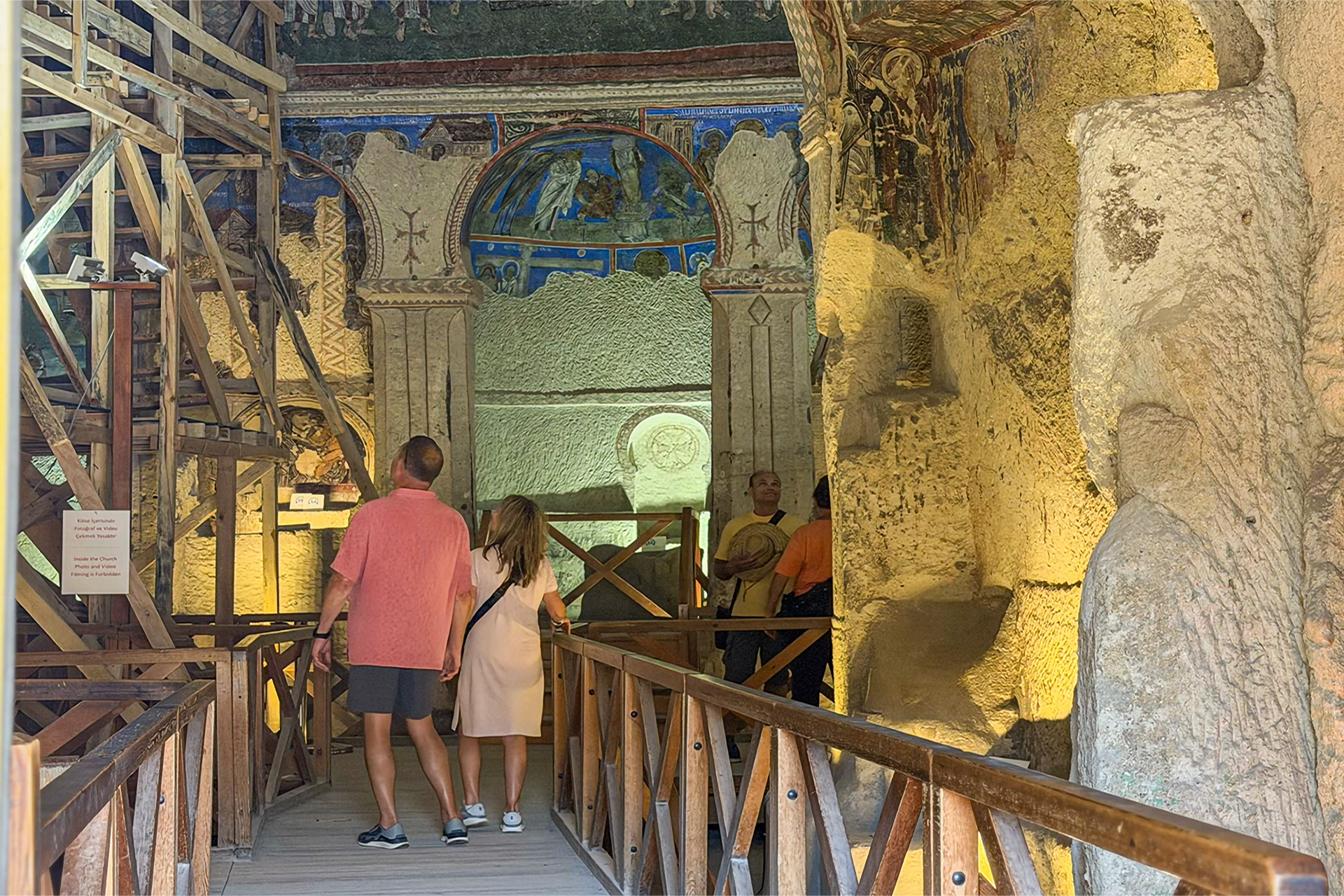
Ephesus and the Aegean
Western Turkey contains some of the country’s most important classical archaeological landscapes alongside coastal towns, agricultural plains and long-established Aegean communities.
Ephesus is the best-known site, but its significance becomes clearer when understood within the wider region that connected inland Anatolia with the Aegean and Mediterranean worlds.
Our Ephesus Travel Guide explores the ancient city, its surrounding sacred sites and the practical route connections that make Ephesus one of the most natural additions to a first or second trip to Turkey.

Mediterranean Turkey
Turkey’s Mediterranean coast combines archaeology with one of the country’s most dramatic geographical corridors.
The Taurus Mountains rise close behind the coastline, while ancient Lycian, Pamphylian and Roman settlements occupy harbours, valleys, mountain slopes and coastal plains. Antalya, Kaş and Fethiye provide practical bases, but the region works best when treated as a route rather than a collection of disconnected day trips.
Our Mediterranean Turkey Travel Guide explains how destinations such as Antalya, Perge, Termessos, Side, the Lycian coast and Fethiye connect within a broader regional itinerary.

Black Sea Turkey
Northern Turkey follows a very different travel rhythm.
The Black Sea coast is backed by mountains that rise quickly from the shoreline, creating a landscape of steep valleys, tea-growing areas, forests and highland plateaus. Travel distances may appear modest, but mountain roads and changing weather often make movement slower than expected.
Our Black Sea Turkey Travel Guide explains how to approach the coast, historic cities, monasteries, highlands and Kaçkar region without underestimating the time required.

Southeastern Turkey
Southeastern Anatolia brings together archaeology, food, religious traditions and cities shaped by the upper Euphrates and Tigris systems.
Göbeklitepe has transformed international awareness of the region’s early prehistory, but Southeastern Turkey extends far beyond a single archaeological site. Gaziantep, Şanlıurfa, Halfeti, Mardin and the surrounding landscapes reveal different periods of settlement, trade and cultural continuity.
Our Southeastern Turkey Travel Guide provides the broader route structure for exploring this region at a realistic pace.

Why Turkey Should Be Planned by Region, Not by Destination
A map of Turkey can create the impression that many major destinations can be combined easily.
The reality is more complex.
The country’s geography changes repeatedly from west to east and from coast to interior. The Marmara region is organized around Istanbul and its waterways. Central Anatolia is dominated by a high plateau. Mountain systems separate the Mediterranean and Black Sea coasts from the interior, while Southeastern Anatolia opens toward the upper Mesopotamian landscape. Eastern Turkey rises into extensive highlands where altitude and winter conditions have an even greater influence on movement.
These differences affect far more than scenery.
They determine how roads develop, where airports are located, how long transfers take, which months provide comfortable conditions and how much can realistically be included in one day.
This is why a strong Turkey itinerary should begin with regional sequencing, not with a list of attractions.
Istanbul to Cappadocia is a logical transition because regular domestic flights connect two major tourism regions.
Cappadocia to the Mediterranean can work particularly well as an overland route when enough time is available because Central Anatolia gradually gives way to the Taurus Mountains and southern coast.
Ephesus and Pamukkale fit naturally within a western route.
The Black Sea and Southeastern Turkey require more deliberate planning because they sit outside the most common first-time corridor.
The question should therefore not be:
“How many famous places can fit into my trip?”
A more useful question is:
“Which regions can be connected without sacrificing the experience inside each one?”
Geography Changes Travel Time in Turkey
Straight-line distance is not always a useful measure of travel difficulty.
A relatively short transfer through the mountains can take longer than a considerably greater distance across Central Anatolia. Coastal roads may follow bays and steep slopes rather than direct lines. Istanbul traffic can change transfer times substantially, while journeys through the Black Sea highlands depend on narrow mountain roads and changing weather.
Domestic flights solve some of these challenges, but flying is not automatically the best answer for every route.
Airport transfers, check-in time and flight schedules need to be considered alongside the flight itself. Within regions such as Cappadocia or along the Mediterranean coast, travelling by road can provide much better continuity because important sites are distributed between towns rather than concentrated around airports.
A practical route therefore uses different forms of transportation for different purposes.
Flights are valuable for major geographical jumps.
Road travel works particularly well within regions and along linear corridors.
Walking becomes part of the experience in historic centres, archaeological sites and landscapes such as Cappadocia’s valleys.
The most efficient trip is not necessarily the one with the fewest hours on the road. It is the one where each transfer contributes logically to the route rather than creating unnecessary backtracking.
How Turkey’s Main Travel Corridors Connect
For many first-time visitors, the most coherent route begins in Istanbul, continues to Cappadocia, and then moves either west toward the Aegean or south toward the Mediterranean.
This structure works because each transition introduces a different geographical and historical layer without forcing the itinerary to reverse direction repeatedly.
Istanbul provides the strongest introduction to the country’s imperial history and contemporary urban life.
Cappadocia changes the scale completely, replacing the metropolitan environment with valleys, villages, rock-cut heritage and the Central Anatolian plateau.
From there, continuing west brings the trip toward the classical landscapes of Ephesus and the Aegean. Moving south instead leads across the Taurus system toward Antalya and the Lycian coast.
Longer itineraries can connect several of these regions, while shorter trips are usually stronger when they resist that temptation.
The Black Sea and Southeastern Turkey should generally be treated differently. Both deserve enough time to develop as regional experiences rather than being added simply because a flight or road connection exists.
This principle will appear repeatedly throughout this guide:
A route should expand only when the additional region adds more value than the travel time required to reach it.
What Makes a Well-Planned Turkey Trip?
A strong itinerary balances contrast with continuity.
Istanbul and Cappadocia work well together because they provide very different experiences without requiring complicated movement.
Ephesus adds another historical layer without repeating Istanbul.
The Mediterranean introduces coastal landscapes, ancient cities and a slower geographical rhythm.
The Black Sea changes the emphasis toward mountains, highlands and regional food culture.
Southeastern Turkey introduces early archaeology, the Euphrates landscape and cities whose architectural and culinary identities differ markedly from western and central Turkey.
The goal is not to make every region look connected when it is not.
It is to understand where genuine travel corridors exist and where a separate trip produces a better experience.
The following sections examine each region individually, beginning with Istanbul, and show how its major sites, detailed guides, private tours and local experiences fit into the wider Turkey route.
Istanbul: Where Most Turkey Trips Begin
For many international travellers, Istanbul is the natural starting point for a trip through Turkey. It is the country’s largest transport hub, but its importance goes far beyond flight connections.
The city provides historical context for much of what appears later in the journey.
Roman infrastructure, Byzantine churches, Ottoman palaces, mosques, markets and waterfront residences survive within the same urban landscape. Understanding these layers at the beginning of a trip makes later destinations easier to place within the wider history of Anatolia.
A first visit usually works best when Istanbul is divided into geographical areas rather than approached as one continuous sightseeing list.
The Historic Peninsula contains the greatest concentration of imperial monuments.
The Bosphorus explains the geography that made Istanbul strategically important.
Neighbourhoods beyond the old city reveal the modern metropolis that developed around those historical cores.
For a complete regional overview, including how to structure sightseeing, transportation and time between different parts of the city, use our Istanbul Travel Guide.
Understanding Istanbul Through the Historic Peninsula
The Historic Peninsula is the strongest place to begin because several monuments representing different periods of Istanbul’s history stand within walking distance of one another.
Hagia Sophia reveals the scale and engineering ambition of sixth-century Constantinople and the later Ottoman transformation of the building.
Nearby, the Hippodrome of Constantinople preserves the outline and surviving monuments of the ceremonial arena that once stood beside the Byzantine imperial palace.
Below ground, the Basilica Cistern shows another side of the city’s infrastructure through the water systems developed for the Byzantine capital.
A short walk away, Topkapı Palace Istanbul introduces the Ottoman court through its courtyards, Harem, collections, kitchens, council chambers and waterfront pavilions.
The Grand Bazaar Istanbul adds the commercial dimension of the Ottoman city, where historic trading halls, occupational streets, workshops and courtyard hans continue to function within a modern market environment.
These monuments should not be treated as unrelated attractions.
Together they explain how imperial government, religion, infrastructure, trade and everyday urban life developed within the same part of Istanbul.
For travellers who want to understand how these sites fit together geographically, the Istanbul Old City Guide provides a more focused framework for the Historic Peninsula.
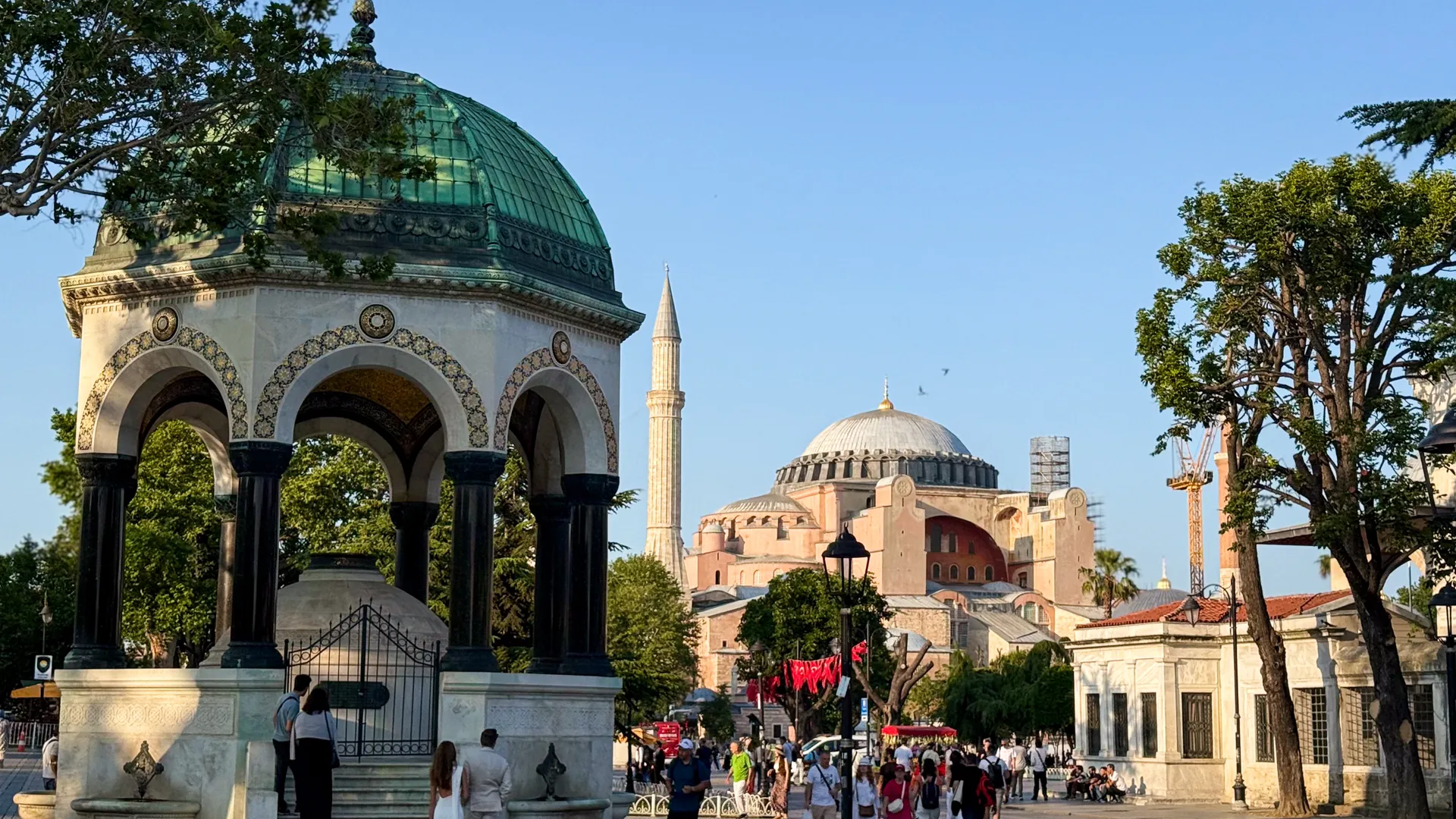
Do Not Try to See the Entire Old City in One Morning
The concentration of monuments in Sultanahmet can make Istanbul appear easier to cover than it really is.
Walking distances may be short, but individual sites require time.
Topkapı Palace alone can occupy much of a half-day when the Harem and major collections are included. Hagia Sophia requires a different kind of attention, while the Basilica Cistern and Hippodrome add separate historical layers.
The Grand Bazaar deserves enough time to move beyond a direct walk through its busiest streets.
Trying to compress all of these places into one morning reduces each one to a brief stop.
For most first-time visitors, two full days is a practical minimum for the principal historical areas of Istanbul, while three or more days allow time for the Bosphorus, neighbourhoods and a less compressed pace.
Our private Istanbul Sightseeing Tour is structured around this principle, separating major historical sites rather than forcing the Old City into one continuous checklist.
The Bosphorus Is Part of Istanbul’s History, Not Just Its View
The Bosphorus is often approached as a scenic addition to sightseeing, but the waterway explains much of Istanbul’s historical importance.
It connects the Black Sea with the Sea of Marmara and separates Europe from Asia, placing the city at the centre of maritime routes that shaped trade, defence and imperial expansion.
Seeing Istanbul from the water also changes the scale of the city.
Palaces, waterfront mansions, fortresses, mosques, neighbourhoods and bridges that appear disconnected from land become part of one continuous shoreline.
A Private Bosphorus Yacht Cruise provides a useful way to understand this geography while moving beyond the concentrated monument circuit of Sultanahmet.
For a first visit, the Bosphorus works particularly well after the Historic Peninsula.
The old city explains why Istanbul became an imperial capital.
The water explains why that capital developed where it did.

Istanbul Beyond the Historic Peninsula
Istanbul should not be reduced entirely to Byzantine and Ottoman monuments.
Areas beyond Sultanahmet reveal different phases of the city’s development.
Galata grew around maritime trade.
Beyoğlu became associated with embassies, European communities, theatres and commercial life during the later Ottoman period.
The neighbourhoods along the Bosphorus developed around waterfront residences, palaces, villages and ferry connections.
On the Asian side, districts such as Üsküdar and Kadıköy offer another perspective on the metropolitan structure of Istanbul.
Travellers with additional time benefit from allowing at least part of a day to move beyond the principal monuments.
This is often where Istanbul begins to feel less like a historical site and more like a living city.
Practical Planning for Istanbul
Istanbul’s main challenge is not distance alone.
Traffic, pedestrian density, security queues and the physical size of major monuments all affect the amount that can realistically be included in one day.
Accommodation location therefore matters.
For a first visit focused heavily on historical monuments, staying within or near the Historic Peninsula reduces travel time.
Travellers who want more evening activity and easier access to Beyoğlu may prefer the northern side of the Golden Horn.
Public transport is extensive, and trams, metros, ferries and suburban rail connections often provide more predictable movement than road transport during busy periods.
For detailed planning, our Planning a Trip to Istanbul guide brings together the practical decisions that need to be made before arrival.
More specific transport guidance can be found in our Istanbul Public Transportation Guide, while travellers arriving through the city’s main aviation hub can use our Arriving at Istanbul Airport Guide and Istanbul Airport Tips for airport-specific planning.
Taxi use can also require some local understanding, particularly in a city where traffic conditions change quickly. Our guide to Taxis in Istanbul and the BiTaksi App explains the practical side of using taxis within the city.

How Istanbul Connects With the Rest of Turkey
Istanbul connects efficiently with almost every major travel region by domestic flight.
This makes it the most flexible entry and exit point for multi-region itineraries.
The most common first transition is:
Istanbul → Cappadocia
This combination works because it creates strong contrast without requiring a complicated route.
Istanbul provides dense urban history and imperial architecture.
Cappadocia introduces a volcanic plateau, rock-cut settlements, valleys and smaller communities.
Our Istanbul to Cappadocia Private Tour combines these two regions within a structured itinerary for travellers who want to experience both without adding unnecessary destinations.
For a broader first journey that continues beyond Cappadocia, the Best of Turkey Tour extends the route through Central and Western Anatolia.
Cappadocia: Landscape, Rock-Cut Heritage and Local Experiences
Cappadocia changes the logic of a Turkey trip.
Istanbul is organized around neighbourhoods and monumental buildings.
Cappadocia is organized around a landscape.
Villages, valleys, churches, underground cities, vineyards, workshops and viewpoints are distributed across a broad area rather than concentrated in one centre. This makes route planning particularly important.
A visitor who approaches Cappadocia only as a collection of famous stops may spend a surprising amount of time driving back and forth across the same roads.
A better approach is to understand how the valleys and settlements relate geographically and then build each day around one section of the region.
For accommodation, route planning, major sites and practical travel information, begin with our Cappadocia Travel Guide.
Why Cappadocia Looks the Way It Does
Cappadocia’s landscape developed from volcanic deposits laid down over millions of years and later reshaped by erosion.
Different layers of volcanic material responded differently to wind, water, temperature change and gravity, producing the cones, ridges, cliffs and pillars now associated with the region.
The famous Fairy Chimneys of Cappadocia are only one expression of this larger geological system.
Their importance becomes clearer when they are seen within complete valleys rather than as isolated rock formations.
Our Valleys of Cappadocia guide compares the landscapes around Göreme and neighbouring settlements and explains why places such as Red Valley, Rose Valley, Love Valley, Zemi Valley and Ihlara offer very different walking experiences.
Cappadocia Is a Cultural Landscape as Well as a Geological One
The volcanic rock did more than create scenery.
People carved it.
Churches, monasteries, houses, storage spaces, dovecotes and underground settlements developed within the same landscape.
This relationship between geology and human adaptation is central to understanding Cappadocia.
At the Göreme Open Air Museum, rock-cut churches preserve one of the region’s most concentrated expressions of Byzantine religious architecture and painting.
Elsewhere, entire subterranean complexes developed beneath settlements and agricultural land.
Our Underground Cities of Cappadocia guide explains how these spaces functioned and how the major sites differ.
For travellers choosing between the two best-known examples, the dedicated Kaymaklı Underground City and Derinkuyu Underground City guides provide more detailed comparisons.

How Many Days Do You Need in Cappadocia?
Two days allows a concentrated introduction, but it requires careful selection.
Three days creates a much stronger first experience.
It allows time to combine the principal landscapes, Göreme Open Air Museum, an underground city and at least one slower cultural or outdoor experience without making every stop feel rushed.
Four or five days creates enough flexibility for longer valley walks, southern routes, workshops, local food, wine experiences and sites beyond the central Göreme area.
Our 3 Days Cappadocia Tour is designed around the principal regional layers, while the 5 Days Cappadocia Tour provides more room for secondary sites and experiences.
For travellers with only one full sightseeing day, the Highlights of Cappadocia Tour provides a focused introduction to the region’s major landscapes and historical context.
Cappadocia Works Best When Each Day Has a Direction
The best routes avoid repeatedly crossing the region from one side to the other.
A northern or central day can focus on Göreme, Uçhisar, Paşabağ, Avanos and surrounding valleys.
A southern route can combine underground cities with landscapes and settlements further from the central visitor zone.
A hiking-focused day may concentrate primarily on the valleys around Göreme rather than adding distant archaeological sites.
This geographical logic is reflected in several Adventus routes.
The Green Tour Cappadocia explores a different regional direction from the Blue Tour Cappadocia, while the Highlights of Cappadocia Tour provides a broader introduction for travellers with more limited time.
The objective is not to complete a colour-coded tour system.
It is to understand that Cappadocia becomes easier to experience when each day follows a coherent geographical route.
Hot Air Ballooning: Iconic, but Not the Whole Experience
Hot air ballooning is the most recognizable modern image of Cappadocia.
The aerial perspective is exceptional because it reveals how individual valleys connect across the larger volcanic landscape.
But ballooning should be treated as one experience within Cappadocia rather than the reason the region exists as a destination.
Our Cappadocia Hot Air Balloon page explains the experience and practical considerations for travellers considering a flight.
It is also important to plan the rest of the trip independently of balloon availability.
Flights depend on weather and aviation conditions, and a Cappadocia itinerary should remain worthwhile even if a balloon flight cannot operate.
The guide to 10 Unforgettable Things to Do in Cappadocia Beyond Balloons explores the region through hiking, heritage, food, crafts, wine and local cultural experiences.

Walk Through Cappadocia, Not Only Around It by Car
Some of Cappadocia’s most rewarding places cannot be understood fully from panoramic viewpoints.
Walking reveals the scale of the landscape.
Trails pass below rock formations, alongside vineyards, through former agricultural areas and past carved churches and dovecotes that can be almost invisible from the road.
Red and Rose valleys are particularly rewarding for travellers who want a combination of geology, rock-cut heritage and late-afternoon light.
Ihlara offers a very different environment, where the Melendiz River runs through a deep canyon lined with rock-cut churches.
Love Valley and Zemi Valley provide additional walking options closer to Göreme.
The choice should depend on the kind of walk you want rather than on which valley has the most recognizable name.
Stay Within Cappadocia’s Architectural Story
Accommodation can also become part of the regional experience.
Cave hotels are often marketed primarily as unusual rooms, but their real interest lies in Cappadocia’s much older tradition of combining rock-cut spaces with stone-built domestic architecture.
Not every property marketed as a cave hotel has the same historical character.
Some occupy restored houses containing genuine rock-cut rooms.
Others combine historic masonry and carved spaces.
Newer properties may reproduce aspects of the architectural style.
Our Cappadocia Cave Hotels: History, Authenticity & How to Choose guide explains how to evaluate these differences before booking.

Experience Cappadocia Through Craft Traditions
Avanos is one of the clearest places to encounter a living craft tradition.
Pottery remains closely associated with the town and the Kızılırmak River, while workshops continue to use wheel-based techniques that require far more skill than a short demonstration suggests.
Travellers who want to participate rather than simply observe can join a Pottery Workshop in Cappadocia.
Our Workshops in Cappadocia Guide provides a broader introduction to regional crafts and explains how to approach workshop visits as cultural experiences rather than obligatory shopping stops.

Food Adds Another Layer to Cappadocia
Cappadocia’s food culture developed within a Central Anatolian agricultural environment shaped by grain, legumes, orchards, vineyards and seasonal preservation.
Testi kebabı is the best-known dish, but it represents only one part of a broader household cuisine.
A hands-on Cooking Class in Cappadocia provides a more participatory way to understand local ingredients and preparation.
Weekly markets offer another perspective.
Our guide to Farmers Markets in Cappadocia explains where and when these markets operate and how they fit into everyday regional life.

Cappadocia Has a Long-Established Wine Culture
Vineyards have been part of Cappadocia’s agricultural landscape for generations, and the region is particularly associated with the Emir grape.
Rock-cut storage spaces also provided naturally useful environments for cellaring and storing wine.
Travellers primarily interested in understanding local wines can choose a Wine Tasting in Cappadocia.
Those who prefer to place the wine within the physical landscape can consider an Outdoor Wine Experience in Cappadocia.
The distinction is useful.
One focuses more directly on the wines.
The other uses the valleys and surrounding landscape as part of the experience.

Evening Cultural Experiences in Cappadocia
Evenings in Cappadocia do not need to end with sightseeing.
A Whirling Dervishes Ceremony in Cappadocia introduces the Mevlevi Sema tradition within a contemplative setting.
It should not be confused with a Turkish Night Experience, which is built around folk performance, music and entertainment.
These experiences serve different interests.
Sema is connected with a spiritual and musical tradition whose historical centre lies in Konya.
Turkish Night is a social evening centred on regional performance.
Understanding that difference before booking helps travellers choose according to their expectations.

Cappadocia Can Also Be a Base for Central Anatolia
Cappadocia does not need to function only as a destination from which travellers immediately fly elsewhere.
Its location allows several important parts of Central Anatolia to be explored as extensions.
Konya provides access to the Mevlevi heritage associated with Rumi and the Seljuk period.
The Hittite capital Hattuşa and the sanctuary of Yazılıkaya open a much earlier chapter of Anatolian history.
Gümüşler Monastery near Niğde expands the story of rock-cut Christian architecture beyond the central Cappadocian valleys.
The Aladağ Mountains introduce a completely different natural environment south of the volcanic plateau.
These extensions will be covered in greater detail later in this guide because they form an important bridge between Cappadocia and the wider geography of Central Anatolia.
How Cappadocia Connects to the Next Region
After Cappadocia, a first-time Turkey itinerary usually takes one of three directions.
West toward Ephesus and the Aegean for classical archaeology and the western route.
South toward the Mediterranean for Antalya, the Taurus Mountains and the Lycian coast.
Deeper into Central Anatolia through Konya before continuing west.
Travellers with more specific interests may instead move toward the Black Sea or Southeastern Turkey, but these transitions require more time and should be treated as deliberate regional routes rather than quick additions.
The next section of this Turkey Travel Guide moves west to Ephesus and the Aegean, where the geography changes again and the itinerary begins to connect the Central Anatolian plateau with the ancient cities and agricultural landscapes of western Turkey.
Ephesus and the Aegean: Classical Cities, Sacred Landscapes and the Western Route
Western Turkey introduces another major shift in a multi-region itinerary.
The Central Anatolian plateau gives way to a lower, more Mediterranean landscape shaped by river valleys, agricultural plains, olive groves, vineyards and access to the Aegean coast. Archaeological sites are often closer to contemporary towns and villages, while ancient trade routes repeatedly connect inland settlements with former harbours.
Ephesus provides the clearest introduction to this regional structure.
Its importance cannot be explained by the surviving Roman monuments alone. The ancient city developed within a changing coastal landscape near the Kaystros River, and its relationship with the harbour helped make it one of the most important commercial and administrative centres of Roman Asia. As sediment gradually altered the coastline, settlement patterns and access to the sea changed with it. UNESCO therefore recognises Ephesus not simply as a collection of monuments, but as a settlement landscape shaped by environmental change across successive periods. (UNESCO World Heritage Centre)
For the complete regional framework, including the Ancient City, surrounding sacred sites, Selçuk, Şirince and practical planning, continue with our Ephesus Travel Guide.
Ephesus Is More Than the Library of Celsus
The Library of Celsus is the most recognizable structure at Ephesus, but focusing on one monument can obscure what makes the site exceptional.
Walking through the ancient city reveals how an entire Roman metropolis functioned.
Curetes Street connects civic and religious buildings.
The Commercial Agora reflects the city’s trading life.
The Great Theatre shows the scale of public gathering and entertainment.
Baths, fountains and public buildings explain infrastructure and civic investment.
The Terrace Houses introduce a completely different perspective through the domestic environments of wealthy residents.
Together, these spaces allow travellers to understand relationships between government, commerce, religion, entertainment and private life rather than viewing archaeological remains as isolated ruins.
Our Ephesus Ancient City Guide explores the archaeological site in greater detail, including its monuments, walking route and practical visitor considerations.

Why the Terrace Houses Matter
The Terrace Houses are particularly valuable because they move the experience away from monumental public architecture and into domestic life.
Decorated rooms, mosaics, wall paintings and marble surfaces reveal how affluent families lived within the Roman city.
This creates an important contrast.
The Library of Celsus and Great Theatre represent the public image of Ephesus.
The Terrace Houses reveal the private world behind it.
Travellers with a strong interest in Roman archaeology should allow enough time for them rather than treating the Ancient City as a rapid walk between its most photographed landmarks.
Ephesus Connects Several Religious Traditions
The wider Ephesus landscape also shows how religious significance changed across centuries.
The Temple of Artemis once attracted pilgrims from across the ancient Mediterranean and became one of the most famous sanctuaries of antiquity.
Later, Ephesus developed major associations with early Christianity.
The Church of Mary, Basilica of Saint John and traditions surrounding the House of the Virgin Mary demonstrate how the region remained important as religious priorities changed.
UNESCO specifically identifies this continuity between the Artemis cult, early Christianity and later pilgrimage traditions as an important part of Ephesus’s significance. (UNESCO World Heritage Centre)
This is why Ephesus works better as a regional historical landscape than as a single Roman archaeological site.
Different monuments belong to different periods, but they remain geographically connected.
The House of the Virgin Mary Adds a Different Kind of Experience
The House of the Virgin Mary stands on the forested slopes above Ephesus and feels very different from the monumental Ancient City below.
According to Christian tradition, Mary spent her final years in this area under the care of Saint John. The site later became an important pilgrimage destination and continues to receive visitors who approach it through faith, history or cultural interest.
Its small scale is part of the contrast.
After several hours among marble streets, theatres and monumental public buildings, the quieter setting creates a different rhythm.
For travellers primarily interested in archaeology, it provides context for the later religious importance of the Ephesus region.
For Christian travellers, it may be one of the principal reasons for visiting.

Selçuk Helps Connect the Different Layers
The modern town of Selçuk is not simply an access point for the Ancient City.
The Temple of Artemis, Ephesus Archaeological Museum, Ayasuluk Hill, Basilica of Saint John and Isa Bey Mosque bring several periods of the region’s history together within a relatively compact area.
This makes Selçuk useful for understanding what happened after the centre of Roman Ephesus declined.
Settlement did not simply disappear.
Political, religious and urban activity shifted.
A visitor who sees only the marble streets of Roman Ephesus misses this later continuity.
Şirince Introduces the Living Aegean Landscape
Şirince adds another dimension to the Ephesus region.
The hillside village is known for its traditional architecture, agricultural surroundings, local food and wine culture. It offers a useful contrast with the monumental scale of archaeological sites and can work particularly well as an overnight base for travellers who prefer a smaller settlement environment.
Its value is not that it is somehow separated from tourism.
It is that the village introduces the contemporary agricultural and cultural landscape surrounding Ephesus.
This becomes particularly relevant on longer journeys where archaeology is balanced with food, wine and slower regional experiences.
How Much Time Do You Need Around Ephesus?
A single full day provides a strong introduction if the Ancient City is the main priority.
It can be combined with the House of the Virgin Mary and one or two additional sites around Selçuk, although the day requires careful pacing.
Two days creates a much better regional experience.
The Ancient City can be explored without rushing, the Terrace Houses can receive proper attention, and Selçuk, Şirince or additional sacred sites can be included separately.
A third day becomes worthwhile when Ephesus is being combined with regional food, wine, the coast or a continuation toward Pamukkale.
The amount of time required therefore depends on whether Ephesus is being treated as an archaeological stop or as part of a broader Aegean route.
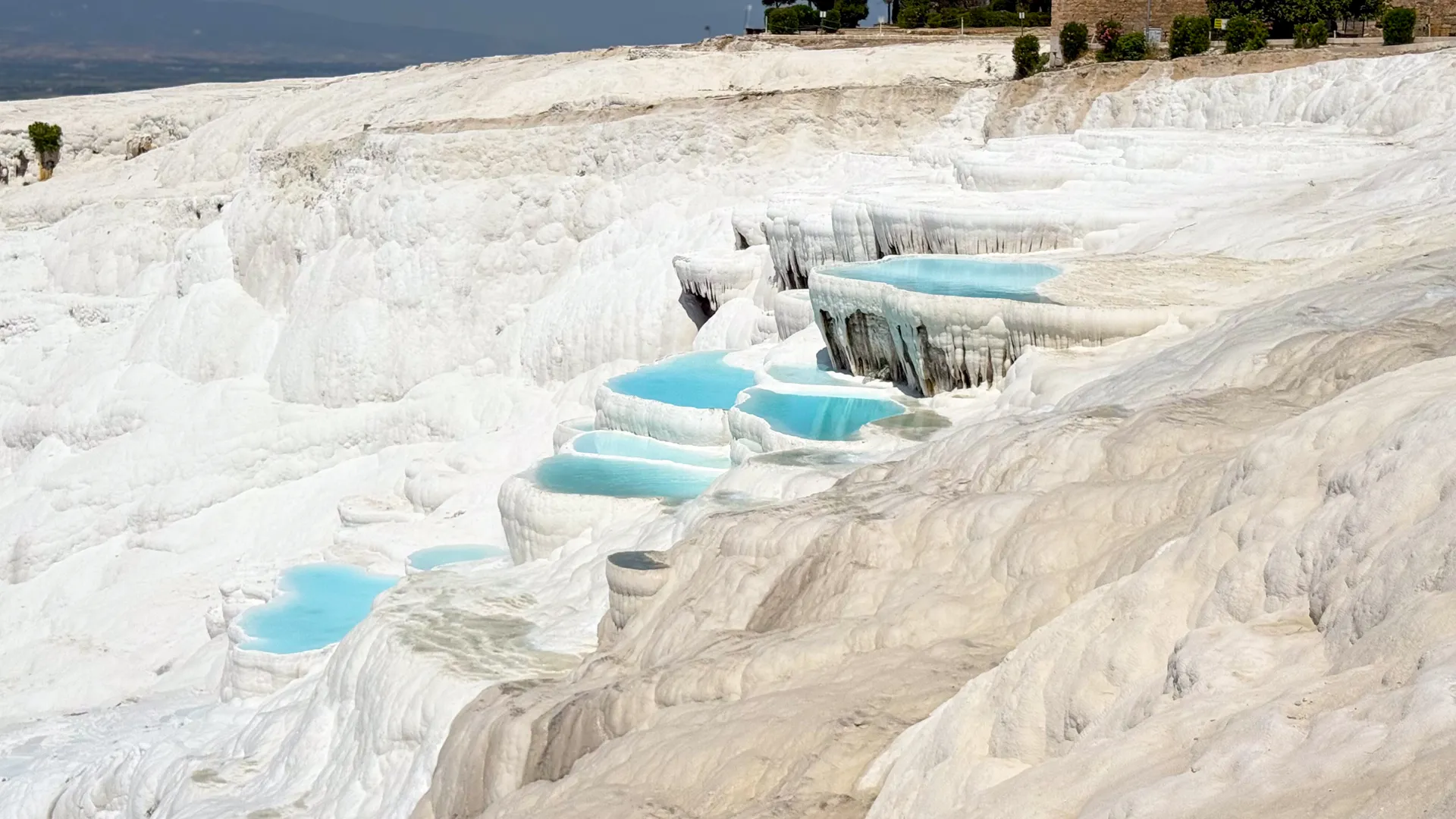
Ephesus and Pamukkale Form a Natural Western Combination
Ephesus and Pamukkale are frequently combined because they introduce two very different landscapes within the same western itinerary.
Ephesus is fundamentally urban and archaeological.
Pamukkale combines the white travertine terraces with the ancient city of Hierapolis above them.
The contrast works well, but the route is stronger when it includes enough time between the two rather than treating both sites as quick stops on a transfer day.
Our Ephesus to Pamukkale: Aegean Heritage & Local Life Tour uses Şirince as a base while connecting Ephesus, Kuşadası, local food and wine culture with the inland route to Hierapolis and Pamukkale.
For travellers beginning in Istanbul, the Istanbul, Ephesus & Pamukkale Tour connects the imperial history of Istanbul with the classical Aegean and Pamukkale within one regional sequence.
Longer first-time journeys can integrate Ephesus within the Best of Turkey Tour, where Istanbul, Cappadocia, Central Anatolia, Pamukkale and Ephesus form a broader cross-country route.
When Should Ephesus Be Added to a Turkey Itinerary?
Ephesus makes the most sense when there is enough time to move beyond Istanbul and Cappadocia without compressing the trip.
For a six- or seven-day journey, Istanbul and Cappadocia generally provide a stronger structure on their own.
At around nine or ten days, Ephesus becomes much easier to incorporate.
With additional time, the Aegean can then develop into a more complete regional experience involving Şirince, Pamukkale, coastal towns, food and wine.
This distinction matters because Ephesus is not difficult to reach.
The challenge is giving it enough time to be more than a flight, a rushed archaeological visit and another immediate transfer.
Mediterranean Turkey: Archaeology, Mountains and the Lycian Coast
Southern Turkey introduces another major change in geography.
The Mediterranean coast is shaped by the close relationship between the Taurus Mountains and the sea. In some areas, broad coastal plains allow ancient cities and modern settlements to spread inland. Elsewhere, mountains descend almost directly toward the shoreline, creating narrow corridors of bays, cliffs and coastal roads.
This geography has always influenced movement.
Ancient harbours developed where ships could connect with inland routes.
Cities controlled plains, river valleys and mountain passes.
Modern travel still follows many of the same physical constraints.
For this reason, the Mediterranean works best when approached as a regional corridor rather than as a base from which every destination is treated as a day trip.
Our Mediterranean Turkey Travel Guide provides the complete framework for the region, including Antalya, archaeological sites, the Lycian coast, outdoor landscapes and practical route planning.
Antalya Is the Main Gateway to the Mediterranean
Antalya provides the most practical introduction to southern Turkey.
The city combines a major airport and contemporary urban infrastructure with a historic centre, archaeological museum and access to several important ancient cities.
Kaleiçi, the historic old town, preserves narrow streets, Ottoman-period houses, sections of the ancient and medieval fortifications, Hadrian’s Gate and the old harbour. Its value within a longer itinerary is partly practical.
After travelling from Central Anatolia or arriving by air, Antalya provides a place to understand the region before continuing west or east along the coast. The city also acts as a gateway to archaeological landscapes that developed across ancient Pamphylia and Pisidia.
For travellers who want Antalya itself to become a complete regional experience rather than simply a gateway, the Antalya Signature Tour • Ancient Cities & Turquoise Coast combines Kaleiçi, Selge and Köprülü Canyon, Perge and Aspendos, Çıralı, Olympos, a private Mediterranean boat experience, and Tahtalı Mountain within a carefully paced five-day route.
The itinerary balances archaeology with the Taurus landscape and slower coastal time, allowing Antalya to function as a destination in its own right rather than only as the starting point for the wider Lycian coast.

Perge Shows the Scale of Roman Urbanism in Pamphylia
Perge lies on the coastal plain east of Antalya.
Its monumental gate, colonnaded streets, bath complex, agora, theatre and stadium illustrate the scale of urban development possible within the fertile Pamphylian landscape.
The site differs considerably from Ephesus.
Ephesus developed around a major harbour and steep urban topography.
Perge spreads across flatter ground, allowing its streets and public architecture to be read more openly.
Comparing the two can be particularly rewarding for travellers interested in Roman city planning because it shows how similar civic institutions developed within different landscapes.

Termessos Reveals the Mountain Side of the Region
Termessos provides almost the opposite experience.
The ancient city occupies a high position within the Taurus Mountains northwest of Antalya.
Reaching its principal monuments requires walking uphill through forested and uneven terrain, making the landscape an inseparable part of the archaeological experience.
The theatre is particularly memorable because the mountain setting extends beyond the surviving structure into wide views across the surrounding valleys.
Termessos therefore works best for travellers comfortable with a more demanding archaeological visit.
It is not simply another ruin near Antalya.
It shows how ancient communities adapted to and benefited from difficult mountain geography.

Side Combines Ancient City and Modern Coast
Side developed on a peninsula east of Antalya and remains one of the easiest places to see how an archaeological landscape and contemporary coastal town occupy the same space.
The theatre, monumental streets, agora and waterfront remains sit within and around the modern settlement.
This produces a very different atmosphere from more isolated archaeological sites.
A visit can move between Roman monuments, harbour views and contemporary restaurants without a long transfer between each element.
For travellers following the eastern Antalya coast, Side can be combined with other archaeological sites while still preserving time by the sea.

Sagalassos Extends the Mediterranean Story Into the Mountains
Sagalassos lies inland and at considerable elevation, demonstrating that the historical systems connected with Turkey’s Mediterranean region were not confined to the shoreline.
The ancient city developed high in the mountains of Pisidia and preserves monumental spaces including the Upper Agora, fountains, baths and civic buildings.
Its setting is as important as the surviving architecture.
Sagalassos shows how inland communities participated in the political and economic systems of the Roman world while occupying a dramatically different environment from the coastal cities below.
For travellers moving overland from Cappadocia toward Antalya, it can also become part of the route rather than requiring a separate return journey from the coast.
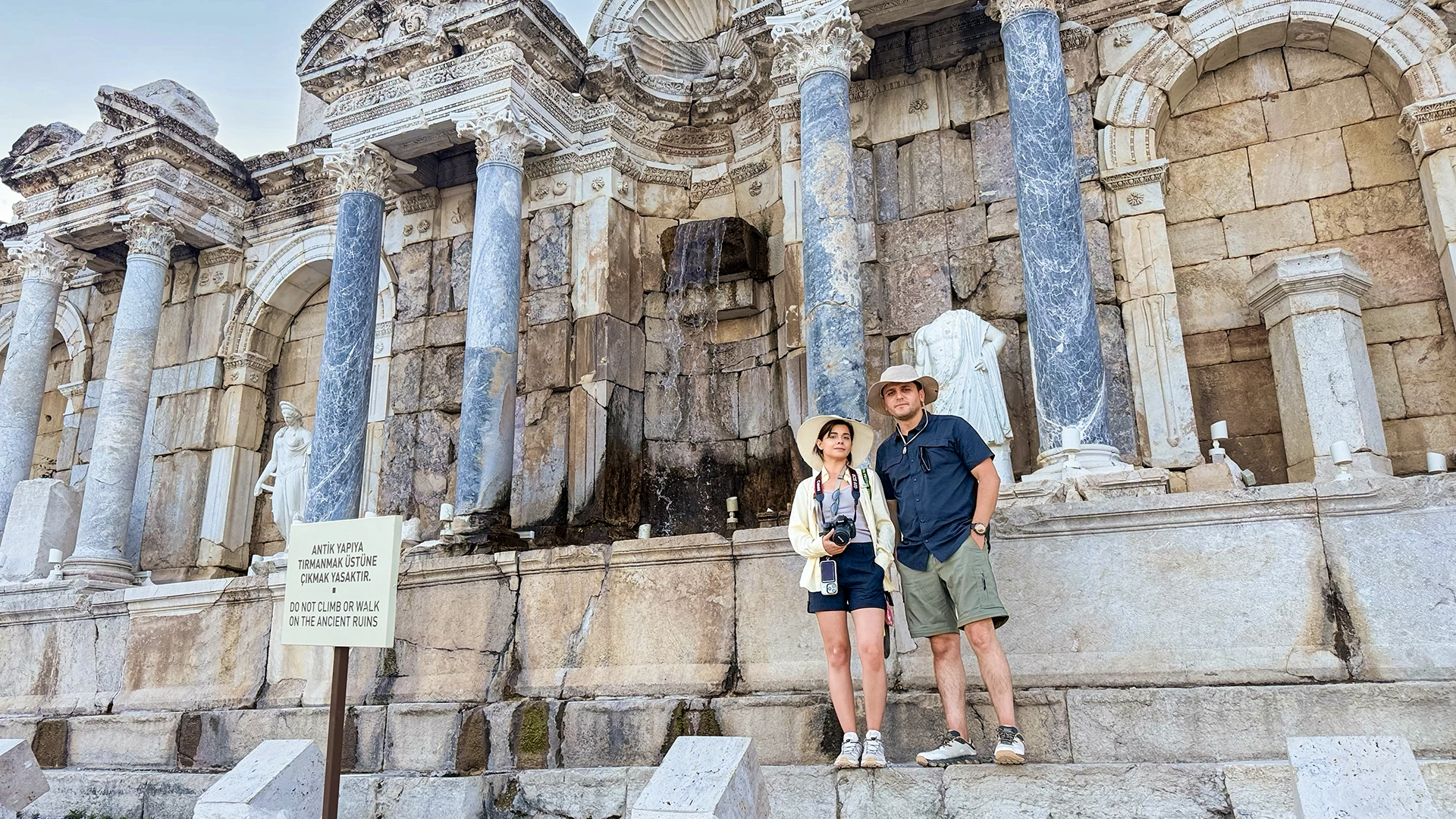
The Lycian Coast Is a Historical Route, Not Only a Beach Destination
West of Antalya, the Mediterranean coastline increasingly enters the historical territory associated with ancient Lycia.
This is one of the most distinctive archaeological landscapes in Turkey.
Lycian cities developed among mountains, river valleys and natural harbours, while monumental rock-cut tombs and stone sarcophagi created a funerary tradition that remains visible throughout the region.
The coast also demonstrates repeated cultural interaction.
Local Lycian traditions existed alongside Greek and later Roman influences.
At Xanthos and Letoon, UNESCO specifically recognises the importance of this combination and the inscriptions that help preserve knowledge of Lycian language and history. (UNESCO World Heritage Centre)
For travellers, the important point is that ancient Lycia cannot be reduced to one archaeological site.
The coastline itself forms the route.
Myra, Kekova and Kaş Connect Archaeology With the Sea
The area around Demre, Kekova and Kaş is one of the strongest examples of how Mediterranean archaeology and coastal travel can be combined without forcing them into separate days.
At Myra, monumental Lycian rock-cut tombs rise above a substantial Roman theatre.
The nearby Church of Saint Nicholas introduces the region’s later Christian history.
Along the Kekova coastline, archaeological remains continue at the water’s edge and beneath the surface, while Simena occupies a settlement where ancient structures and contemporary village life remain physically close.
Kaş then provides a practical coastal base for this section of the route.
Its harbour, restaurants and compact centre allow a slower rhythm between archaeological days.
The result is a section of Turkey where the journey between sites is often as important as the sites themselves.

Patara Explains Lycia’s Political and Maritime Importance
Patara was one of the principal cities of ancient Lycia and occupied an important position near the coast.
Its surviving theatre, assembly building, monumental streets and harbour-related remains reveal a city that combined political importance with maritime connections.
The archaeological site sits close to one of the Mediterranean’s broadest sandy coastal landscapes.
This proximity makes Patara a particularly useful example of why archaeology and nature should not be separated too rigidly in southern Turkey.
A traveller can explore the political institutions of ancient Lycia and then move directly into a protected coastal environment.

The Lycian Way Adds a Walking Dimension
The Lycian Way has become one of Turkey’s best-known long-distance walking routes.
It follows sections of the southwestern coast through mountain paths, villages, archaeological sites and coastal landscapes.
Most visitors do not need to walk the entire trail to understand its appeal.
Individual sections can be integrated into a broader Mediterranean itinerary, allowing travellers to experience the coast on foot rather than only through vehicle transfers.
This is particularly valuable because the landscape changes continuously at walking pace.
Ancient paths, pine forest, rocky slopes and open sea views create an experience that cannot be reproduced by simply stopping at panoramic viewpoints.
Ölüdeniz and Fethiye Introduce the Outdoor Side of the Coast
As the route approaches Fethiye, the emphasis gradually shifts from concentrated archaeological sightseeing toward landscape and outdoor experiences.
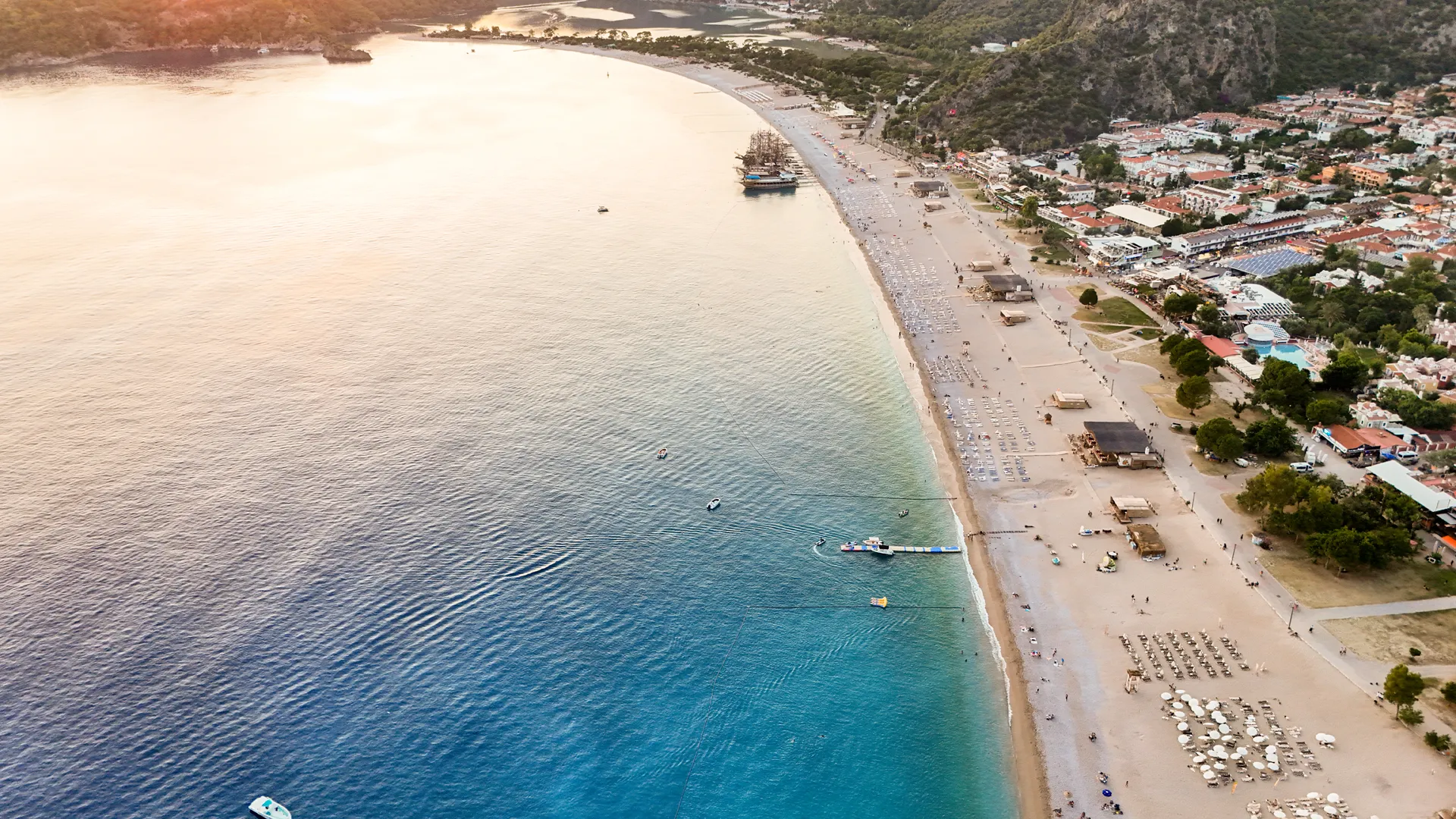
Ölüdeniz sits beneath Babadağ and is known for the contrast between the high mountain and sheltered coastal waters below.
Fethiye adds a working harbour, contemporary town life and nearby traces of Lycian heritage, including rock-cut tombs overlooking the bay.
For travellers interested in seeing the coastline from a completely different perspective, the Paragliding Experience in Ölüdeniz begins from Babadağ and provides an aerial view across the lagoon, mountains and surrounding coast.
The activity is optional.
The region remains worthwhile without it.
But for travellers comfortable with tandem paragliding, the geography makes the experience particularly relevant to place rather than simply an adventure activity that could occur anywhere.
Mediterranean Turkey Is Also a Food Region
The Mediterranean coast changes the culinary rhythm of a Turkey itinerary.
Seafood, citrus fruit, vegetables, olive oil, tahini and fresh produce become more prominent along the coast, while mountain communities bring dairy products, grains, herbs and meat into the regional kitchen.
Even within the Mediterranean, food changes considerably.
Antalya has its own local traditions.
Mersin and Adana introduce different ingredients and preparation methods.
Further east, Hatay reflects particularly deep connections between Anatolian, Levantine and Mediterranean food cultures.
Our Turkish Dishes by Region guide explains these regional differences in greater detail and helps place food within the same geographical framework used throughout this Turkey Travel Guide.

How Many Days Do You Need on the Mediterranean Coast?
A short Antalya stay can work in two or three days if the objective is to combine the city with selected nearby archaeological sites.
That is very different from exploring the wider Lycian coast.
A route connecting Antalya, Demre, Kekova, Kaş, Patara, Ölüdeniz and Fethiye requires substantially more time because the experience depends on moving progressively along the coastline rather than returning to the same base every night.
Five to seven days creates a much more coherent western Mediterranean route.
Longer stays allow archaeological visits to be balanced with walking, swimming, boat travel and slower time in coastal towns.
This is one region where adding days often improves the itinerary more than adding additional destinations.
Cappadocia to the Mediterranean Can Be Part of the Experience
The distance between Cappadocia and the Mediterranean is often treated as a logistical problem to solve with the fastest possible transfer.
It does not have to be.
An overland route can use Central Anatolia and the Taurus Mountains as meaningful parts of the journey.
Sites such as Çatalhöyük, Eşrefoğlu Mosque, Sagalassos and Termessos can divide the transition into distinct historical and geographical stages before the route reaches Antalya.
Our Cappadocia to Fethiye: Heritage & Turquoise Coast is designed around this principle, turning the movement from Central Anatolia toward Fethiye into a seven-day route through archaeology, mountain landscapes and the Mediterranean coast. (Adventus Travel Company)
For travellers who want the Lycian coastline itself to become the main focus, the Lycian Coast Tour from Cappadocia continues through Antalya, Kaş, Kekova, Patara, Ölüdeniz and Fethiye, combining ancient cities with coastal landscapes and time by the sea. (Adventus Travel Company)
These routes demonstrate an important principle that applies throughout Turkey:
A long transfer does not always need to be eliminated. Sometimes it should be redesigned into part of the trip.
When Should You Add the Mediterranean to a Turkey Itinerary?
The Mediterranean becomes particularly valuable when the itinerary has enough time for the pace to change.
After Istanbul, Cappadocia and intensive archaeological sightseeing, the coast provides a natural transition toward longer outdoor periods, smaller towns and more flexible days.
For travellers with approximately twelve days or more, a Mediterranean extension can work particularly well.
With less time, it is usually better to choose either the Aegean or Mediterranean rather than attempting to cover both comprehensively.
The right choice depends on interest.
Choose the Aegean and Ephesus when classical archaeology and the western historical route are the priority.
Choose the Mediterranean when archaeology should be combined more evenly with mountains, coastal landscapes, swimming, walking and smaller seaside communities.
Travellers with enough time do not need to choose.
A longer route can connect both, but the itinerary should allow each region to develop at its own pace.
The next section moves north to the Black Sea, where distance becomes less important than terrain, rainfall and elevation, and the rhythm of travel changes again.
Black Sea Turkey: Coast, Highlands and a Slower Travel Rhythm
The Black Sea follows a different travel logic from the rest of Turkey.
The coastline is narrow, the mountains rise quickly behind it, and settlement extends vertically from coastal towns toward forested valleys and highland plateaus. Rainfall is more consistent than in Central or Western Anatolia, while mountain roads frequently make short distances take longer than expected.
This is why the Black Sea should rarely be added casually to a first-time itinerary.
It works best as a dedicated regional route or as a deliberate extension with enough time for the landscape to unfold gradually.
For a complete overview of route planning, highlands, historic towns and regional structure, continue with our Black Sea Turkey Travel Guide.
Why the Black Sea Feels Different From the Rest of Turkey
The eastern Black Sea is shaped by the relationship between sea, mountains and rainfall.
Along the coast, towns developed around ports, fishing, trade and narrow strips of cultivable land.
Further inland, steep valleys lead toward forests, villages and summer highlands.
This vertical geography changes both travel and daily life.
A destination that appears close on the map may require a slow mountain ascent.
Weather can shift quickly.
Cloud and rain can obscure highland views even during otherwise suitable travel periods.
The region therefore rewards flexibility more than rigid scheduling.
Amasya Creates a Strong Inland Beginning
For travellers approaching the Black Sea from Central Anatolia or Cappadocia, Amasya provides one of the most natural transitions north.
The city developed along the Yeşilırmak River between steep mountain slopes, creating a compact historical landscape where Ottoman houses, mosques, bridges and ancient rock-cut tombs occupy different levels of the valley.
Its geography makes the city visually distinctive, but it also gives the route historical continuity.
Moving from the Central Anatolian plateau toward Amasya begins the gradual transition into the wetter and more mountainous northern landscape before reaching the coast.
Trabzon Is the Historical Anchor of the Eastern Black Sea
Trabzon provides the strongest urban base for exploring the eastern Black Sea.
Its position on long-distance trade routes between Anatolia, the Caucasus and the Black Sea gave the city importance across Byzantine, Trebizond and Ottoman periods.
The city itself preserves religious and civic monuments from different phases of that history, while the surrounding region opens toward monasteries, mountain valleys and the route east toward Rize.
For many travellers, Trabzon works best not as a final destination but as the historical centre from which the landscape begins to expand.

Sümela Monastery Connects Architecture With Extreme Terrain
Sümela Monastery is one of the clearest examples in Turkey of architecture adapting directly to difficult geography.
The monastery occupies a dramatic position within the Altındere Valley, where buildings developed against a steep rock face above a forested mountain landscape.
Its importance lies not only in the visual impact of the setting.
The monastery includes a rock-cut church, chapels and spaces required to support monastic life in an isolated environment, showing how religious communities organized daily life within demanding terrain.
A visit also helps explain a broader Black Sea pattern:
the landscape is not simply the background to historical monuments.
It frequently determines where and how those monuments could exist.

Rize Introduces the Agricultural Landscape of the Eastern Coast
East of Trabzon, the relationship between climate and agriculture becomes particularly visible around Rize.
Tea cultivation dominates many hillsides, producing a landscape that is both agricultural and cultural.
The steep terrain means fields often occupy slopes rather than broad plains.
Settlements, roads and agricultural plots therefore develop vertically across the landscape.
For visitors, this is an important reminder that the green appearance of the eastern Black Sea is not simply natural forest.
Much of the visible landscape also reflects generations of farming, grazing and settlement.

The Highlands Should Not Be Treated as Viewpoints
Places such as Ayder are often approached as scenic stops.
The broader highland tradition is more important than any single viewpoint.
For generations, seasonal movement between lower settlements and higher summer pastures formed part of the economic and social rhythm of the region.
Highland plateaus, known as yaylas, are therefore working cultural landscapes as well as places of natural beauty.
Modern tourism has changed some of the best-known locations significantly, but the relationship between elevation, grazing, summer settlement and mountain access remains essential to understanding the region.
The further travel moves toward the Kaçkar Mountains, the more important weather, road conditions and realistic driving times become.

Black Sea Food Reflects the Same Geography
Regional food makes the connection between climate and daily life particularly easy to see.
Anchovies, corn, black cabbage, dairy products and tea are closely associated with the Black Sea kitchen.
The significance is not simply that these ingredients are locally famous.
They reflect what could be produced reliably within a wet coastal environment backed by mountains.
Our Black Sea Turkey Cuisine guide explores this relationship between landscape, ingredients and regional dishes in greater detail.
Food is especially useful in this region because it helps connect the coast with the highlands.
Fish reflects the sea.
Tea reflects the humid eastern slopes.
Corn and greens reflect local agricultural adaptation.
Dairy traditions connect lower settlements with mountain grazing systems.

How Many Days Do You Need in the Black Sea?
A brief two- or three-day extension can introduce Trabzon and selected nearby sites, but it does not provide a complete sense of the region.
A more meaningful route generally requires several days because the experience depends on moving between coast, towns, valleys and highlands.
For travellers following the region from Central Anatolia, six days allows a much stronger progression through historical towns and the eastern Black Sea landscape without turning every day into a long transfer.
Our Black Sea Coast Turkey Tour follows this logic, connecting the Hittite heartland and Amasya with Giresun, Trabzon, Rize and the highlands as one continuous northern route rather than a collection of disconnected day trips.
When Should the Black Sea Be Added to a Turkey Trip?
The Black Sea works best for travellers who already understand that the region requires its own pace.
It is particularly suited to travellers interested in mountain landscapes, regional food, monasteries, rural settlements, photography and routes that move beyond Turkey’s most familiar first-time circuit.
It is less suitable as a last-minute addition to an itinerary already containing Istanbul, Cappadocia, Ephesus and the Mediterranean.
The question is not whether the Black Sea is worth visiting.
It is whether the itinerary contains enough time for the region to feel distinct.
When the answer is yes, northern Turkey provides one of the strongest contrasts available within the country.
Southeastern Turkey: Göbeklitepe, the Euphrates and Mesopotamian Cities
Southeastern Turkey opens another completely different historical and geographical layer.
The region sits at the northern edge of Mesopotamia, where the Euphrates and Tigris systems helped support settlement, agriculture, trade and cultural exchange across thousands of years.
Its importance cannot be reduced to one famous archaeological site.
Göbeklitepe represents an extraordinary early phase of communal building, but the wider region continues through Roman frontier cities, Islamic architecture, Syriac Christian traditions, Ottoman-era commercial centres, living pilgrimage sites and some of Turkey’s strongest regional food cultures.
For route planning across Şanlıurfa, Gaziantep, Mardin, Halfeti and Mount Nemrut, begin with our Southeastern Turkey Travel Guide.
Göbeklitepe Changes the Chronology of the Journey
Göbeklitepe belongs to the Pre-Pottery Neolithic period and includes monumental structures erected between approximately 9600 and 8200 BCE.
Its T-shaped limestone pillars, some decorated with reliefs of wild animals, were created by hunter-gatherer communities during one of the most important transitions in early human history. UNESCO describes the site as containing monumental communal buildings associated with social and ritual activity rather than simply defining it as a conventional “temple complex.”
That distinction matters.
Göbeklitepe should not be used as a dramatic slogan about a mysterious lost civilization.
Its significance is more interesting than that.
The site demonstrates that complex organization, coordinated labour and monumental construction existed among communities before fully developed urban societies emerged.
For travellers moving through Turkey chronologically, this places Southeastern Anatolia at the earliest end of a sequence that later includes the Hittites, classical cities, Byzantium and the Ottoman world.

Şanlıurfa Connects Archaeology With Living Tradition
Göbeklitepe is usually visited from Şanlıurfa, but the city deserves attention beyond its role as an archaeological base.
Balıklıgöl and the surrounding historic district reflect religious traditions associated with the Prophet Abraham, while bazaars, courtyards, mosques and food culture continue to shape everyday life in the old city.
This creates an important contrast with Göbeklitepe.
The archaeological site reveals prehistoric collective activity.
Şanlıurfa demonstrates how belief, pilgrimage and urban life continue to shape the region today.
Our Şanlıurfa Turkey Guide explores Göbeklitepe, Balıklıgöl and the city’s historical layers in greater detail.
Sıra Gecesi Adds a Living Cultural Layer
One of the most useful evening experiences in Şanlıurfa is Sıra Gecesi.
The tradition brings together music, conversation and regional food within a social setting rather than separating performance from hospitality.
For travellers, the value lies in seeing a cultural practice that belongs to the living city rather than adding another archaeological visit to the day.
The Sıra Gecesi Experience in Şanlıurfa can be included as part of a Southeastern route for travellers interested in the region’s music and social traditions.

Gaziantep Shows How Food and Trade Shape a City
Gaziantep introduces a very different regional character.
The city has long-standing commercial and craft traditions, but its culinary identity is particularly important.
Pistachios, baklava, kebabs, pepper, bulgur and a wide range of regional preparations form a food culture closely tied to agriculture, craftsmanship and historical trade.
The Zeugma Mosaic Museum adds another layer through mosaics recovered from the ancient city of Zeugma near the Euphrates.
This combination makes Gaziantep particularly valuable for travellers who want archaeology and food to carry equal weight within the itinerary.
Our Gaziantep Turkey Guide explores the city’s historical, culinary and practical travel context in greater detail.

Halfeti Changes the Relationship With the Euphrates
Halfeti introduces the river itself as part of the travel experience.
The modern landscape was transformed by the construction of the Birecik Dam, which partially submerged older settlements and changed the relationship between villages and the Euphrates.
A boat journey makes this transformation easier to understand.
The Halfeti Boat Tour passes through the river landscape toward partially submerged Savaşan and views of Rumkale, allowing archaeology, recent history and geography to be experienced together from the water.
This experience works particularly well between Gaziantep and Şanlıurfa because Halfeti becomes part of the route rather than requiring a separate return trip.

Mardin Is Best Understood as a Complete Urban Landscape
Mardin rises above the Mesopotamian Plain and is defined as much by its urban form as by individual monuments.
Stone houses, terraces, narrow streets, madrasahs, mosques, churches and courtyards respond directly to the slope and climate.
The city also reflects long-standing interaction between Muslim and Christian communities, Arabic, Kurdish, Turkish and Syriac cultural traditions, and trade routes connecting Anatolia with Mesopotamia and the Levant.
This is why Mardin should not be approached only as a series of architecture stops.
The city itself is the experience.
Our Mardin Turkey Travel Guide examines how architecture, belief and daily life remain connected within this hillside settlement.

Midyat and Mor Gabriel Extend the Syriac Heritage Story
East of Mardin, Midyat adds another important layer through its stone architecture and Syriac Christian heritage.
The surrounding region includes monasteries that continue to hold religious importance.
Mor Gabriel Monastery is particularly significant because it remains an active centre of Syriac Orthodox religious life.
Including this area prevents a Southeastern itinerary from becoming too narrowly focused on prehistoric archaeology or Islamic urban history.
The region’s strength lies precisely in the coexistence of several historical traditions within the same landscape.
Mount Nemrut Adds the Commagene Kingdom
Mount Nemrut introduces another completely different historical chapter.
At high elevation, the sanctuary associated with King Antiochus I of Commagene combines monumental statues and royal religious symbolism within a dramatic mountain setting.
The site is often associated with sunrise or sunset, but the archaeological context matters more than the time of day.
Commagene occupied a political and cultural position between larger Hellenistic and Persian traditions, and the sanctuary reflects this deliberate combination of influences.
Including Nemrut at the end of a longer Southeastern route provides a strong chronological contrast with Göbeklitepe.
One belongs to the earliest monumental traditions of the Neolithic.
The other represents a royal cult landscape created thousands of years later.

How Many Days Do You Need in Southeastern Turkey?
Three days can provide a concentrated route through Gaziantep, Halfeti, Şanlıurfa and Göbeklitepe.
Our Gaziantep to Göbeklitepe Tour is structured around this shorter corridor, combining Gaziantep’s culinary culture with the Euphrates landscape and the prehistoric context of Göbeklitepe.
A more complete Southeastern journey requires considerably more time.
Adding Mardin, Midyat and Mount Nemrut changes the trip from a short archaeological extension into a genuine regional itinerary.
The Southeastern Turkey Cultural Tour follows a six-day route through Gaziantep, Halfeti, Şanlıurfa, Göbeklitepe, Mardin, Midyat and Mount Nemrut, allowing the region’s archaeological, religious, culinary and architectural layers to develop in sequence.
Should Southeastern Turkey Be Part of a First Trip?
It can be, but only when the itinerary has enough time.
For most travellers with one week, Istanbul and Cappadocia remain the stronger introduction.
At nine or ten days, adding Ephesus may still produce a more coherent first-time route.
Southeastern Turkey becomes especially valuable for travellers with a strong interest in archaeology, early human history, food, religious traditions and regional architecture, or for those returning to Turkey after already experiencing the principal western and central routes.
It can also work extremely well as a dedicated journey.
That is often the better choice because the distances between Gaziantep, Şanlıurfa, Mardin and Mount Nemrut deserve to be treated as part of one regional sequence rather than as isolated flights and day trips.
Cappadocia Can Connect Naturally With the Southeast
Cappadocia provides a useful overland starting point for Southeastern Turkey.
The transition moves from Central Anatolia toward Gaziantep and the Euphrates, allowing the landscape and cultural context to change progressively rather than abruptly.
This is particularly effective for travellers who want to continue deeper into Anatolia after exploring Cappadocia rather than returning immediately to Istanbul.
The route is longer than a domestic flight connection, but when planned correctly the movement itself becomes part of the broader geographical story.
This is the same principle applied throughout this Turkey Travel Guide:
The strongest routes do not simply connect airports. They connect regions in ways that make the change between them understandable.
The next section will return to Central Anatolia beyond Cappadocia, connecting Konya, Mevlana, Çatalhöyük, the Hittite landscape, Gümüşler Monastery and the Aladağ Mountains before moving into Eastern Anatolia and the seasonal planning framework for the country as a whole.
Central Anatolia Beyond Cappadocia: Konya, Çatalhöyük and the Hittite Landscape
Cappadocia is the best-known destination in Central Anatolia, but it represents only one part of a much larger historical landscape.
Travelling beyond its valleys opens several completely different chapters of Anatolian history.
To the southwest, Konya connects Seljuk architecture with the Mevlevi tradition associated with Jalal al-Din Rumi.
Further across the Konya Plain, Çatalhöyük reaches back thousands of years earlier to one of the most important Neolithic settlements in the world.
North of Cappadocia, Hattuşa and Yazılıkaya introduce the political and religious centre of the Hittite Empire.
South toward Niğde, Gümüşler Monastery and the Aladağ Mountains show how quickly the volcanic plateau can give way to Christian rock-cut heritage and high mountain landscapes.
These places are particularly valuable for travellers who want to explore Central Anatolia in greater depth without treating Cappadocia as an isolated destination.

Konya Connects Seljuk Anatolia With the Mevlevi Tradition
Konya was one of the principal political and cultural centres of medieval Anatolia and became particularly important under the Seljuks of Rum.
Mosques, madrasahs and other surviving monuments still reveal that period, but the city is internationally associated above all with Mevlana Jalal al-Din Rumi and the Mevlevi tradition that developed after his death.
The Mevlana Museum occupies the former Mevlevi lodge centred on Rumi’s tomb. The complex includes spaces associated with Sema, religious life and the functioning of the dervish lodge, making it more than a memorial to a single historical figure. Turkey’s official museum records identify Rumi’s shrine as the core of the complex and document the later development of the Semahane, masjid, dervish cells and kitchen around it. (T.C. Kültür ve Turizm Bakanlığı)
This distinction matters for visitors.
Rumi should not be separated completely from the institutional and cultural world that developed around his teachings.
The museum provides the strongest starting point for understanding that context, while Seljuk monuments elsewhere in Konya help place the Mevlevi story within the wider medieval city.

Konya Is More Than a Stop Between Cappadocia and Pamukkale
Konya is often used as a practical overnight point on routes crossing Central Anatolia.
That undersells the city.
Travellers with an interest in Islamic architecture, Sufism, Seljuk history or Anatolian urban development can justify a dedicated visit rather than treating Konya as a transfer stop.
Our Konya Tour from Cappadocia connects Cappadocia with Konya through this broader cultural context, allowing the city to be understood through Mevlana and the architectural history surrounding him.
Konya also provides access to one of the most important archaeological sites in prehistoric Anatolia.
Çatalhöyük Reaches Back to the Neolithic
The Neolithic Site of Çatalhöyük stands on the Konya Plain and changes the chronological scale of a Turkey itinerary dramatically.
UNESCO dates the principal Neolithic occupation of the eastern mound to approximately 7400 to 6200 BCE, with later Chalcolithic occupation continuing on the western mound. Excavations have revealed tightly clustered houses entered from roof level, wall paintings, reliefs, burials and evidence of changing social practices within a long-lived settled community. (UNESCO World Heritage Centre)
Its importance lies partly in what it reveals about the transition toward sedentary agricultural life.
Visitors do not come to Çatalhöyük for monumental stone architecture comparable with Ephesus or Hattuşa.
The significance is almost the opposite.
The site demonstrates how communities organized domestic space, ritual, food production and social life during a period when permanent settlement itself was becoming increasingly important.
For travellers interested in archaeology, this makes Çatalhöyük one of the strongest contrasts available in Turkey.
Göbeklitepe reveals monumental communal construction among earlier hunter-gatherer communities.
Çatalhöyük reveals a dense settled community developing on the Central Anatolian plain.
Later Hittite, Greek, Roman, Byzantine and Ottoman sites then show very different forms of political and urban organization.
Taken together, these places allow a Turkey trip to cover an extraordinary span of human settlement without reducing prehistory to a single famous site.
Hattuşa Introduces the Hittite Empire
North of Cappadocia, Hattuşa opens another major chapter of Anatolian history.
The city served as the capital of the Hittite Empire, one of the major political powers of the second millennium BCE.
UNESCO highlights its urban organization, temples, royal residences, fortifications, monumental gates and the nearby rock sanctuary of Yazılıkaya as evidence of the political and religious world centred on the Hittite capital. (UNESCO World Heritage Centre)
The site works particularly well for travellers who have already spent time in classical or Ottoman environments.
Hattuşa is built on a different scale and according to a different political system.
Massive fortifications respond to the surrounding terrain.
The Lion Gate and King’s Gate mark controlled entrances through the defensive circuit.
Temple areas and royal spaces reveal an organized imperial centre rather than the remains of a later Greco-Roman city.
Understanding these differences prevents Turkey’s ancient history from becoming one continuous category of “ruins.”

Yazılıkaya Makes Hittite Religion More Visible
The sanctuary of Yazılıkaya, immediately associated with Hattuşa, provides one of the strongest surviving visual records of Hittite religious imagery.
Rock-cut chambers contain processions of deities carved into the natural stone, connecting religious belief directly with landscape.
UNESCO treats Yazılıkaya as an integral component of the Hattuşa World Heritage property and specifically identifies its sculpted rock ensemble as one of the site’s outstanding artistic achievements. (UNESCO World Heritage Centre)
Seeing Hattuşa and Yazılıkaya together is therefore essential.
The capital explains political organization.
The sanctuary introduces another part of the worldview that supported it.
Our Hittite Empire Tour from Cappadocia connects these sites within a dedicated Central Anatolian route for travellers who want to explore the Hittite period without relocating from Cappadocia.
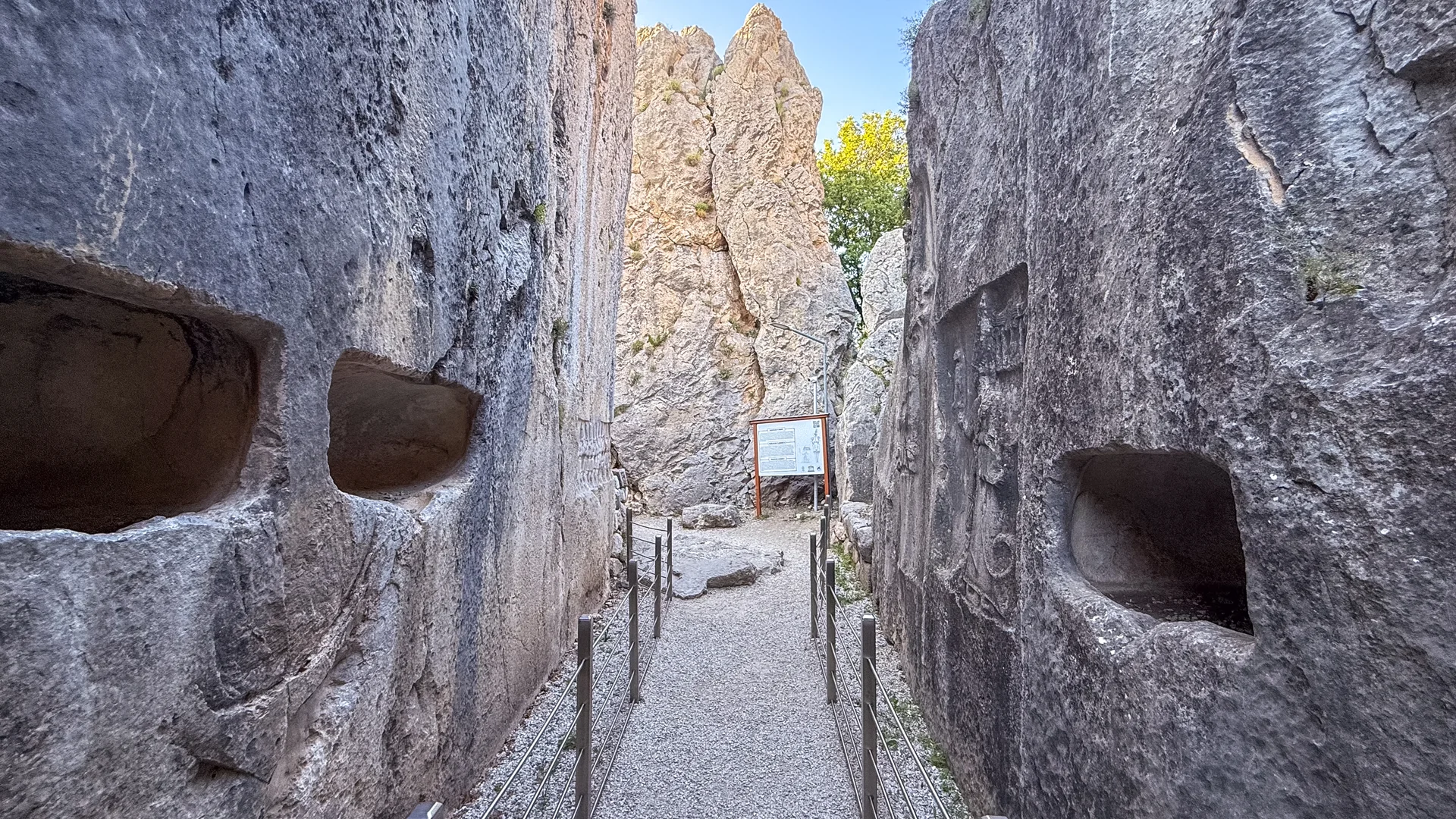
Gümüşler Monastery Extends Cappadocia’s Rock-Cut Heritage
Southwest of Cappadocia, near Niğde, Gümüşler Monastery provides another important example of rock-cut Christian architecture.
Its relationship with Cappadocia is immediately recognizable, but the experience is different from Göreme Open Air Museum.
Rather than a broad valley containing numerous churches, Gümüşler is organized as a more concentrated monastic complex excavated into a substantial rock mass.
The church, courtyard, monastic rooms and surviving wall paintings demonstrate that the tradition of adapting volcanic and soft rock for religious architecture extended beyond the central Cappadocian valleys.
Our Gümüşler Monastery Guide explores the site’s architecture and paintings in greater depth.
For travellers who want to visit it from Cappadocia, the Gümüşler Monastery Tour Cappadocia combines the monastery with the changing landscapes south of the main visitor region.
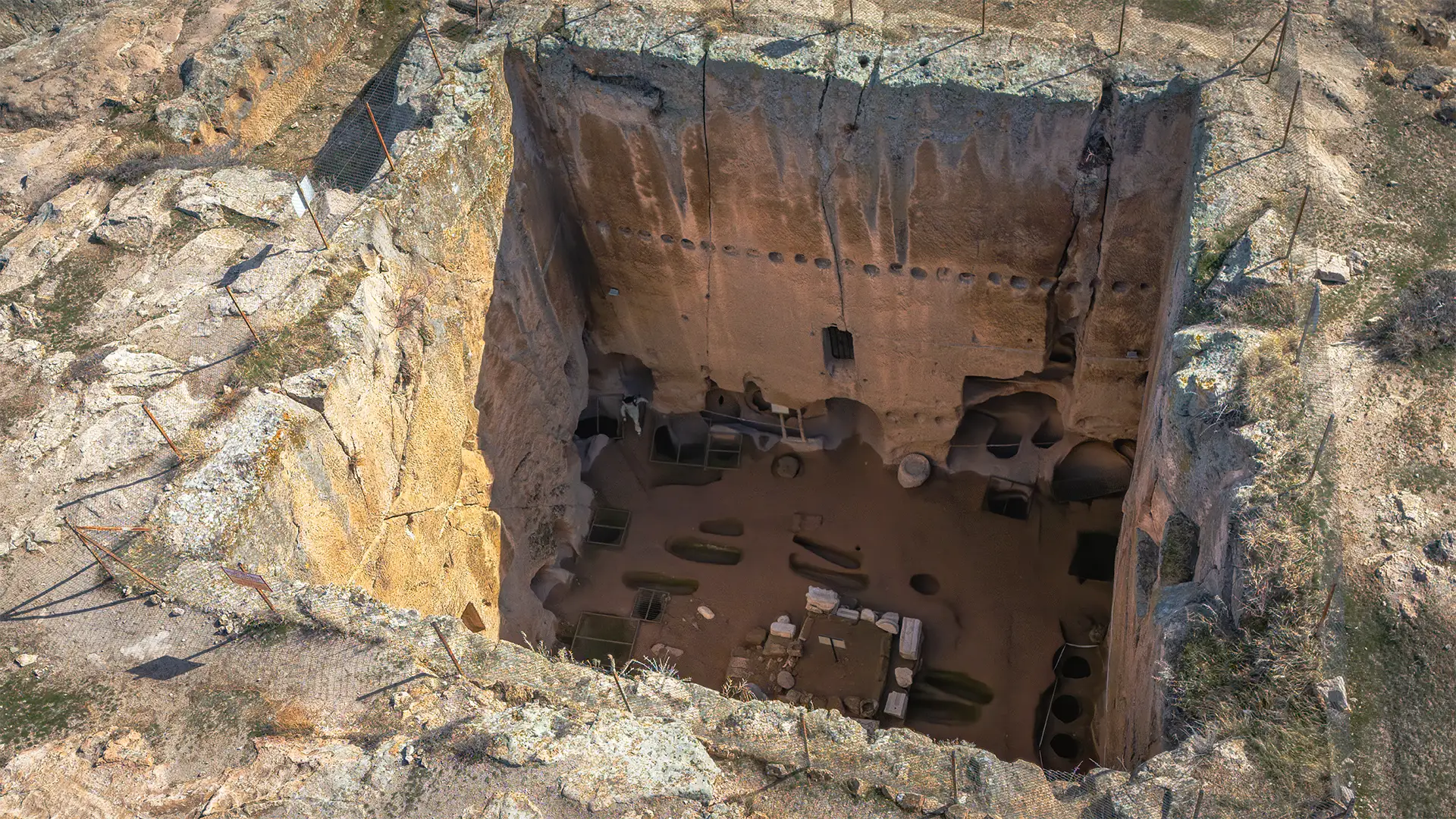
The Aladağ Mountains Reveal Another Side of Central Anatolia
Central Anatolia should not be imagined only as open plateau.
South of Cappadocia, the landscape rises dramatically toward the Aladağlar, part of the Taurus mountain system.
This transition can be surprisingly abrupt.
The volcanic valleys and agricultural plateau around Cappadocia give way to high peaks, mountain villages, narrow valleys and very different vegetation.
For travellers whose interests extend beyond archaeology and cultural heritage, this provides one of the strongest natural contrasts available from a Cappadocia base.
Our Cappadocia Nature Tour: Aladağlar is designed around this change in geography, moving beyond the familiar volcanic landscape toward the mountain environment to the south.
The experience is particularly valuable for travellers spending several days in Cappadocia who want one day to feel completely different from the valley and museum circuit.
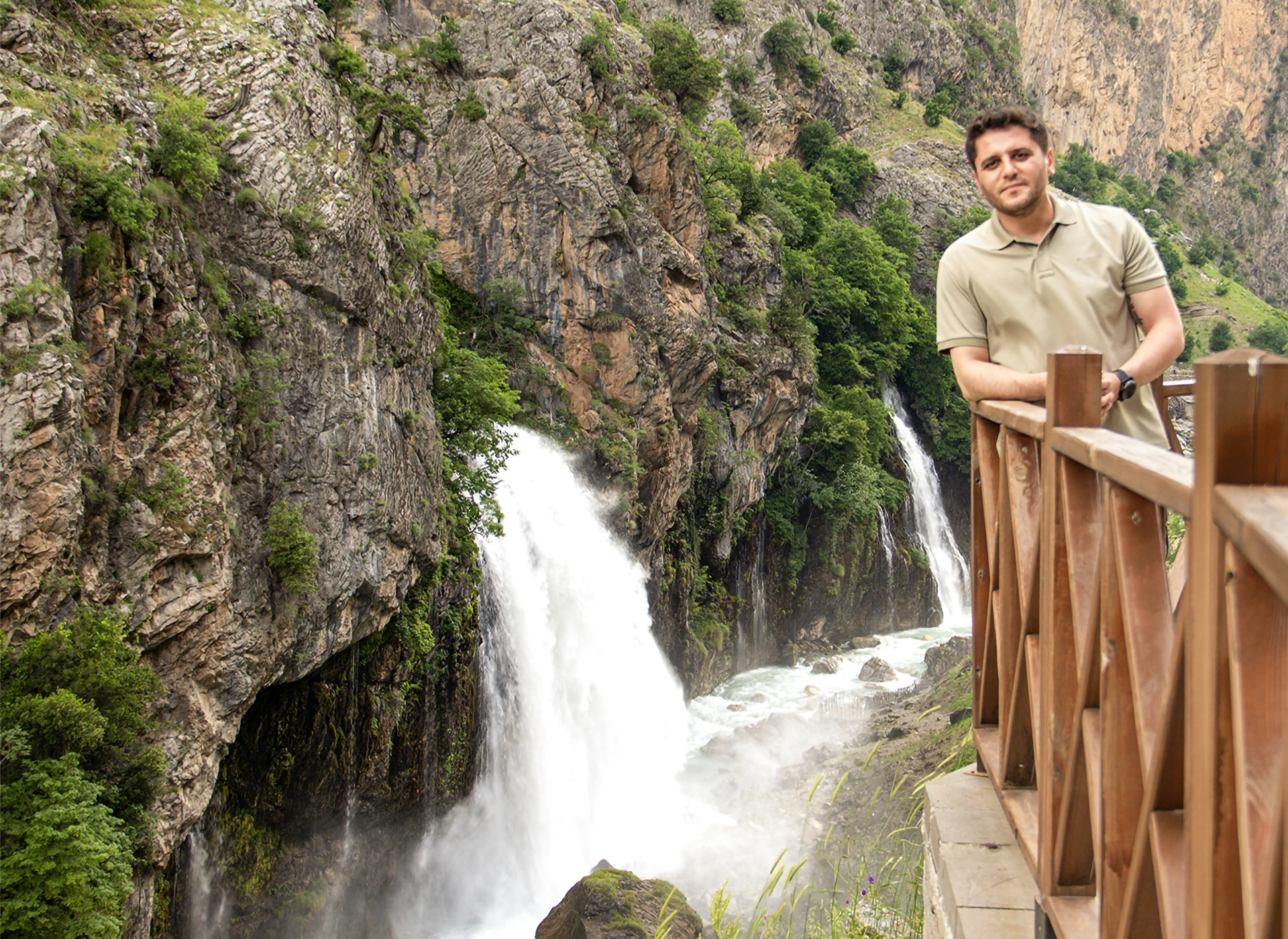
Central Anatolia Works Best When History Is Treated Chronologically
One of the advantages of travelling through Central Anatolia is the extraordinary chronological range concentrated within the wider region.
Çatalhöyük belongs to the Neolithic.
Hattuşa represents the imperial world of the Hittites.
Konya introduces medieval Seljuk Anatolia and the Mevlevi tradition.
Cappadocia preserves Byzantine rock-cut heritage alongside much older geology and later village life.
Gümüşler adds another expression of Christian monastic architecture.
These sites are not interchangeable.
That is precisely why they work together.
A traveller interested in history can move through several completely different systems of settlement, belief and political organization without leaving Central Anatolia.
Should You Add These Sites to a First Turkey Trip?
Not all of them.
For a short first visit, Istanbul and Cappadocia should remain the priority.
Adding Konya can make sense when continuing west toward Pamukkale and Ephesus because it lies naturally within an inland route.
Çatalhöyük becomes particularly relevant for travellers with a strong interest in prehistory.
Hattuşa and Yazılıkaya deserve a dedicated day and are best included when Hittite history is a genuine interest rather than simply another box to tick.
Gümüşler and the Aladağ Mountains work particularly well during longer Cappadocia stays because they add depth without requiring a complete regional relocation.
The principle is the same one used throughout this guide:
Add a site because it changes the story of the trip, not simply because it can be reached.
Eastern Anatolia: High Landscapes, Medieval Cities and Longer Distances
Eastern Anatolia requires a different level of commitment.
Elevation increases significantly, distances between major destinations become longer, winters are more severe and the principal historical sites are distributed across a much larger geographical area.
This is not usually the most practical extension for a short first trip to Turkey.
For travellers with sufficient time, however, Eastern Anatolia offers a combination of high-altitude landscapes, medieval architecture, Armenian heritage, Silk Road history, volcanic geography and regional cultures that differ markedly from the country’s western tourism corridors.
The region is best approached as a dedicated route rather than as a collection of isolated side trips.
Kars Provides Access to Ani and the Northeast
Kars is one of the strongest bases for beginning an exploration of northeastern Turkey.
Its urban architecture reflects several different historical periods, while the surrounding high plateau immediately establishes the geographical character of the region.
The principal reason many travellers come is the Archaeological Site of Ani, approximately 40 kilometres east of the city.
Ani occupies a plateau beside the Arpaçay ravine on the present-day border with Armenia.
UNESCO describes it as a medieval city where residential, religious and military architecture developed under successive Christian and Muslim dynasties. It flourished particularly in the tenth and eleventh centuries as the capital of the Bagratid Armenian kingdom and benefited from its position on a branch of the Silk Roads. (UNESCO World Heritage Centre)
Ani Is More Than a Collection of Churches
The surviving monuments at Ani include churches, defensive walls, palatial structures, religious buildings and remnants of infrastructure associated with a substantial medieval city.
This diversity is important.
Ani should not be understood exclusively through Armenian ecclesiastical architecture, although that heritage is central to the site.
Its later Byzantine, Seljuk and Georgian phases also reveal how political control and architectural traditions changed while Ani remained connected with long-distance trade. UNESCO specifically identifies this succession of cultural influences as part of the site’s exceptional value. (UNESCO World Heritage Centre)
The setting adds another layer.
Deep ravines protect several sides of the plateau, demonstrating why the location was strategically valuable while also making the ruined city feel unusually isolated today.
For travellers interested in medieval history, Ani can justify the trip to northeastern Turkey on its own.
Lake Van Introduces a Completely Different Eastern Landscape
Further south, Lake Van creates another geographical centre within Eastern Anatolia.
The lake occupies a vast high-altitude basin surrounded by volcanic and mountainous terrain.
Travel around it is very different from both Cappadocia and the Black Sea.
Distances are broader, settlement is more dispersed and the scale of the landscape dominates the route.
Van provides the main urban base and access to one of the region’s most important medieval monuments.
Akdamar Church Connects Armenian Heritage With Lake Van
The Church of the Holy Cross stands on Akdamar Island in Lake Van.
The church was constructed between 915 and 921 CE under King Gagik I Artsruni of the Armenian kingdom of Vaspurakan. Its exterior is particularly notable for extensive carved reliefs, while its island setting makes the relationship between architecture and landscape impossible to separate. (UNESCO World Heritage Centre)
A visit requires travelling by boat from the southern shore of Lake Van.
That movement is part of the experience.
Unlike monuments reached through dense cities or archaeological parks, Akdamar appears gradually within the open lake landscape.
The site adds another important cultural layer to an Eastern Anatolia itinerary and complements Ani by revealing a different centre of medieval Armenian political and religious life.
Mount Ararat Defines the Geography of the Far East
Mount Ararat rises to 5,137 metres, making it the highest mountain in Turkey.
Its physical dominance over the surrounding landscape has given it significance far beyond mountaineering.
The mountain is associated with biblical traditions concerning Noah’s Ark and remains an important geographical and cultural symbol across the region.
For most travellers, Ararat is experienced visually from the surrounding landscape rather than through an ascent.
Climbing requires appropriate preparation, current permits and specialist mountain planning, and should not be treated as an ordinary extension of a cultural sightseeing itinerary.
Its value within this Turkey Travel Guide is primarily geographical.
Ararat demonstrates how dramatically the country changes as travel moves toward its eastern highlands.
Eastern Turkey Requires More Careful Seasonal Planning
Seasonality matters everywhere in Turkey, but it becomes particularly important in the east.
High elevation produces colder winters, extended snow cover and a shorter period of comfortable overland travel than in Istanbul, the Aegean or Mediterranean.
Road conditions and mountain access can change substantially according to weather.
This does not mean Eastern Anatolia is inaccessible outside summer.
Cities remain inhabited year-round, and winter can create exceptional landscapes.
But a multi-stop cultural route involving Kars, Ani, Van and remote sites requires more contingency planning in colder months.
For most first-time visitors to the region, late spring through early autumn provides the simplest operational window.
Eastern Anatolia Is Better as a Dedicated Trip
Trying to add Kars, Ani or Van to an already full Istanbul-Cappadocia-Ephesus itinerary usually produces more travel than value.
Flights make individual destinations technically accessible, but accessibility is not the same as regional coherence.
A stronger route allows several eastern destinations to connect with one another.
Kars and Ani naturally form one pair.
Van and Akdamar create another.
Additional time can then introduce further archaeological, architectural and natural sites according to interest.
This approach allows Eastern Anatolia to develop its own identity instead of functioning as a remote final stop attached to a western itinerary.
Who Should Prioritise Eastern Anatolia?
Eastern Turkey is particularly rewarding for travellers interested in medieval architecture, Armenian heritage, Silk Road history, high-altitude landscapes, photography and regions where tourism remains less concentrated.
It also suits returning visitors who have already experienced Istanbul, Cappadocia and the principal western routes and want to understand how dramatically Turkey changes beyond them.
For a first trip of one or two weeks, other regions usually create a more coherent introduction.
For a longer or repeat trip, Eastern Anatolia can become the central purpose rather than an extension.
This distinction is important because the strongest Turkey itinerary is not always the one that reaches furthest across the map.
It is the one that gives each region enough time to become understandable.
From Regions to Timing: When Should You Visit Turkey?
Once the route has been chosen, season becomes the next major planning decision.
Turkey does not have one national travel season.
Istanbul, Cappadocia, the Mediterranean, Black Sea, Southeast and Eastern Anatolia respond differently to the same month because altitude, rainfall, latitude and proximity to the sea vary considerably.
A summer trip that works extremely well in the Black Sea highlands may produce intense midday heat in Southeastern Anatolia.
Winter can restrict some mountain routes while creating one of the most distinctive ways to experience Cappadocia.
Spring may provide excellent archaeological conditions in Ephesus while higher mountain areas remain comparatively cool or unsettled.
The next section therefore approaches the best time to visit Turkey by region and travel style, rather than attempting to identify one month that is supposedly ideal for the entire country.
Best Time to Visit Turkey: Choose by Region, Not by Month
There is no single best month to visit Turkey.
The country stretches across several climate systems, and the conditions that work well for one region may be less suitable for another. Istanbul can be visited comfortably through much of the year. Cappadocia has a continental climate with cold winters and warm summers. The Mediterranean and Aegean coasts have long, dry summers, while the Black Sea remains wetter and Eastern Anatolia experiences much more severe winter conditions.
For a multi-region trip, the most useful question is therefore not:
“What is the best month to visit Turkey?”
It is:
“Which season allows the regions on my route to work well together?”
For many first-time itineraries combining Istanbul, Cappadocia and western or southern Turkey, spring and autumn provide the broadest balance between temperature, daylight and comfortable sightseeing conditions.
Summer works particularly well for the coasts and highlands but requires more careful heat planning in archaeological sites and Southeastern Turkey.
Winter reduces visitor density in many destinations and can produce exceptional landscapes, but it changes how outdoor and mountain routes need to be planned.
Visiting Turkey in Spring
Spring is one of the most versatile periods for travelling across several regions.
Temperatures gradually become more comfortable for long archaeological visits, walking and overland travel, while the intense heat of midsummer has not yet developed across much of the country.
Istanbul works particularly well during this period because walking between neighbourhoods and monuments remains comfortable.
Cappadocia’s valleys become easier to explore on foot as winter conditions recede, although weather can still change quickly and balloon flights always remain dependent on daily aviation conditions.
Ephesus, Pamukkale and the Mediterranean archaeological sites are also particularly suitable for spring travel because large exposed sites can be explored before the hottest part of the year.
The Black Sea begins to open gradually toward higher elevations, although the mountain and yayla season develops later than the coastal season.
Eastern Anatolia requires greater care because snow and colder conditions may persist much longer at altitude.
Spring is therefore strongest when the route concentrates on:
Istanbul + Cappadocia + Ephesus/Aegean + Mediterranean
rather than relying heavily on high mountain access.
Visiting Turkey in Summer
Summer creates the greatest contrast between regions.
On the Mediterranean and Aegean coasts, the season supports swimming, boat travel and long evenings by the sea. The same conditions can make exposed archaeological sites extremely hot during the middle of the day.
A summer itinerary should therefore use time more carefully.
Major ruins are often better visited earlier in the morning or later in the afternoon.
Midday can be reserved for lunch, museums, shaded areas, swimming or transfers where appropriate.
Cappadocia remains fully accessible, but longer valley walks are more comfortable when scheduled outside the hottest hours.
The Black Sea and its highlands become particularly attractive during summer because higher elevations are more accessible and the region offers a cooler contrast with southern Turkey.
Eastern Anatolia also enters its most practical overland period as mountain roads and high-altitude landscapes become easier to explore.
Southeastern Turkey requires the most caution.
Cities such as Gaziantep and Şanlıurfa can become extremely hot, making extended outdoor archaeological visits less comfortable during the middle of the day.
For travellers tied to summer holidays, the solution is not necessarily to avoid these regions.
It is to design each day around the climate.
Visiting Turkey in Autumn
Autumn provides many of the same advantages as spring.
Temperatures begin to moderate across the Aegean, Mediterranean and Southeast, while Istanbul and Cappadocia remain highly suitable for sightseeing.
The sea can also remain warm enough for coastal travel well beyond the peak summer period, allowing archaeology and beach time to coexist more comfortably.
Cappadocia is particularly well suited to autumn walking because the balance between daytime temperatures and outdoor activity is often favourable.
Ephesus and other exposed archaeological sites also become easier to explore as summer heat decreases.
The Black Sea remains possible, but conditions at higher elevations become increasingly dependent on local weather as the season progresses.
Eastern Anatolia has a shorter transition into winter, meaning autumn routes should be timed more carefully there than in western Turkey.
For travellers who want to combine several regions within the same itinerary, autumn is one of the most flexible periods available.
Visiting Turkey in Winter
Winter changes the country rather than simply closing it.
Istanbul remains an active year-round city, and museums, palaces, mosques, markets and neighbourhoods can still be explored normally, although colder and wetter days should be expected.
Cappadocia becomes one of the most distinctive winter destinations in Turkey.
Snow can transform the valleys and fairy chimneys, while lower visitor numbers create a very different atmosphere from spring and summer.
The trade-off is greater weather variability.
Walking conditions may include snow, ice or mud, and hot air balloon flights remain dependent on suitable weather.
The Mediterranean coast is much milder than Central or Eastern Anatolia and can still work well for cultural travel, archaeological sites and city stays, although it is no longer a conventional beach season.
The Aegean remains accessible but quieter.
The Black Sea and Eastern Anatolia require the greatest flexibility because mountain weather, snow and road conditions can have a stronger impact on movement.
Winter therefore works particularly well for travellers who prioritise:
cities, museums, archaeology, food, cultural experiences and winter landscapes
rather than long coastal swimming days or high mountain routes.
When Is the Best Time for Istanbul?
Istanbul can be visited throughout the year.
Spring and autumn generally provide the most balanced conditions for walking through the Historic Peninsula, exploring neighbourhoods and spending time along the Bosphorus.
Summer brings longer days but also larger visitor numbers and warmer conditions.
Winter can be colder, wetter and occasionally snowy, but the city remains fully active.
For most travellers, season matters less in Istanbul than the amount of time allowed.
A well-paced three-day stay in winter is usually more rewarding than an overloaded one-day itinerary in perfect weather.
When Is the Best Time for Cappadocia?
Cappadocia changes considerably between seasons.
Spring and autumn are particularly suitable for hiking and outdoor sightseeing.
Summer provides long daylight hours but requires earlier or later starts for extended valley walks.
Winter can produce exceptional snow-covered landscapes but requires greater flexibility around walking conditions and balloon operations.
There is no season when Cappadocia stops being worthwhile.
The experience simply changes.
Travellers planning primarily around a hot air balloon flight should also avoid choosing dates on the assumption that a particular month guarantees flight conditions.
Balloon operations depend on daily weather and aviation decisions throughout the year.
When Is the Best Time for Ephesus and the Aegean?
Spring and autumn are particularly comfortable for archaeological sightseeing.
Ephesus is an exposed site, and several hours may be spent walking between monuments with limited shade.
Summer remains completely viable, but early starts become more important.
For travellers combining Ephesus with coastal time, summer provides the strongest beach conditions, while late spring and early autumn create a more balanced archaeology-and-coast itinerary.
Winter brings lower visitor density but shorter days and more variable weather.
When Is the Best Time for Mediterranean Turkey?
The answer depends on the purpose of the trip.
For swimming and conventional coastal holidays, summer provides the warmest conditions.
For archaeology, hiking and overland travel, spring and autumn are often more comfortable.
The Lycian coast is particularly rewarding outside the peak summer heat when walking, ancient sites and coastal towns can be combined more easily within the same day.
Winter remains surprisingly useful for cultural travel around Antalya and other lower coastal areas because temperatures are considerably milder than in Central or Eastern Anatolia.
When Is the Best Time for the Black Sea?
Summer provides the most reliable period for reaching highland plateaus and mountain areas.
This does not mean rain disappears.
Rainfall remains part of the region’s climate and should be expected even during favourable travel periods.
Lower coastal areas can be visited across a broader season, but higher routes become more dependent on weather as spring begins and autumn advances.
Travellers visiting the Black Sea should therefore build a little flexibility into highland days instead of assuming every mountain view will be available at a fixed hour.
When Is the Best Time for Southeastern Turkey?
Spring and autumn provide the most comfortable conditions for exploring the region’s archaeological sites and historic cities.
Summer can become very hot, particularly during the middle of the day.
A summer route remains possible but should use early starts, longer lunch breaks and indoor museums more strategically.
Winter is generally milder than Eastern Anatolia, although cold periods and rain remain possible.
For travellers interested in Göbeklitepe, Mardin, Gaziantep and Şanlıurfa, temperature should be considered alongside the amount of outdoor walking planned each day.
When Is the Best Time for Eastern Anatolia?
Late spring through early autumn provides the simplest conditions for a broad overland route.
High altitude means winter arrives earlier and lasts longer than in most of western Turkey.
Cities remain accessible outside this period, but remote archaeological sites, mountain roads and multi-stop itineraries require more contingency planning.
Eastern Anatolia is therefore the region where choosing the right season has the greatest impact on route flexibility.
How Many Days Do You Need in Turkey?
There is no useful answer based on the size of the country alone.
The number of days required depends on how many regions are being combined.
A traveller spending seven days entirely in Istanbul has a completely different trip from someone attempting to divide seven days between Istanbul, Cappadocia, Ephesus and Antalya.
The second itinerary technically reaches more places.
It does not necessarily experience more of Turkey.
For first-time travellers, the most useful planning rule is:
Add days before adding regions.
A region should have enough time to establish its own character before the itinerary moves elsewhere.
Is 5 Days Enough for Turkey?
Five days is enough for one strong regional experience.
Istanbul alone can easily justify five days when the Historic Peninsula, Bosphorus, neighbourhoods, museums and food are all included.
Cappadocia can also support a focused multi-day trip, particularly for travellers interested in hiking, archaeology, crafts, food and regional experiences beyond ballooning.
It is possible to combine Istanbul and Cappadocia within five days, but the result is much more compressed.
Flights, airport transfers and hotel changes begin consuming a significant proportion of the available time.
For a first visit, five days is therefore strongest when the itinerary accepts a limited geographical scope.
Is 7 Days Enough for Turkey?
Yes.
Seven days provides enough time for a coherent first trip when the route is controlled.
The strongest combination is usually:
Istanbul + Cappadocia
This provides urban history, Ottoman and Byzantine heritage, volcanic landscapes, rock-cut architecture and cultural experiences without introducing a third major regional transfer.
A seven-day itinerary can include another destination, but doing so usually requires sacrificing time inside Istanbul or Cappadocia.
For most travellers, the stronger decision is to experience two regions properly.
What Can You See in 9 to 10 Days?
Nine or ten days creates significantly more flexibility.
A first-time route can now include:
Istanbul + Cappadocia + Ephesus/Pamukkale
without every destination becoming a transit stop.
This structure works particularly well because each region introduces something different.
Istanbul provides imperial and contemporary urban context.
Cappadocia introduces Central Anatolian landscape and rock-cut heritage.
Pamukkale and Hierapolis add another combination of geology and ancient settlement.
Ephesus provides the strongest classical urban experience within the route.
Our Best of Turkey Tour is structured around this broader first-time progression, connecting the regions as one itinerary rather than as separate bookings.
What Can You Do With 12 to 14 Days?
At approximately two weeks, the itinerary begins to have real choices.
One option is to extend the classic route toward the Mediterranean.
Another is to spend more time within Istanbul, Cappadocia and the Aegean rather than introducing another region.
A possible structure could include:
Istanbul → Cappadocia → Konya → Pamukkale → Ephesus
with additional time for Şirince, coastal stops or slower regional experiences.
Alternatively:
Istanbul → Cappadocia → Mediterranean coast
creates a completely different journey focused more heavily on archaeology, mountains and sea.
The important point is that twelve or fourteen days should not automatically be used to add every major region.
The extra time can improve depth just as effectively as geographical range.
What Can You Do With Two Weeks or More?
Trips beyond two weeks allow Turkey to be approached as a series of connected regional landscapes rather than a highlights route. The Mediterranean can be explored progressively instead of through one Antalya stop. The Black Sea can become a dedicated northern section.
Southeastern Turkey can develop through Gaziantep, Halfeti, Şanlıurfa, Göbeklitepe, Mardin and Mount Nemrut rather than through a single flight to one archaeological site.
For travellers who want to combine this southeastern depth with Turkey’s two strongest introductory regions, the 15-Day Turkey Tour • Istanbul, Cappadocia & Mesopotamia connects Istanbul and four nights in Cappadocia with Gaziantep, Halfeti, Şanlıurfa, Göbeklitepe, Mardin and Mount Nemrut. The route is designed as one continuous journey, allowing the landscape and cultural context to change gradually from imperial Istanbul and Central Anatolia toward the upper Mesopotamian world.
Longer journeys also make slower experiences easier to include.Markets, Workshops, Longer hikes, Wine tastings, Cooking experiences, Boat journeys, Free evenings, Secondary archaeological sites.
These are usually the first elements removed from an over-compressed itinerary, even though they often become some of the strongest memories of the trip.
How Many Regions Should You Combine?
As a general planning framework:
5 days: one region, or a very compressed two-region trip.
7 days: two regions.
9 to 10 days: two regions comfortably, or three with good transport connections.
12 to 14 days: three regions comfortably, with the possibility of a fourth when the route is particularly efficient.
Two weeks or more: regional depth becomes more important than counting destinations.
These are not fixed rules.
Flight schedules, travel style and personal interests can change the structure.
But they provide a useful defence against one of the most common mistakes in Turkey planning:
mistaking geographical coverage for travel quality.
How Should First-Time Travellers Structure Turkey?
For most first-time visitors, the strongest route begins with the country’s most accessible contrasts.
7 Days: Istanbul and Cappadocia
A seven-day trip can divide time between Istanbul and Cappadocia without introducing a third major region.
Istanbul establishes Byzantine and Ottoman history, the Bosphorus and the structure of the modern city.
Cappadocia then changes the environment completely through valleys, underground cities, rock-cut churches and rural Central Anatolia.
The Istanbul to Cappadocia Private Tour follows this combination for travellers who want the two regions coordinated as one route.
9 to 10 Days: Istanbul, Cappadocia and the Western Route
With additional days, the itinerary can extend west toward Pamukkale and Ephesus.
This creates one of the strongest first-time sequences available in Turkey because the route moves through four very different historical and geographical environments without introducing a completely separate peripheral region.
The Best of Turkey Tour is the clearest Adventus example of this structure.
12 Days or More: Add the Mediterranean or Increase Regional Depth
From around twelve days, the route can begin moving south toward Antalya and the Lycian coast.
The decision should depend on travel style.
Travellers primarily interested in archaeology may prefer additional time around Ephesus, Pamukkale and Central Anatolia.
Those who want archaeology combined with mountains, coastal landscapes and outdoor experiences can extend toward the Mediterranean.
Neither route is inherently more complete.
They simply produce different versions of Turkey.
When Should the Black Sea or Southeast Replace the Classic Route?
The Black Sea and Southeastern Turkey do not need to wait for a second visit.
They can become the centre of a first trip when the traveller’s interests clearly point there.
A traveller interested primarily in highlands, mountain landscapes and regional food may find the Black Sea more rewarding than Ephesus.
Someone focused on prehistory, Göbeklitepe, Mesopotamian architecture and food may prioritise Southeastern Turkey over the Mediterranean.
The concept of a “first-time itinerary” should therefore remain a framework rather than a rule.
The correct route begins with interest.
Then geography determines whether that interest can be translated into a coherent trip.
Avoid the Most Common Turkey Itinerary Mistake
The most common planning error is not choosing the wrong destination.
It is adding one destination too many.
Every additional region creates: airport transfers, check-in and check-out time, luggage handling, transport coordination, orientation in a new place, and another transition day.
These costs are rarely visible when the itinerary is first drafted.
They become visible only during the trip.
This is why an itinerary containing fewer regions can ultimately provide more experiences.
A third day in Cappadocia can become a valley hike, pottery workshop or cooking experience.
An additional day in Istanbul can become the Bosphorus and neighbourhood exploration.
Another day on the Mediterranean can become a boat journey, archaeological site or simply enough time to enjoy the coast without checking the clock.
Good planning therefore requires knowing when to stop adding.
The next section turns from how long to stay to how to move between regions, including domestic flights, road travel, airports, private transfers and when an overland journey can become part of the experience rather than simply time between destinations.
How to Travel Between Regions in Turkey
Transportation in Turkey works best when different modes are used for different parts of the trip.
Domestic flights are useful for large geographical jumps.
Private or rental vehicles are often more practical within regions.
Public transportation works particularly well inside major cities.
Walking becomes essential in historic centres, archaeological sites and landscapes where the route itself forms part of the experience.
The mistake is assuming that one transport method should solve the entire itinerary.
A well-designed trip changes transportation according to geography.
When Domestic Flights Make Sense
Turkey has an extensive domestic aviation network connecting Istanbul with major regional gateways across the country.
Flights are particularly useful when the itinerary needs to cross large distances without sacrificing an entire day to overland travel.
Typical examples include:
Istanbul → Cappadocia
Istanbul → İzmir for Ephesus and the Aegean
Istanbul → Antalya for the Mediterranean
Istanbul → Trabzon for the eastern Black Sea
Istanbul → Gaziantep or Şanlıurfa for Southeastern Turkey
These connections allow travellers to establish a regional base quickly and then continue locally by road.
Cappadocia is served primarily through Kayseri and Nevşehir airports, while Ephesus is usually approached through İzmir. Antalya has its own major international and domestic airport, and the principal cities of Southeastern and Black Sea routes are similarly connected by air.
The practical value of flying decreases when the next destination already lies naturally along an overland corridor.
A short flight can look efficient when only airborne time is considered.
Once airport transfers, check-in, security, baggage collection and the journey back from the arrival airport are included, road travel can sometimes produce a smoother day.
When Driving Is Better Than Flying
Road travel becomes particularly valuable when important places lie between the starting point and destination.
This occurs repeatedly in Turkey.
Between Cappadocia and Konya, the journey itself can form part of a Central Anatolian route.
Continuing toward Pamukkale and Ephesus creates a logical inland-to-western progression.
Between Cappadocia and Antalya, archaeological and geographical stops can transform what would otherwise be considered a long transfer into several days of meaningful travel.
Along the Mediterranean coast, driving is usually essential because ancient cities, beaches, mountain landscapes and smaller towns are distributed between Antalya, Kaş and Fethiye.
The Black Sea follows the same principle for a different reason.
Here, driving allows coastal towns, valleys and highlands to connect progressively rather than requiring repeated returns to airports.
The question is therefore not simply:
“Is there a flight?”
It is:
“Would flying remove an important part of the route?”
Turkey Works Particularly Well for Linear Routes
One of the most effective ways to reduce unnecessary travel is to avoid returning to the same city after every region.
A linear itinerary moves progressively through the country.
For example:
Istanbul → Cappadocia → Konya → Pamukkale → Ephesus
or:
Cappadocia → Central Anatolia → Antalya → Kaş → Fethiye
This approach reduces backtracking and allows the landscape to change gradually.
It also creates a stronger sense of geographical continuity.
The transition from plateau to coast, or from imperial city to rural Central Anatolia, becomes part of the travel experience rather than simply time between hotels.
Long Drives Should Be Evaluated by What Happens Along the Way
Not every long overland day is poor itinerary design.
A six-hour journey containing only motorway and hotel transfers may provide little value.
A similar amount of travel divided by an archaeological site, village, mountain pass or meaningful lunch stop can function completely differently.
The objective should not be to eliminate all driving.
It should be to distinguish between: necessary movement and empty movement.
This distinction is particularly important in a country as geographically varied as Turkey.
Some of the strongest routes are successful precisely because the traveller sees the country change between destinations.
Trains Can Work for Selected Routes
Rail travel exists across Turkey, including high-speed services connecting several major cities.
It can be useful when the railway corresponds naturally with the itinerary, particularly between large urban centres.
But trains do not provide a complete solution for most multi-region cultural routes.
Cappadocia’s archaeological sites and valleys are distributed away from railway stations.
The Mediterranean coast requires road access between many destinations.
Ephesus still requires local transportation from the regional rail and airport network.
Highlands and archaeological landscapes in the Black Sea and Southeast similarly depend heavily on road movement.
Rail should therefore be considered one useful transport option, not the backbone of every Turkey itinerary.
Intercity Buses Are Extensive
Turkey also has a large intercity bus network linking cities and towns across the country.
For independent travellers with flexible time, buses can provide economical access to destinations that do not require a flight.
The trade-off is journey duration.
Long-distance overnight or daytime buses can consume a significant part of a short itinerary, especially when the route includes several regions.
They are most useful when budget and flexibility matter more than preserving sightseeing time.
For a tightly structured one- or two-week trip, combining domestic flights with regional road transport is usually more efficient.
Transportation Inside Istanbul Requires a Different Strategy
Istanbul is the major exception to the regional road-travel logic.
Traffic can make relatively short car journeys unpredictable, particularly during commuting periods.
Trams, metros, ferries, Marmaray and other public transportation links often provide a more practical way to move between major parts of the city.
Our Istanbul Public Transportation Guide explains the network in more detail, including how different forms of transport connect the Historic Peninsula, Bosphorus and wider city.
Taxis remain useful for specific journeys, luggage, late arrivals and routes poorly served by public transport.
For practical advice on taxi use, see our guide to Taxis in Istanbul and the BiTaksi App.

Airport Days Need More Time Than the Flight Duration
A common itinerary mistake is to treat a one-hour domestic flight as a one-hour transfer.
The real sequence includes: hotel departure, airport transfer, arrival before departure, check-in and security, the flight, baggage collection, and transport from the destination airport to the next hotel.
A short flight may therefore occupy much of a morning or afternoon.
This does not make domestic aviation inefficient.
It simply means flight days should be planned realistically.
Whenever possible, avoid placing a major archaeological site or tightly timed activity immediately after a regional flight.
Allow the travel day to absorb normal variations without damaging the rest of the itinerary.
Private Transfers Become More Valuable on Complex Routes
Private transportation becomes particularly useful when the route contains: multiple archaeological sites, remote landscapes, luggage between changing hotels, limited public transport, or stops that need to be coordinated within the same day.
The advantage is not simply having a vehicle.
It is being able to control sequence and timing.
A private vehicle can leave when the itinerary requires, stop where the route becomes meaningful and continue directly to the next accommodation without returning to a bus station or airport.
This flexibility is one reason Private Turkey Tours become particularly useful on multi-region routes.
The value increases as the itinerary becomes more geographically complex.
Practical Travel Essentials Before Visiting Turkey
Once the route and transportation structure are clear, several practical questions should be resolved before departure.
Visa and entry rules.
Currency.
Tipping.
Clothing.
Communication.
Mobile connectivity.
Cultural etiquette.
None of these topics needs to dominate the planning process, but resolving them in advance removes unnecessary friction after arrival.
Check Visa and Entry Requirements Before Booking
Entry requirements for Turkey vary according to nationality, passport type, length of stay and purpose of travel.
Some travellers can enter without a visa.
Others may be eligible for an electronic visa.
Different nationalities may need to complete a conventional visa process in advance.
Because these regulations can change, general travel advice should never replace current official information.
Our Visa and Entry Requirements for Turkey guide explains the main process and directs travellers toward the relevant official Turkish government resources for final verification.
Check requirements before purchasing non-refundable travel arrangements, particularly if the itinerary includes a passport renewal or multi-country travel.
Currency and Paying in Turkey
Turkey’s national currency is the Turkish lira.
Credit and debit cards are widely used in cities, hotels, established restaurants and many tourism businesses, but carrying some local currency remains useful.
Cash may still be preferred for: small purchases, local markets, tips, some taxis, small restaurants, and businesses in less urban areas.
Travellers should avoid relying exclusively on either cash or cards.
A combination provides more flexibility.
Our Currency and Tipping in Turkey guide explains cash use, card payments, currency exchange and common tipping practices in greater detail.
Tipping Depends on the Service
Tipping in Turkey exists, but it does not follow one fixed percentage across every situation.
Restaurants, hotel staff, drivers and licensed guides may all involve different expectations.
The most useful approach is to understand the type and quality of service rather than treating every transaction identically.
This is another reason to review tipping practices before arrival rather than deciding after each service without context.
The dedicated Currency and Tipping in Turkey guide provides more detailed guidance for common travel situations.
What Should You Wear in Turkey?
There is no national tourist dress code.
What to wear depends primarily on:
season – region – activity and setting.
A summer afternoon in Fethiye requires different clothing from a winter morning in Cappadocia.
Walking through Ephesus demands different footwear from spending time on a Mediterranean beach.
Active mosques require greater attention to modest clothing than ordinary sightseeing streets.
Our What to Wear in Turkey guide provides a seasonal and regional packing framework covering Istanbul, Cappadocia, archaeological sites, the Mediterranean and Southeastern Turkey.
For most multi-region trips, versatile layers are more useful than packing for one climate.
Comfortable walking shoes are particularly important.
Many of Turkey’s major cultural sites involve marble, stone, slopes, stairs or uneven archaeological surfaces.
Religious Sites Require Context-Specific Clothing
Mosques remain active places of worship.
Visitors should therefore distinguish them from archaeological monuments or museums.
Clothing should be respectful of the religious setting, and shoes are removed before entering prayer areas.
Requirements can vary slightly according to the site and the area open to visitors.
Carrying clothing that can be adapted easily during the day is usually more convenient than returning to the hotel before every religious visit.
This becomes particularly useful in Istanbul, where a sightseeing day can move rapidly between palaces, mosques, museums and markets.
English Is Widely Used in Major Travel Destinations
Travellers can usually manage easily with English in Turkey’s principal tourism areas.
Hotels, guides, restaurants and major visitor services in places such as Istanbul, Cappadocia, Antalya and Ephesus regularly work with international travellers.
English becomes less predictable in small towns, markets, rural areas and local businesses.
This rarely creates a serious barrier.
Simple Turkish words, gestures and translation tools usually cover most everyday situations.
More importantly, making even a small effort to use the local language can change the tone of an interaction.
Our Essential Turkish Phrases for Travelers guide covers greetings, polite expressions, ordering and common everyday situations.
Useful words do not need to be complicated.
Merhaba for hello.
Lütfen for please.
Teşekkür ederim for thank you.
A few expressions are usually more valuable than attempting to memorize an extensive phrasebook.
Turkish Hospitality Is Often Expressed Through Small Gestures
Social interaction is an important part of travelling in Turkey.
Tea may be offered in a shop.
A conversation may continue longer than expected.
A host may insist on offering food.
A local business owner may spend considerable time explaining an object even before a purchase is discussed.
These situations should not automatically be interpreted as sales techniques or obligations.
Hospitality often operates through small gestures of attention.
At the same time, travellers are not expected to accept every offer.
A polite refusal is perfectly normal.
Our guide to Turkish Hospitality, Greetings and Etiquette explains these social conventions in greater detail.
Understanding them can be particularly useful in markets, workshops, village visits and private homes where interactions are less transactional than those found in conventional sightseeing environments.
Mobile Connectivity Makes Independent Travel Easier
Mobile data is useful for:
navigation, translation, restaurant searches, flight updates, transport apps, messaging hotels or guides, and accessing reservations.
Travellers can use international roaming, a local SIM or an eSIM depending on their provider and trip length.
The most important point is to decide before arrival how the phone will remain connected.
Waiting until navigation is needed outside an airport is unnecessarily inconvenient.
Our Essential Tips for Traveling to Turkey guide covers mobile connectivity alongside electricity, drinking water and other everyday practical considerations.
Electricity and Charging
Turkey uses a 220V, 50Hz electrical system and predominantly Type C and Type F plugs.
Travellers arriving from countries with different plug systems should bring an appropriate adapter.
A power bank is also useful on long sightseeing days, particularly when phones are being used continuously for photography, navigation and digital tickets.
This is a small detail, but practical preparation often has the greatest value when it prevents routine problems rather than solving major ones.
Water, Sun and Walking Conditions Matter More Than Many Visitors Expect
Turkey’s major sightseeing routes can involve considerably more outdoor time than a city-break itinerary initially suggests.
Ephesus is exposed.
Cappadocia involves valleys and uneven volcanic terrain.
Mediterranean archaeological sites can become hot.
The Grand Bazaar and Istanbul Old City involve long periods on foot.
Southeastern cities can require extended outdoor walking between monuments and historic neighbourhoods.
Carrying water, sun protection and suitable footwear becomes particularly important from late spring through early autumn.
The correct preparation changes by season, but the principle remains consistent:
plan for the physical environment, not only the photographs of the destination.
Food in Turkey: Expect Regional Differences
Turkish food should not be understood as one national restaurant menu repeated across the country.
Regional ingredients, agriculture, climate and historical connections change what people cook and how they eat.
A meal in Gaziantep can feel completely different from one in the Black Sea.
Cappadocia has its own Central Anatolian traditions.
The Aegean relies heavily on vegetables, herbs and olive oil.
The Mediterranean changes again through coastal produce and southern culinary influences.
This regional variation is one of the reasons food deserves to be treated as part of the route rather than as something added between sightseeing stops.
Our Top 10 Turkish Dishes guide provides an accessible introduction to dishes travellers are likely to encounter across the country.
Istanbul Offers the Broadest Culinary Cross-Section
Istanbul brings together food traditions from across Turkey.
Regional restaurants, historic trades, seafood, street food, bakeries and contemporary dining all coexist within the city.
This makes Istanbul useful as an introduction, but it should not create the impression that every dish belongs equally to every region.
Food becomes more interesting later in the itinerary when ingredients begin to correspond directly with geography.
Cappadocia Connects Food With Agriculture and Craft
Cappadocia’s cuisine reflects Central Anatolian agriculture and household cooking.
Local meals can include grains, legumes, dairy products, fruit and slow-cooked dishes adapted to seasonal availability.
Testi kebabı is the most visible regional dish for visitors, but it also creates a connection with Avanos pottery because the preparation uses a clay vessel.
A Cooking Class in Cappadocia allows travellers to participate directly in food preparation rather than experiencing the regional kitchen only through restaurant service.
Weekly markets add another perspective by showing what households actually buy and what is available seasonally.
The Black Sea Kitchen Follows a Different Agricultural System
Corn, black cabbage, anchovies, dairy products and tea appear repeatedly within Black Sea food culture.
These ingredients are not random regional signatures.
They reflect a humid coastal environment, mountain agriculture and access to the sea.
Our Black Sea Turkey Cuisine guide explains this relationship in greater depth.
Southeastern Turkey Is One of the Country’s Strongest Food Destinations
Gaziantep is particularly important for travellers interested in food.
Pistachios, baklava, kebabs, peppers and numerous local preparations form part of a culinary tradition whose identity extends well beyond one famous dish.
Şanlıurfa, Mardin and surrounding cities add their own specialities.
A Southeastern itinerary can therefore be built partly around archaeology and partly around food without the two themes competing.
They belong to the same regional story.
Markets Help Reveal Everyday Food Culture
Restaurants show one side of regional cuisine.
Markets reveal another.
Seasonal fruit and vegetables, cheeses, olives, grains, spices and household ingredients explain how people eat beyond restaurant menus.
Markets are particularly useful for travellers interested in local life because they remain working commercial environments rather than curated food attractions.
The principle is the same whether visiting a weekly market in Cappadocia or a historic bazaar in Southeastern Turkey:
observe how the place actually functions before treating it as a sightseeing experience.
Practical Knowledge Should Support the Trip, Not Overwhelm It
A traveller does not need to memorize every custom, transport rule or local phrase before arriving in Turkey.
The objective of preparation is simpler.
Know the entry requirements.
Understand how you will pay.
Pack for the regions and activities on your route.
Learn a few useful words.
Keep realistic expectations about transportation.
Then allow the country itself to provide the rest of the context.
For a broader collection of day-to-day practical advice, continue with our Essential Tips for Traveling to Turkey.
The next section will move from practical planning to private travel structure, explaining when a private route genuinely improves a Turkey itinerary, how Adventus approaches tailor-made travel and how the site’s commercial tour architecture fits naturally into the different regional routes.
Private Turkey Tours: When a Private Route Makes Sense
Private travel in Turkey is not necessary for every itinerary.
Major cities can be explored independently, domestic flights are easy to book, and many of the country’s best-known monuments can be visited without a guide.
The value of a private route increases when the trip becomes more complex.
Several regions need to connect.
Archaeological sites sit outside city centres.
Long transfer days contain worthwhile stops.
Travellers have specific interests.
Walking pace, mobility, photography or food experiences affect the schedule.
In these situations, private travel is less about adding formality and more about controlling time, sequence and context.
Our Private Turkey Tours are built around this principle.
The itinerary should adapt to the traveller while still respecting the geographical logic of the country.

What Does Private Travel Change?
A private itinerary changes the structure of the day.
Departure times can respond to the sites being visited rather than to a group schedule.
More time can be reserved for archaeology, architecture, photography, food or walking according to interest.
A museum can be shortened when it is less relevant.
A valley walk can be extended when conditions are good.
A transfer day can include a meaningful archaeological or cultural stop rather than functioning only as transportation between hotels.
The advantage is not that every day becomes completely spontaneous.
Good private travel still requires structure.
The difference is that the structure can be adjusted around the people travelling rather than requiring every traveller to fit the same timetable.
Licensed Guiding Adds Context Where It Matters Most
Turkey contains archaeological and historical sites whose significance is difficult to understand from visual observation alone.
A column does not explain the building it belonged to.
A palace courtyard does not automatically reveal who was permitted to enter it.
A rock-cut church cannot be understood only through surviving frescoes.
An underground city becomes far more meaningful when ventilation, defence, storage and movement are explained together.
Licensed guides are particularly valuable in places such as:
Istanbul’s Historic Peninsula, Ephesus, Cappadocia, Hattuşa, Göbeklitepe, Southeastern Turkey, and major archaeological sites along the Mediterranean coast.
The guide should not simply repeat dates.
The real value is connecting architecture, landscape, political history and everyday life so that the destination becomes easier to read.
Private Transportation Is Most Useful Outside Major Cities
In Istanbul, public transportation can often outperform road travel.
Outside major urban centres, the situation changes.
Cappadocia’s valleys and archaeological sites are spread across a wide region.
The Mediterranean coast requires movement between ancient cities, small towns and bays.
Black Sea routes connect coastal roads with mountain valleys.
Southeastern itineraries frequently move between cities, archaeological sites and rural landscapes.
Private transportation allows these places to be sequenced according to the route rather than according to public transport timetables.
It is particularly useful when accommodation changes during the journey because luggage can remain with the vehicle while intermediate sites are visited.
Private Travel Should Not Mean More Stops
Flexibility can easily become another form of over-planning.
A private vehicle makes it technically possible to visit more places.
That does not mean more places should be added.
The strongest private itineraries often use flexibility to create more time, not more stops.
A long lunch can remain long.
A valley walk does not need to end because a group bus is waiting.
A museum can receive another thirty minutes when the traveller is genuinely engaged.
A viewpoint can be skipped when the weather is poor.
The purpose of private travel is not to maximize the number of attractions completed in a day.
It is to make the day respond more intelligently to the traveller.
Who Benefits Most From a Private Turkey Tour?
Private travel is particularly useful for:
travellers combining several regions,
families,
small groups,
travellers with specific archaeological or cultural interests,
photographers,
travellers who prefer a slower pace,
guests with mobility considerations,
and travellers whose arrival or departure schedule does not fit standard group departures.
It is also valuable for repeat visitors.
A first trip often follows well-known regional routes.
A second or third visit may involve smaller archaeological sites, mountain regions, specialist museums, longer hikes or towns that are difficult to connect efficiently through fixed programmes.
Private planning becomes more valuable as the itinerary becomes more individual.
When Independent Travel May Be the Better Choice
A private tour is not automatically the best solution.
Travellers spending several days entirely in Istanbul may prefer to explore neighbourhoods independently and use licensed guides only for specific historical days.
A traveller staying in one Mediterranean beach town may not need continuous private transportation.
Independent travellers with generous time may enjoy using trains, buses and local transport as part of the experience.
The objective is not to make every Turkey trip private.
It is to use private structure where it genuinely improves access, interpretation, pacing or continuity.
Suggested Turkey Itineraries: Choose a Route Before Choosing a Tour
Turkey offers too many possible combinations for one itinerary to represent every traveller.
The most effective way to choose a tour is therefore to begin with the route.
Do you want a focused Istanbul and Cappadocia trip?
A classic first journey across western and central Turkey?
A dedicated Cappadocia stay?
An archaeology-heavy Aegean route?
A Mediterranean journey?
The Black Sea?
Southeastern Anatolia?
Once that decision is clear, the individual itinerary becomes much easier to evaluate.
The following Adventus routes are organized according to the same regional logic used throughout this Turkey Travel Guide.
Istanbul: A Focused Introduction to the Imperial City
Travellers spending limited time in Istanbul should avoid treating the city as a collection of rapid monument visits.
Our Istanbul Sightseeing Tour is structured around the Historic Peninsula and the city’s principal Byzantine and Ottoman monuments, including the context needed to understand how they relate to one another.
It works particularly well at the beginning of a longer Turkey itinerary because Istanbul establishes historical themes that reappear later across Anatolia.
The city can then be connected directly with Cappadocia rather than adding another short stop between them.
Istanbul and Cappadocia: The Strongest Short First Trip
For travellers with approximately one week, the combination of Istanbul and Cappadocia creates one of the strongest introductions to Turkey.
The two regions are dramatically different.
Istanbul is dense, urban and shaped by imperial history.
Cappadocia is dispersed across valleys, villages and a volcanic plateau.
Regular domestic flights make the transition manageable without consuming several days in overland travel.
The Istanbul to Cappadocia Private Tour is designed around this contrast, connecting the two regions within a coherent five-day private itinerary.
This route is particularly suitable for travellers who want meaningful historical and geographical variety but do not have enough time for a broader cross-country journey.
Best of Turkey: The Classic Multi-Region First Journey
Travellers with more time can expand beyond Istanbul and Cappadocia without abandoning route continuity.
The Best of Turkey Tour connects Istanbul, Cappadocia, Konya, Pamukkale and Ephesus through a continuous first-time route.
Each region contributes a different historical and geographical layer.
Istanbul establishes Byzantine and Ottoman context.
Cappadocia introduces volcanic landscape and rock-cut heritage.
Konya connects the route with Seljuk Anatolia and the Mevlevi tradition.
Pamukkale combines geology with Hierapolis.
Ephesus completes the route through one of the best-preserved classical urban landscapes in the country.
This structure works because the destinations do not simply repeat one another.
Each changes the story.
Cappadocia Tours: Choose According to Time and Interest
Cappadocia can support anything from one concentrated sightseeing day to a five-day regional stay.
The correct choice depends less on how many attractions a tour contains and more on how deeply the traveller wants to experience the region.
Highlights of Cappadocia Tour
The Highlights of Cappadocia Tour is designed for travellers who need a strong introduction within one full day.
It focuses on major landscapes and heritage sites while maintaining enough context to explain why Cappadocia developed differently from other regions of Turkey.
This is the most appropriate option when time is limited and a broad first overview is the priority.
Green Tour Cappadocia
The Green Tour Cappadocia follows a southern regional direction and introduces a different landscape from the central Göreme circuit.
Underground heritage and southern valleys become more prominent, making it particularly useful for travellers who have already explored the principal central sites.
Blue Tour Cappadocia
The Blue Tour Cappadocia moves toward another side of the region and places greater emphasis on settlements, churches, valleys and cultural landscapes away from the most familiar northern route.
It works best as a complementary day rather than as another version of the same sightseeing circuit.
3 Days Cappadocia Tour
For most first-time visitors, three days provides one of the strongest balances between coverage and pace.
The 3 Days Cappadocia Tour allows major landscapes, rock-cut heritage and underground architecture to be combined without forcing every day into a rapid sequence of stops.
It also creates enough room for at least one participatory or slower experience.
5 Days Cappadocia Tour
Travellers who want hiking, workshops, food, wine, secondary archaeological sites and more relaxed regional exploration benefit from additional time.
The 5 Days Cappadocia Tour allows Cappadocia to function as a complete destination rather than as a short extension from Istanbul.
This is particularly suitable for travellers who prefer depth over geographical coverage.
Cappadocia Hiking Tour
For active travellers who want walking to become the main structure of their time in the region, the Cappadocia Hiking Tour • Valleys & Local Experiences offers a more specialized five-day itinerary.
Longer hikes through Ihlara Valley and Avla Canyon are combined with Red, Swords and Görkündere valleys, while Kaymaklı Underground City, Göreme Open Air Museum, Soğanlı Valley, Paşabağ and Zelve keep the route connected to Cappadocia’s archaeological and cultural landscape.
This option works particularly well for travellers who want a more active Cappadocia experience without turning the trip into a technical trekking expedition.
Day Trips and Extensions From Cappadocia
Cappadocia also works as a base for exploring parts of Central Anatolia that would otherwise require separate accommodation.
Konya Tour From Cappadocia
The Konya Tour from Cappadocia connects the volcanic landscape of Cappadocia with Seljuk architecture and the Mevlevi heritage of Konya.
It is particularly relevant for travellers interested in Rumi, Sufism and medieval Anatolia.
Hittite Empire Tour From Cappadocia
The Hittite Empire Tour from Cappadocia travels north toward Hattuşa and Yazılıkaya.
This is one of the strongest archaeological extensions available from Cappadocia because it introduces an entirely different civilization rather than another version of Cappadocian heritage.
Gümüşler Monastery Tour Cappadocia
The Gümüşler Monastery Tour Cappadocia extends the story of rock-cut Christian architecture toward Niğde.
It works particularly well for travellers who have already visited Göreme Open Air Museum and want to understand how this architectural tradition developed beyond the central valleys.
Cappadocia Nature Tour: Aladağlar
The Cappadocia Nature Tour: Aladağlar changes the landscape completely.
Instead of volcanic valleys and rock-cut heritage, the route moves toward the high mountain environment of the Aladağlar.
It is best suited to travellers spending enough time in Cappadocia to include one day focused primarily on nature.
Ephesus and Pamukkale Tours: Building the Western Route
Western Turkey works particularly well when Ephesus and Pamukkale are treated as part of the same broader itinerary.
Ephesus to Pamukkale: Aegean Heritage and Local Life
The Ephesus to Pamukkale Tour connects the archaeological landscape of Ephesus with Şirince, local Aegean life and the inland route toward Pamukkale and Hierapolis.
This is a stronger experience than visiting Ephesus as a rapid day trip because it provides enough time for the surrounding region to develop its own character.
Istanbul, Ephesus and Pamukkale Tour
The Istanbul, Ephesus & Pamukkale Tour is useful for travellers whose priorities lie more heavily toward imperial Istanbul and classical western Turkey than toward Cappadocia.
It combines three major historical landscapes without requiring the itinerary to cross the entire country.
Mediterranean and Lycian Routes: When the Coast Becomes the Journey
Southern Turkey works best when the itinerary moves progressively rather than repeatedly returning to one base.
Antalya Signature Tour • Ancient Cities & Turquoise Coast
The Antalya Signature Tour • Ancient Cities & Turquoise Coast is designed for travellers who want to explore the Antalya region in depth without extending the route as far as Kaş or Fethiye.
Over five days, the itinerary connects Antalya and Kaleiçi with Selge and Köprülü Canyon, Perge and Aspendos, two nights in Çıralı, Olympos Ancient City, a private Mediterranean boat experience, and Tahtalı Mountain. It is the stronger option when ancient cities, Taurus landscapes and coastal time should remain balanced within one focused Antalya itinerary.
Cappadocia to Fethiye: Heritage and Turquoise Coast
The Cappadocia to Fethiye: Heritage & Turquoise Coast turns the transition from Central Anatolia to the Mediterranean into part of the itinerary.
Rather than flying over the geography between the regions, the route moves through archaeological and mountain landscapes before reaching the coast. It is particularly suitable for travellers who enjoy understanding how one region changes into another.
Lycian Coast Tour From Cappadocia
The Lycian Coast Tour from Cappadocia continues more deeply into southern Turkey through Antalya, Kaş and Fethiye.
Ancient Lycian and Roman sites, mountain landscapes, coastal towns and turquoise bays become parts of the same route. This is the stronger option when the Mediterranean itself is intended to become a major part of the trip rather than simply a final beach stay.
Black Sea Route: A Dedicated Northern Journey
The Black Sea is best treated as a complete regional experience.
The Black Sea Coast Turkey Tour approaches the region progressively from Central Anatolia.
The route moves through the Hittite landscape and Amasya before continuing toward Giresun, Trabzon, Rize and the eastern highlands.
This sequencing matters.
The Black Sea does not appear suddenly as a coastal extension.
The traveller experiences the gradual transition from the Anatolian interior toward a wetter, steeper and more mountainous landscape.
For travellers interested in nature, regional food, highlands and routes outside Turkey’s most familiar first-time circuit, this can become the central purpose of the trip.
Southeastern Turkey Tours: Archaeology, Food and Cultural Continuity
Southeastern Turkey works particularly well when archaeology and living culture are given equal importance.
Gaziantep to Göbeklitepe Tour
The Gaziantep to Göbeklitepe Tour provides a shorter introduction to the region.
Gaziantep’s food culture and Zeugma mosaics connect with Halfeti, Şanlıurfa and Göbeklitepe within one regional corridor.
This is particularly suitable for travellers who want to add Southeastern Turkey without extending as far as Mardin and Mount Nemrut.
Southeastern Turkey Cultural Tour
The Southeastern Turkey Cultural Tour develops the region more fully.
Gaziantep, Halfeti, Şanlıurfa, Göbeklitepe, Mardin, Midyat and Mount Nemrut create a route spanning prehistory, ancient kingdoms, Islamic architecture, Syriac Christian heritage and living food traditions.
The strength of this itinerary lies in the contrast between its destinations.
Göbeklitepe and Mardin do not repeat one another.
Gaziantep and Mount Nemrut do not serve the same purpose.
The region becomes meaningful precisely because the story keeps changing.
How to Choose the Right Turkey Tour
The right tour should follow your interests before it follows a fixed duration.
Choose Istanbul and Cappadocia when you want the strongest contrast within a shorter trip.
Choose Best of Turkey when you want a first journey across several major historical and geographical regions.
Choose Cappadocia-focused itineraries when landscape, hiking, rock-cut heritage and local experiences deserve more time.
Choose Ephesus and Pamukkale when classical archaeology and western Turkey are central interests.
Choose the Mediterranean when ancient cities should be balanced with mountains, sea and coastal travel.
Choose the Black Sea when landscape, highlands and slower regional routes are the priority.
Choose Southeastern Turkey when archaeology, food, belief and long cultural continuity form the main purpose of the trip.
There is no single Adventus itinerary that represents the “complete Turkey.”
The country is too geographically and culturally varied for that claim to be useful.
A stronger approach is to choose the part of Turkey that fits the traveller, then build the route so each region receives enough time to become more than a stop.
Tailor-Made Travel: When Existing Routes Are Only the Starting Point
Published itineraries provide useful route frameworks, but they do not need to remain fixed.
A traveller may want an additional hiking day in Cappadocia.
Another may want less time in Istanbul and more archaeological depth at Ephesus.
Food may become a central theme in Southeastern Turkey.
Photography may require later starts or longer stops.
A coastal route may need additional nights in Kaş.
Mobility considerations may require shorter walking days and different hotel choices.
This is where tailor-made planning becomes most useful.
The route can be adjusted while preserving the geographical logic that makes it work.
What should not change is the basic principle:
Customization should improve the itinerary, not make it geographically incoherent.
Adding a destination simply because it is possible is not always customization.
Sometimes the most important tailored decision is deciding what to leave out.
The next section will bring the entire planning framework together through route examples by travel length, followed by the final Turkey Travel Guide FAQ and the page’s closing navigation toward regional guides, tours and experiences.
Suggested Turkey Itineraries by Travel Length
The number of days available should determine the geographical scope of a Turkey itinerary.
This sounds obvious, but it is one of the most common places where planning goes wrong.
Turkey rewards regional contrast, yet every additional region creates another transfer, another hotel change and another period of orientation. The objective is therefore not to fit the maximum number of destinations into the available time.
It is to build a route where each new region contributes something genuinely different.
The following structures are not fixed programmes. They are practical frameworks for understanding what can be combined comfortably at different trip lengths.
5 Days in Turkey: Choose One Region or Accept a Fast Two-Region Trip
Five days is enough for a meaningful trip to Turkey when the geographical scope remains controlled.
For most first-time travellers, Istanbul alone can easily justify the entire period.
A five-day Istanbul stay allows time for the Historic Peninsula, Topkapı Palace, the Bosphorus, neighbourhoods beyond Sultanahmet, markets and slower meals without turning every day into continuous sightseeing.
Another strong option is Cappadocia alone.
Five days in Cappadocia allows the region to be experienced far beyond the standard two-day circuit. Valleys, underground cities, Göreme Open Air Museum, workshops, food, wine and day trips into Central Anatolia can all be combined without urgency.
The 5 Days Cappadocia Tour follows this deeper regional approach.
Combining Istanbul and Cappadocia within five days is possible, particularly when domestic flights align well, but it creates a much faster journey.
The Istanbul to Cappadocia Private Tour is designed for travellers who specifically want this contrast within a shorter timeframe.
The important point is to understand the trade-off.
Two regions create variety.
One region creates depth.
Neither is automatically better.
7 Days in Turkey: Istanbul and Cappadocia
For most first-time travellers, seven days produces one of the clearest route decisions in Turkey:
Istanbul → Cappadocia
The combination works because the two destinations contrast strongly while remaining efficiently connected by domestic flight.
A practical structure might allow approximately three days in Istanbul and three days in Cappadocia, with the remaining time absorbing the regional transition.
In Istanbul, the itinerary can include the Historic Peninsula, the Bosphorus and selected neighbourhoods without reducing the city to one sightseeing day.
In Cappadocia, three days allows the principal heritage sites and landscapes to be combined with at least one slower experience.
That experience might be:
a Pottery Workshop in Cappadocia,
a Cooking Class in Cappadocia,
or a longer valley walk.
The experience should complement the itinerary rather than compete with the principal historical sites for time.
9 to 10 Days in Turkey: The Classic First-Time Route
Nine or ten days creates enough time for a third regional layer.
One of the strongest structures is:
Istanbul → Cappadocia → Konya → Pamukkale → Ephesus
This is the logic behind the Best of Turkey Tour.
The route moves through several different historical systems without forcing the traveller to return repeatedly to Istanbul.
Istanbul introduces Byzantine and Ottoman imperial history.
Cappadocia introduces volcanic landscape and rock-cut heritage.
Konya adds Seljuk Anatolia and the Mevlevi tradition.
Pamukkale combines natural travertines with the ancient city of Hierapolis.
Ephesus provides one of the strongest surviving examples of a classical city in western Anatolia.
This is one of the most balanced first-time routes because each destination contributes something distinct.
10 Days Without Cappadocia: Istanbul, Ephesus and Pamukkale
Cappadocia does not need to appear in every first trip.
Travellers whose interests centre more heavily on classical archaeology, western Anatolia and imperial Istanbul may prefer:
Istanbul → Ephesus → Pamukkale
The Istanbul, Ephesus & Pamukkale Tour follows this western-oriented structure.
Additional time can be used for Şirince, local food and wine, the Aegean coast or a slower stay in Istanbul.
This route can be particularly effective for travellers who prefer fewer domestic transitions or who intend to return to Turkey later for Cappadocia and Central Anatolia.
12 to 14 Days in Turkey: Add the Mediterranean
At around two weeks, the itinerary can begin to expand without every new region reducing the quality of the previous one.
One option is:
Istanbul → Cappadocia → Central Anatolia → Mediterranean coast
This produces a journey that gradually changes from imperial city to volcanic plateau, mountain corridor and Mediterranean shoreline.
The Cappadocia to Fethiye: Heritage & Turquoise Coast is especially useful within this structure because the movement between Cappadocia and the coast becomes part of the trip.
Travellers who want the Mediterranean to receive even greater emphasis can follow the Lycian Coast Tour from Cappadocia, continuing through Antalya, Kaş and Fethiye.
This type of itinerary works particularly well when the traveller wants archaeology and history to remain important but does not want every day to be dominated by monuments.
By the time the route reaches the Mediterranean, the pace can change.
Boat travel, Swimming, Coastal walks, Smaller towns.
A Paragliding Experience in Ölüdeniz can add an aerial perspective over Babadağ and the coastline for travellers who want an outdoor experience specific to the region.
15 Days in Turkey: Istanbul, Cappadocia & Mesopotamia
Fifteen days creates enough time to move beyond Turkey’s classic western route without reducing Istanbul or Cappadocia to brief stops.
A strong alternative is:
Istanbul → Cappadocia → Gaziantep → Halfeti → Şanlıurfa → Göbeklitepe → Mardin → Mount Nemrut
The 15-Day Turkey Tour • Istanbul, Cappadocia & Mesopotamia follows this progression, beginning with three full sightseeing days in Istanbul before allowing four nights in Cappadocia and then continuing overland into Southeastern Turkey.
The route works particularly well for travellers interested in archaeology, regional cuisine, religious history, living culture and landscapes beyond Turkey’s most familiar first-time circuit. Rather than adding Southeastern Turkey as a short extension, the itinerary gives Gaziantep, the Euphrates, Şanlıurfa, Göbeklitepe, Mardin and the Kingdom of Commagene enough time to form a complete second half of the journey.
This makes it a very different fifteen-day option from an itinerary that continues west toward Ephesus or south toward the Mediterranean. The emphasis is on moving progressively deeper into Anatolia and Mesopotamia rather than covering the maximum number of regions.
Two Weeks or More: Depth Becomes More Valuable Than Coverage
With two weeks or more, the temptation is to keep adding regions.
That is not always the best use of the additional time.
Longer trips allow experiences that disappear first from compressed programmes.
A second valley hike.
A free afternoon in Istanbul.
A market visit.
A slower archaeological day.
A wine tasting.
A coastal boat trip.
A village lunch.
A day without changing hotels.
These elements can add more to the journey than another domestic flight.
Long trips therefore work best when the additional days are divided between regional depth and carefully selected expansion.
A traveller could combine Istanbul, Cappadocia, the Aegean and Mediterranean.
Another could spend the same amount of time between Istanbul, Cappadocia and Southeastern Turkey.
Both can be excellent trips.
They simply tell different stories.
Alternative Turkey Routes for Specific Interests
Not every traveller should begin with the same itinerary.
Turkey becomes easier to plan when interests are defined before destinations.
For Archaeology and Ancient Civilizations
Turkey contains archaeological landscapes covering an extraordinary chronological range.
A history-focused route could connect:
Istanbul → Hattuşa → Cappadocia → Çatalhöyük → Ephesus → Pamukkale
or move eastward toward:
Gaziantep → Şanlıurfa → Göbeklitepe → Mount Nemrut
The important point is to preserve chronology and contrast.
Göbeklitepe should not be treated as interchangeable with Ephesus.
Hattuşa does not offer the same experience as a Roman city.
Çatalhöyük is meaningful precisely because it reveals a form of settled life that predates monumental classical urbanism by thousands of years.
For travellers with specialist archaeological interests, private routing becomes particularly useful because less-visited sites can be combined without requiring the entire itinerary to follow conventional tourism circuits.
For Byzantine and Christian Heritage
A route focused on Byzantine and early Christian heritage could begin in Istanbul with Hagia Sophia and Chora before continuing toward Cappadocia.
The Göreme Open Air Museum introduces rock-cut churches and painted sanctuaries within the volcanic landscape.
Gümüşler Monastery expands that story beyond the central Cappadocian valleys.
Ephesus then adds another major Christian landscape through the Church of Mary, Basilica of Saint John and traditions associated with the House of the Virgin Mary.
This creates a route where religious history is followed through different architectural environments rather than through one repetitive category of churches.
For Ottoman History
Travellers primarily interested in the Ottoman period should allow more time in Istanbul.
Topkapı Palace Istanbul provides the strongest introduction to the imperial court, while mosques, markets, neighbourhoods and Bosphorus residences reveal how the city developed beyond the palace walls.
The Grand Bazaar Istanbul adds the commercial structure of the Ottoman city.
From Istanbul, the journey can continue toward places such as Amasya, Safranbolu or other regional centres depending on time and interest.
An Ottoman-focused Turkey trip does not need to rush immediately toward every famous archaeological site.
The historical depth of Istanbul alone can justify several days.
For Food and Culinary Travel
Turkey’s regional cuisines are sufficiently different to support an itinerary built partly around food.
Istanbul provides the broadest introduction.
Cappadocia connects food with Central Anatolian agriculture, village cooking and vineyards.
The Black Sea introduces tea, corn, greens, anchovies and highland dairy traditions.
Gaziantep and Şanlıurfa bring completely different culinary systems through pistachios, kebabs, grains, spices and sweets.
The Mediterranean and Aegean shift toward olive oil, herbs, vegetables, seafood and coastal produce.
Travellers interested in food should therefore avoid planning every meal around a generic list of “Turkish dishes.”
Regional cuisine becomes more meaningful when it follows the same geography as the itinerary.
For Nature and Outdoor Travel
Turkey’s strongest outdoor experiences are distributed across very different landscapes.
Cappadocia provides valley hiking within a volcanic environment.
The Mediterranean combines the Lycian coast with mountain paths and the Lycian Way.
The Aladağ Mountains introduce higher terrain south of Cappadocia.
The Black Sea opens toward the Kaçkar Mountains and highland plateaus.
Ölüdeniz connects the Mediterranean coast with Babadağ.
These regions should not be combined simply because they all involve nature.
Each requires different seasons, equipment and physical expectations.
A dedicated nature-oriented route often benefits from spending longer in fewer regions.
Experiences in Turkey: Add Participation, Not Just More Sightseeing
A strong Turkey itinerary should not consist entirely of monuments.
Museums and archaeological sites provide historical context, but participatory experiences reveal another side of a region.
The best experiences are those that belong specifically to the place where they occur.
Istanbul: Experience the Geography From the Bosphorus
A Private Bosphorus Yacht Cruise works because the Bosphorus is fundamental to understanding Istanbul.
From the water, the relationship between Europe and Asia, imperial palaces, fortresses, waterfront mansions and neighbourhoods becomes much easier to read.
The experience adds geographical understanding rather than simply functioning as leisure between sightseeing days.
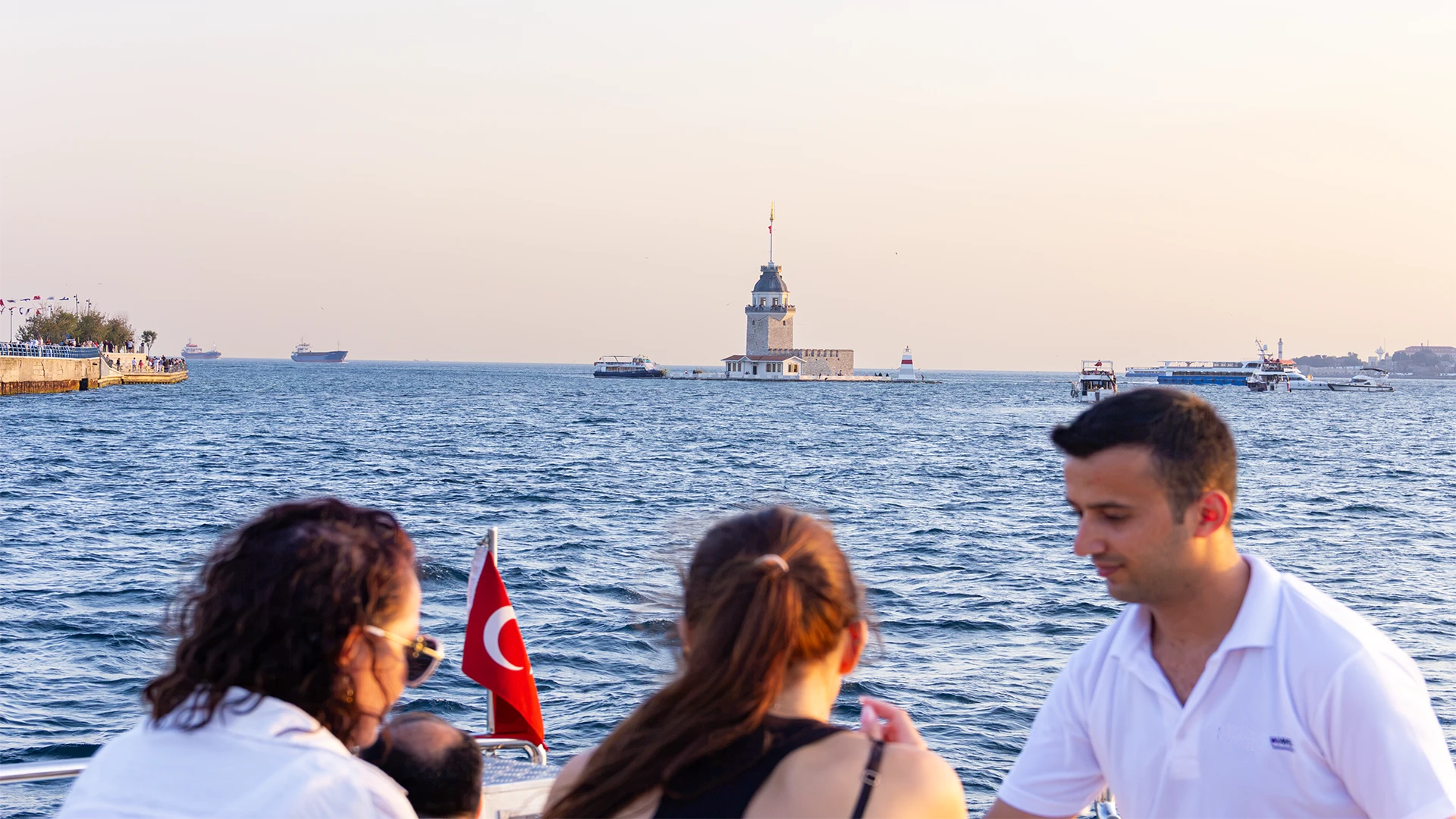
Cappadocia: Choose Experiences According to Interest
Cappadocia offers the widest concentration of Adventus experiences because the region combines landscape, craft, food, wine and living traditions within a relatively compact area.
A Cappadocia Hot Air Balloon provides the aerial perspective.
A Pottery Workshop in Cappadocia introduces Avanos through craft.
A Cooking Class in Cappadocia approaches the region through food and household traditions.
A Wine Tasting in Cappadocia focuses more closely on local wines.
An Outdoor Wine Experience in Cappadocia places wine within the volcanic landscape and vineyard environment.
A Whirling Dervishes Ceremony in Cappadocia introduces the Mevlevi Sema tradition within a contemplative setting.
A Turkish Night Experience provides a completely different evening centred on folk performance, music and entertainment.
The correct choice depends on interest.
There is no reason to include every experience simply because it is available.
Southeastern Turkey: Living Culture Alongside Archaeology
Southeastern Turkey particularly benefits from experiences that prevent the itinerary from becoming a sequence of archaeological sites.
The Halfeti Boat Tour makes the Euphrates landscape part of the route between Gaziantep and Şanlıurfa.
The Sıra Gecesi Experience in Şanlıurfa introduces music, food and social tradition within the living city.
These experiences help connect the historical landscape with contemporary regional culture.
Mediterranean Turkey: Let the Landscape Become the Experience
On the Mediterranean, outdoor experiences work best when they respond directly to geography.
The Paragliding Experience in Ölüdeniz uses the extraordinary relationship between Babadağ and the coast.
Walking sections of the Lycian Way, travelling by boat around Kekova or simply allowing time for swimming between archaeological days can serve the same purpose.
The Mediterranean should not be planned entirely as sightseeing followed by free time.
The sea and mountains are part of the destination itself.
Do Not Fill Every Free Hour With an Activity
Experiences add value only when the itinerary still has room for them.
A balloon flight followed immediately by a full sightseeing day may be realistic for some travellers but exhausting for others.
A cooking class needs time.
A wine experience should not be squeezed between two distant archaeological sites.
A Sıra Gecesi following a long transfer day may feel very different from the same evening after a relaxed afternoon in Şanlıurfa.
The same applies to free time.
Not every unscheduled hour is a planning failure.
Walking without a guide.
Returning to a favourite café.
Sitting on a terrace.
Exploring a market slowly.
Resting before dinner.
These moments give longer journeys rhythm.
A professionally planned itinerary should therefore control logistics without controlling every minute.
How to Decide What to Leave Out
One of the most useful planning skills in Turkey is subtraction.
If an itinerary feels crowded, removing the least connected region is usually more effective than shortening every visit.
If Istanbul has only one day because another destination has been added, reconsider the additional destination.
If Cappadocia has become a sequence of airport transfer, balloon flight and rapid sightseeing, add a night or reduce the route.
If the Mediterranean contains a new hotel every night, choose fewer bases.
If Black Sea or Southeastern Turkey appears as a two-day extension to an already complex itinerary, consider making it a separate trip.
A destination becomes valuable only when enough time exists to experience what makes it different.
The final sections of this guide will bring these decisions together through essential first-time planning questions, the role of Adventus Travel in designing a route, and a concise Turkey Travel Guide FAQ.
First-Time Turkey Planning: The Decisions That Matter Most
Once the regions, season and transport structure are clear, most remaining planning decisions become much easier.
First-time travellers do not need to understand every detail of Turkey before booking. They do need to make a few important decisions in the correct order.
The most useful sequence is:
Choose the regions.
Decide how many nights each region deserves.
Establish the transport between them.
Choose accommodation locations.
Add major sightseeing priorities.
Add experiences only after the route has enough breathing room.
Starting with hotels or individual attractions often creates the opposite result. Reservations begin to dictate the geography before the geography itself has been understood.
Start With Regions, Not Hotels
A hotel can be excellent and still be wrong for the itinerary.
The same applies to a destination.
Before choosing accommodation, establish where the trip actually needs to go.
For a first-time seven-day visit, this may be as simple as Istanbul and Cappadocia.
For a longer itinerary, the decision may be whether Cappadocia should continue toward Ephesus and Pamukkale or south toward the Mediterranean.
Once the route is fixed, hotel selection becomes a local decision rather than a national planning problem.
Count Nights, Not Just Days
A six-day trip does not automatically provide six complete sightseeing days.
Arrival times matter.
Departure flights matter.
Domestic transfers matter.
Changing hotels matters.
A route that contains six nights but three regional transfers provides much less usable destination time than six nights in one or two bases.
For this reason, count the actual nights available in each region before deciding what can realistically be included.
A late arrival should not be treated as a full Istanbul day.
A morning flight from Cappadocia followed by an afternoon hotel check-in should not automatically become a full Ephesus sightseeing day.
This simple distinction prevents many itineraries from becoming unnecessarily compressed.
Protect the First and Last Days
International arrival and departure days deserve flexibility.
Long-haul flights can arrive early in the morning, late in the evening or after schedule changes.
Immigration, baggage collection and airport transfers also add uncertainty.
The first day should therefore avoid activities where a missed start time would damage the itinerary.
The same principle applies before departure.
Placing a distant archaeological site several hours from the airport on the final day may technically work, but it adds unnecessary pressure to the end of the trip.
Strong route planning absorbs uncertainty instead of pretending it does not exist.
Decide Your Non-Negotiable Experiences Early
Some activities require more advance planning than ordinary sightseeing.
Hot air balloon flights in Cappadocia are an obvious example.
Specific private experiences, specialist guides, popular hotels and seasonal coastal activities can also have limited availability.
If one experience is central to the trip, identify it before the rest of the daily schedule becomes fixed.
This does not mean building the entire itinerary around one reservation.
It means recognizing which elements have less scheduling flexibility than others.
Do Not Schedule Every Major Experience on Consecutive Days
A strong itinerary alternates intensity.
A long archaeological day can be followed by a lighter cultural experience.
A demanding valley hike does not necessarily need to sit between two equally active touring days.
Several museums and monuments in Istanbul can be balanced by time on the Bosphorus.
A long Mediterranean driving day can be followed by a slower coastal morning.
This rhythm becomes increasingly important on trips longer than one week.
The objective is not simply to avoid physical fatigue.
It also prevents historically important sites from losing impact because the traveller has stopped absorbing information.
Build Around Your Actual Travel Style
Two travellers can visit exactly the same regions and require completely different itineraries.
A traveller interested in photography may need earlier starts and longer stops at fewer locations.
An archaeology-focused traveller may spend far more time at Ephesus or Hattuşa than someone seeking a broader introduction.
Families may benefit from shorter sightseeing blocks.
Travellers interested in food may want markets, cooking experiences and longer meals built into the route.
Those who enjoy walking may reduce vehicle-based sightseeing in favour of valleys or coastal trails.
The itinerary should therefore answer more than:
“What are the major attractions?”
It should also answer:
“How does this traveller actually want to experience them?”
Do You Need a Guide in Turkey?
Not every part of Turkey requires guided sightseeing.
Many neighbourhoods, markets, coastal towns and landscapes can be explored independently.
A licensed guide becomes particularly valuable where the site contains layers that are difficult to interpret without context.
This is especially true for archaeology.
At Ephesus, understanding the relationship between streets, civic buildings, religious monuments and domestic spaces changes the visit substantially.
At Topkapı Palace, the organization of courtyards and controlled access reveals how the Ottoman court functioned.
At Göbeklitepe, archaeological interpretation is essential because the significance of the structures extends far beyond what can be understood simply by looking at the pillars.
In Cappadocia, geology, Byzantine heritage, underground architecture and settlement history overlap within the same landscape.
A good guide should therefore make a destination clearer, not simply provide more information.
When Independent Exploration Works Particularly Well
Independent time is especially valuable in:
Istanbul neighbourhoods, the Grand Bazaar after initial orientation, coastal towns such as Kaş, village centres, local markets, Cappadocia villages, and evenings in most destinations.
These are places where moving without a fixed timetable can become part of the experience. A well-structured private trip does not require a guide to remain with travellers continuously.
Some days benefit from interpretation.
Others benefit from independence.
Where Should You Stay in Turkey?
There is no single accommodation model that works across the country.
Location matters differently in each region.
Istanbul
For a first visit focused on major historical monuments, accommodation near the Historic Peninsula can reduce daily transit.
Travellers who want stronger restaurant, nightlife and neighbourhood access may prefer Beyoğlu or other central areas with convenient public transport connections.
The correct choice depends on what will occupy most of the day.
Cappadocia
Accommodation location affects daily driving less dramatically than many visitors expect because the major sites are distributed across the region.
Göreme offers a central tourism base and broad restaurant access.
Uçhisar provides a different setting along the ridge above the valleys.
Ürgüp and other towns offer additional accommodation styles.
More important than choosing the most famous town is selecting a property that matches expectations for architecture, service, accessibility and atmosphere.
Travellers interested in the region’s distinctive accommodation traditions can use our Cappadocia Cave Hotels: History, Authenticity & How to Choose before booking.
Ephesus
Selçuk provides the most direct access to the archaeological area.
Şirince offers a smaller village setting and can work particularly well for travellers interested in food, wine and a quieter evening environment.
Kuşadası provides a coastal base with a very different atmosphere.
The choice should reflect whether archaeology, village life or the coast is the priority.
Mediterranean Turkey
The Mediterranean benefits from multiple bases rather than one hotel for the entire region.
Antalya works well for the eastern and central archaeological landscape.
Kaş is a strong base for the central Lycian coast.
Fethiye provides access to Ölüdeniz and the western end of many coastal routes.
Attempting to explore all three areas repeatedly from one city creates unnecessary driving.
Black Sea and Southeastern Turkey
Both regions benefit from progressive routing.
Changing accommodation is often necessary because the landscapes and cities are too widely distributed for one central base.
The objective should be to move forward along the route rather than repeatedly returning to the same hotel.
Is Turkey Suitable for Private and Tailor-Made Travel?
Turkey is particularly well suited to tailor-made planning because regional travel involves several different transport and sightseeing systems.
A trip may include: walking days in Istanbul, domestic flights, private regional transfers, archaeological guiding, boat experiences, valley hikes, coastal drives, and free evenings.
These elements do not need to be purchased or experienced in the same way.
The value of tailoring lies in coordinating them into one route.
For travellers who prefer that structure, Private Turkey Tours provide the main Adventus framework for designing a trip according to time, pace and interests rather than adapting every traveller to one fixed programme.
Explore Turkey With Adventus Travel
Adventus Travel is based in Turkey and designs private routes across the country with an emphasis on historical context, regional continuity and realistic pacing.
Our approach begins with geography.
A route should make sense before activities are added to it.
From there, licensed guiding, private transportation, accommodation and experiences can be combined according to the traveller’s interests.
For some guests, this means a first trip through Istanbul, Cappadocia and Ephesus.
For others, the focus may be the Lycian coast, Southeastern archaeology, Black Sea highlands or several days exploring Cappadocia in greater depth.
We do not believe every traveller needs to see the same Turkey.
The objective is to determine which parts of the country belong together for the time available and then allow those regions enough space to be experienced properly.
Travellers who want to compare complete route options can begin with our Private Turkey Tours or contact Adventus Travel to discuss a tailor-made itinerary.
Turkey Travel Guide FAQ
How many days do you need in Turkey?
Seven days is enough for a strong first trip when the itinerary is limited to two regions, most commonly Istanbul and Cappadocia.
Nine to ten days allows a third regional layer such as Ephesus and Pamukkale.
Approximately twelve to fourteen days creates enough time to add the Mediterranean or provide greater depth within the principal regions.
Longer trips should prioritise regional depth rather than simply increasing the number of destinations.
Is 7 days enough for Turkey?
Yes.
Seven days works particularly well for Istanbul and Cappadocia.
Trying to add Ephesus, Pamukkale or Antalya within the same week is possible but usually makes the itinerary considerably more rushed.
For most first-time visitors, two well-planned regions provide a stronger experience than three or four brief stops.
Is 10 days enough for Turkey?
Ten days is enough for one of Turkey’s strongest first-time routes.
A practical itinerary can connect:
Istanbul → Cappadocia → Konya → Pamukkale → Ephesus
Domestic flights and carefully planned overland sections allow these regions to connect without excessive backtracking.
Is 14 days enough for Turkey?
Two weeks provides enough time for a substantial multi-region trip.
Travellers can combine Istanbul, Cappadocia and western Turkey while adding the Mediterranean, or use the additional days for deeper exploration within fewer regions.
Fourteen days does not mean every major region should be included.
The Black Sea and Southeastern Turkey still deserve enough time to function as meaningful regional experiences.
Where should I go on my first trip to Turkey?
For most first-time visitors, Istanbul and Cappadocia provide the strongest starting point.
With additional time, Ephesus and Pamukkale can be added naturally.
Travellers interested in archaeology, coastal landscapes, food or mountain regions may choose a different route, but Istanbul and Cappadocia provide the broadest first introduction to the country’s historical and geographical diversity.
What is the best time to visit Turkey?
Spring and autumn provide the broadest balance for multi-region travel.
Temperatures are generally more comfortable for archaeological sites and walking, while several regions can be combined without the extremes of midsummer heat or high-altitude winter conditions.
However, there is no single best season for the whole country.
Summer is particularly suitable for the Mediterranean, Aegean, Black Sea highlands and Eastern Anatolia.
Winter can work very well for Istanbul, cultural travel and the snow-covered landscapes of Cappadocia.
What are the best months to visit Turkey?
For a classic route combining Istanbul, Cappadocia and western or southern Turkey, April through May and September through October are commonly attractive periods because they balance sightseeing conditions across several regions.
Weather varies from year to year, and higher elevations can behave differently from the coast.
Travellers should therefore select dates according to their actual route rather than relying on a single national weather assumption.
Is summer too hot for Turkey?
Not for the entire country.
Summer can be excellent for coastal travel, the Black Sea highlands and Eastern Anatolia.
The most difficult conditions occur in exposed archaeological sites and Southeastern Turkey during the hottest part of the day.
Early sightseeing, shaded midday breaks and realistic pacing make summer travel much more comfortable.
Is winter a good time to visit Turkey?
Yes, for the right itinerary.
Istanbul remains a year-round city.
Cappadocia can be particularly atmospheric under snow.
Major archaeological sites generally remain relevant for cultural travel, although weather may affect walking conditions.
High mountain routes and Eastern Anatolia require greater flexibility because snow and winter road conditions can influence access.
Should I visit Istanbul or Cappadocia first?
Either direction works, but many first-time itineraries begin in Istanbul because it is the principal international aviation gateway and provides useful historical context before travelling into Anatolia.
Starting in Cappadocia can also work when international flight connections or the onward route make it more efficient.
The correct sequence should be determined by flight logistics and the regions that follow.
How many days should I spend in Istanbul?
Two full days is a practical minimum for the principal historical areas.
Three days provides a stronger first visit because it allows the Historic Peninsula and Bosphorus to be experienced separately.
Four or more days creates time for neighbourhoods, museums, markets and a slower pace beyond the major monuments.
For detailed planning, see our Istanbul Travel Guide.
How many days should I spend in Cappadocia?
Three days provides one of the strongest balances for a first visit.
Two days can cover the principal highlights with careful planning.
Four or five days allows longer hikes, workshops, food and wine experiences, secondary sites and extensions into Central Anatolia.
For a complete regional overview, see our Cappadocia Travel Guide.
Is Ephesus worth adding to a first trip?
Yes, particularly when the trip has approximately nine days or more.
Ephesus adds a classical archaeological landscape that is very different from both Istanbul and Cappadocia.
It also connects naturally with Pamukkale and the wider Aegean route.
For shorter trips, however, adding Ephesus can reduce the amount of time available in the first two regions.
Should I choose Ephesus or the Mediterranean coast?
Choose Ephesus and the Aegean when classical archaeology is the stronger priority.
Choose the Mediterranean when you want archaeology combined more evenly with mountains, coastal towns, swimming, walking and outdoor experiences.
With enough time, both can be included, but they should not be compressed into a few rapid stops.
Is the Black Sea worth visiting on a first trip?
Yes, when the traveller’s interests justify making the region a priority.
The Black Sea is particularly rewarding for mountain landscapes, highlands, monasteries, regional food and slower road travel.
It is less effective as a short extension to an already crowded Istanbul, Cappadocia and western Turkey itinerary.
For route planning, see our Black Sea Turkey Travel Guide.
Is Southeastern Turkey worth visiting?
Yes.
Southeastern Turkey contains some of the country’s most important archaeological, culinary and architectural landscapes, including Göbeklitepe, Şanlıurfa, Gaziantep, Halfeti and Mardin.
It can be included in a first trip when archaeology, food and regional culture are central interests, but it deserves several days rather than functioning as a one-site extension.
See our Southeastern Turkey Travel Guide for the complete regional framework.
Do I need domestic flights in Turkey?
Most multi-region itineraries benefit from at least one domestic flight.
Flights are particularly useful between Istanbul and Cappadocia, Istanbul and Antalya, Istanbul and İzmir, or Istanbul and more distant regions such as Trabzon and Southeastern Turkey.
Within individual regions, road transportation often provides better continuity because archaeological sites, villages and landscapes are distributed away from airports.
Can I travel around Turkey by train?
Train travel is useful on selected routes, but it does not reach many of the places most visitors want to explore.
A multi-region cultural itinerary usually requires a combination of flights, road transportation, public transport and walking.
Rail can be part of the trip without needing to become the entire transport strategy.
Is Turkey easy to travel around independently?
Major destinations are generally accessible for independent travellers.
Domestic transportation is extensive, tourism infrastructure is well developed in the principal visitor regions and English is commonly used in established tourism businesses.
Complex multi-region itineraries require more coordination because airports, archaeological sites and accommodation may be far apart.
Independent travel becomes easier when the itinerary allows enough time for those connections.
Do I need a private guide in Turkey?
No.
A guide is most valuable where historical interpretation changes the quality of the visit.
Major archaeological sites, Ottoman palaces, Byzantine monuments and complex cultural landscapes benefit particularly from licensed guiding.
Neighbourhoods, markets, coastal towns and free time can often be explored independently.
A mixed approach usually works very well.
What currency is used in Turkey?
The official currency is the Turkish lira.
Cards are widely accepted in major tourism destinations, but carrying some local currency is useful for small purchases, markets, tips and businesses where card payment may not be practical.
For more detail, see our Currency and Tipping in Turkey.
What language is spoken in Turkey?
Turkish is the official language.
English is commonly spoken in hotels, major tourism businesses and established visitor destinations, but it becomes less consistent in smaller towns and rural areas.
Learning a few polite Turkish expressions is useful and generally appreciated.
Our Essential Turkish Phrases for Travelers covers the most practical expressions for visitors.
What should I wear in Turkey?
Clothing should be chosen according to season, region and activity rather than one national rule.
Comfortable walking shoes are important for archaeological sites and historic districts.
Religious sites require respectful clothing.
Coastal areas are considerably more relaxed, while Cappadocia and Eastern Anatolia may require substantial layers outside summer.
See our What to Wear in Turkey for a complete seasonal packing guide.
Do I need a visa for Turkey?
Visa requirements depend on nationality, passport type and purpose of travel.
Travellers should verify the current requirements through official Turkish government sources before departure rather than relying on older travel information.
Our Visa and Entry Requirements for Turkey guide provides the planning framework and links to official resources.
Is Turkey safe to visit?
Conditions can change, and safety guidance should not be treated as a permanent statement.
Travellers should check current official travel advisories issued by their own government before departure, particularly when planning routes near international borders or regions affected by temporary security developments.
For ordinary travel, the same practical awareness expected in other major destinations remains useful, including protecting valuables in crowded areas, using reputable transport and following local instructions.
Can Turkey be planned as one continuous route?
Yes, in many cases.
The strongest itineraries often combine domestic flights for large geographical jumps with overland travel where destinations connect naturally.
Examples include:
Istanbul → Cappadocia → Konya → Pamukkale → Ephesus
and
Cappadocia → Central Anatolia → Antalya → Kaş → Fethiye.
The Black Sea, Southeast and Eastern Anatolia generally require more deliberate regional planning because they sit outside the most common western and central corridors.
What is the best way to plan a first trip to Turkey?
Begin with the amount of time available.
Choose two or three regions that genuinely match your interests.
Establish how they connect.
Allocate enough nights to each one.
Only then choose hotels, sightseeing and additional experiences.
That sequence prevents the trip from becoming a collection of reservations that no longer forms a coherent route.
Continue Planning Your Trip to Turkey
Use the regional guides below to move from national planning into destination-level detail.
Istanbul Travel Guide
Plan the Historic Peninsula, Bosphorus, neighbourhoods, transportation and the city’s major historical sites.
Cappadocia Travel Guide
Explore valleys, underground cities, rock-cut heritage, accommodation, hiking and local experiences.
Ephesus Travel Guide
Understand Ephesus within the wider Aegean landscape, including surrounding sacred sites and regional routes.
Mediterranean Turkey Travel Guide
Plan Antalya, archaeological sites, the Lycian coast, mountains and southern coastal routes.
Black Sea Turkey Travel Guide
Explore historic towns, monasteries, tea country, highlands and the Kaçkar landscape.
Southeastern Turkey Travel Guide
Plan Gaziantep, Şanlıurfa, Göbeklitepe, Halfeti, Mardin and the wider Southeastern route.
For travellers who prefer to connect several regions within one coordinated itinerary, explore our Private Turkey Tours or contact Adventus Travel to discuss a route based on your dates, interests and preferred pace.
WRITTEN BY

Nisa Buket Dağdelen
Operations Director & Tour Guide
LinkedIn Profile

Hüseyin Pekgöz
Founder & Managing Partner
LinkedIn Profile
Adventus Travel Compa


