

Göreme Open Air Museum is more than a collection of rock-cut churches. Within this compact valley, monasteries, refectories, burial spaces and richly painted sanctuaries reveal how Christian communities shaped religious life directly into Cappadocia’s volcanic landscape.
This guide explores the monastic world behind Göreme, the meaning of its frescoes, and the churches that define the site today. For a broader understanding of the region’s history, landscapes and travel planning, explore our Cappadocia Travel Guide.

Continue Exploring Cappadocia
Understand Cappadocia’s Landscape and Heritage
- Cappadocia Travel Guide
- Valleys of Cappadocia
- Fairy Chimneys of Cappadocia
- Underground Cities of Cappadocia
Explore Cappadocia’s Christian Heritage
Explore Cappadocia with Adventus
- Highlights of Cappadocia Tour
- Green Tour Cappadocia
- 3 Days Cappadocia Tour
- 5 Days Cappadocia Tour
- Cappadocia Hiking Tour • Valleys & Local Experiences
What Is Göreme Open Air Museum and Why Does It Matter?
Göreme Open Air Museum is a rock-cut monastic settlement rather than simply a group of historic churches. Within the valley, churches, chapels, refectories and living spaces were carved directly into the volcanic rock, creating a religious landscape that developed over many centuries.
Official Turkish museum records describe Göreme as an important center of monastic life from the 4th to the 13th centuries. The concentration of religious and communal spaces makes it possible to see how worship, daily life and monastic discipline existed within the same physical environment.
This is what separates Göreme from a conventional archaeological site. Architecture was not constructed beside the landscape; it was created inside it. The softness of Cappadocia’s volcanic tuff allowed communities to carve churches, dining halls and living spaces while adapting continually to the natural form of the valley.
The site also preserves an exceptional record of Byzantine religious art. Some early sanctuaries relied heavily on crosses and geometric decoration, while churches created after the end of Byzantine Iconoclasm developed increasingly elaborate figurative programs depicting Christ, the Virgin Mary, saints and biblical narratives. UNESCO identifies these rock-cut sanctuaries and their paintings as one of the defining cultural values of the Cappadocian landscape.
Understanding Göreme Open Air Museum therefore requires looking beyond individual frescoes or church names. The real significance lies in the relationship between landscape, communal religious life, architecture and painting. Together, they preserve one of Cappadocia’s clearest records of how Christian communities transformed volcanic terrain into an organized spiritual environment.
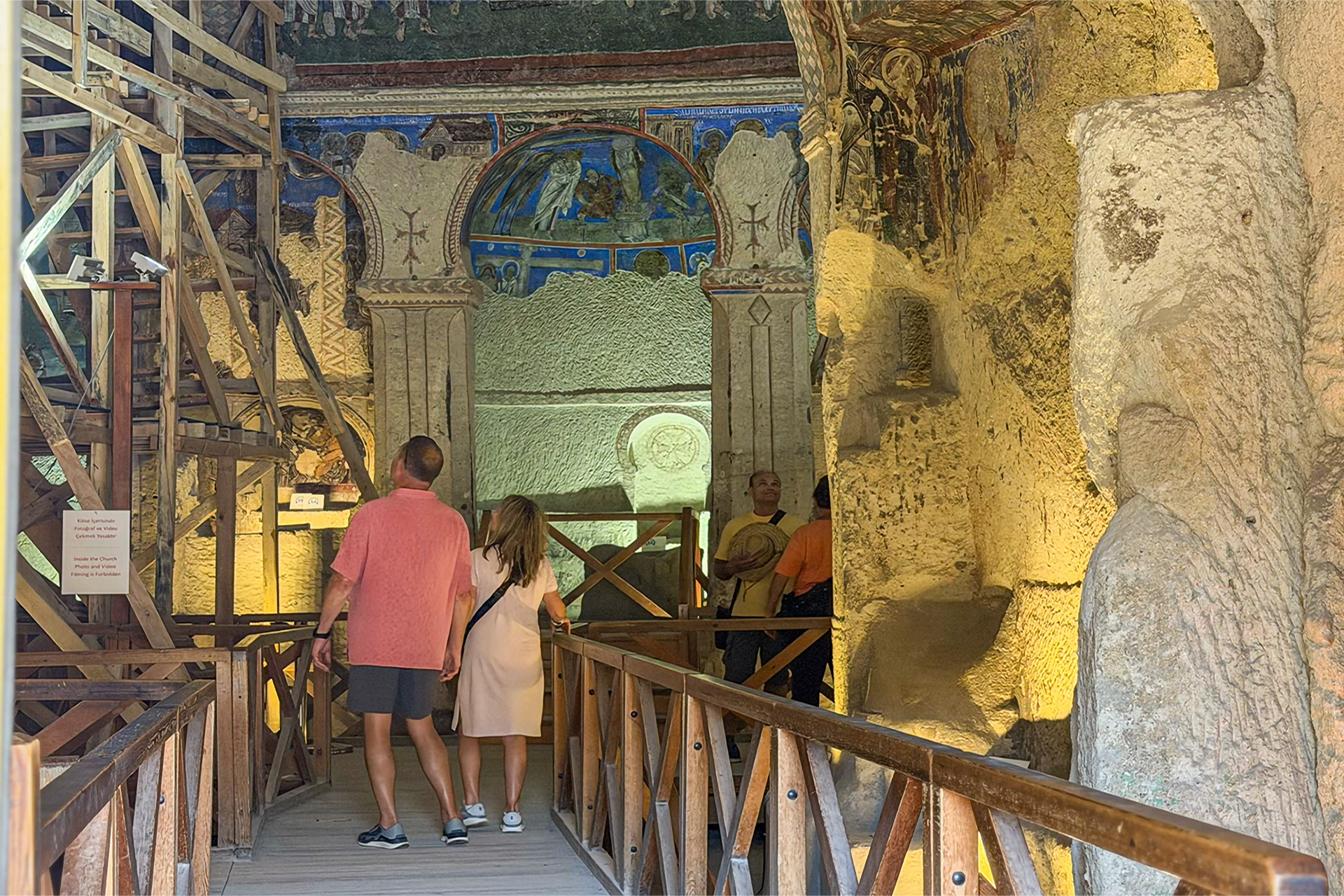
Why Did Cappadocia Become a Center of Monastic Life?
Cappadocia became an important center of Christian monastic life because its geography and religious culture supported both withdrawal and community. The region’s valleys offered secluded spaces for prayer and contemplation, while remaining close enough to settlements and agricultural land to sustain organized religious communities.
Early Christian monasticism did not follow a single model. Some ascetics preferred solitary life, while others gradually formed communities structured around shared worship, work and discipline. Cappadocia became especially important in this transition toward communal monastic life, where withdrawal from ordinary society did not necessarily mean complete isolation.
The volcanic landscape made this form of life physically possible. Soft tuff could be carved into cells, chapels, churches, refectories and storage rooms, allowing communities to expand within the rock itself. At Göreme, this created a compact environment where worship, daily life and communal organization could function together rather than in separate buildings.
Saint Basil the Great and Cappadocian Monasticism
One of the most influential figures in this development was Saint Basil the Great, Bishop of Caesarea in the 4th century and one of the Cappadocian Fathers. Basil did not establish Göreme Open Air Museum itself, but his writings helped shape the wider monastic culture of Cappadocia.
Basil emphasized a form of religious life based on community, prayer, work, obedience and mutual responsibility. He was critical of extreme isolation and argued that Christian virtues such as charity, service and humility were best practiced within a community.
His influence extended beyond monasteries. In Caesarea, Basil also developed a large charitable complex associated with care for the poor, travelers and the sick, reflecting his belief that religious discipline should remain connected with social responsibility.
Göreme Open Air Museum belongs to the wider Cappadocian tradition that emerged from this environment. Its refectories, communal spaces and closely arranged religious structures reflect the kind of organized monastic life that became increasingly important in the region.

How Was Monastic Life Organized at Göreme?
At Göreme, a monastery should not be imagined as a single building surrounded by cloisters. The word itself comes from the Greek monastērion, but in Cappadocia the monastic environment developed as a network of spaces carved into the rock, where prayer, communal meals, work, rest and burial could take place within the same landscape.
This organization becomes clearer when the site is read beyond its churches. Refectories with long rock-cut tables indicate communal dining, while kitchens, storage areas and living spaces reveal the practical structure required to sustain religious communities. The arrangement suggests a disciplined way of life in which spiritual practice and ordinary responsibilities were closely connected.
Prayer, Work and Communal Meals
Prayer formed the spiritual center of monastic life, but daily routines extended beyond worship. Monks also worked, maintained the community and shared meals according to an ordered rhythm. Refectories are particularly important because they provide physical evidence that monastic life at Göreme was communal rather than purely solitary.
The long tables carved directly from the rock were designed for groups rather than individuals. Meals could therefore become part of the religious routine itself, reinforcing ideas of discipline, equality and community.
Monastic Cells and Simplicity
Living spaces were generally modest. Their simplicity was consistent with a monastic ideal that placed spiritual discipline above personal comfort or display.
This restraint should not be interpreted as architectural poverty. Cappadocian communities were capable of creating highly sophisticated churches and painted interiors, yet everyday living spaces remained comparatively plain. The contrast helps distinguish between areas intended for communal worship and those associated with ordinary monastic life.

Burial and the Community of the Dead
Tombs carved within or close to churches reveal another dimension of the monastic landscape. Burial was physically integrated into spaces of worship, allowing the memory of deceased members and patrons to remain within the religious community.
Examples can still be seen in places such as St. Basil Chapel, where graves are cut into the floor near the entrance. Their presence reminds visitors that Göreme was not simply a place where monks prayed and worked; it was also a community in which generations lived, died and were remembered within the same sacred landscape.
Seen together, these spaces explain why Göreme Open Air Museum cannot be understood by moving from one painted church to another. The churches formed only one part of a much larger system in which worship, work, food, shelter and burial were organized around a shared religious life.
Why Were Some Churches Painted While Others Remained Plain?
Not every church at Göreme received the same type of decoration, and this difference reflects both date and function. Some interiors preserve simple red-painted crosses, geometric patterns and symbolic motifs, while others contain elaborate figurative cycles showing Christ, the Virgin Mary, saints and scenes from the Gospels.
Part of this variation belongs to the changing history of Byzantine religious art. During the periods of Iconoclasm, the use of sacred images became a major theological and political controversy. After the restoration of icons in 843, figurative painting returned with greater confidence, and Cappadocia developed some of its most ambitious painted church interiors.
The difference should not be reduced to a simple progression from “primitive” to “advanced.” Some spaces were never intended to receive extensive fresco programs, while others benefited from greater patronage, skilled painters and more complex liturgical functions. The surviving decoration therefore reflects several overlapping factors rather than a single artistic timeline.
How Were the Frescoes Made?
Many of Göreme’s paintings were executed directly onto prepared plaster applied over the carved rock surface. Pigments were then used to build narrative scenes, figures and decorative borders across domes, vaults and walls.
The paintings were not arranged randomly. Christological scenes, saints, apostles and episodes from the life of the Virgin were positioned according to the architecture of each church, allowing the building itself to structure the visual narrative.
This is why the frescoes are best understood as part of the architecture rather than as independent pictures. A dome, apse or vault determined not only where an image appeared, but also how it was experienced during worship.

When Were the Frescoes of Göreme Created?
The painted churches visible today belong to different periods rather than one single artistic phase. Some of the most important figurative cycles developed after the end of Iconoclasm, particularly from the 10th century onward, while other major churches continued to receive decoration into the 11th, 12th and early 13th centuries.
This broader chronology is important because Göreme Open Air Museum preserves the development of Byzantine religious painting across several centuries. The site does not represent one moment in time; it preserves successive layers of artistic, theological and monastic change.
UNESCO identifies the rock-cut sanctuaries of Göreme as exceptional evidence of post-Iconoclastic Byzantine art, but the surviving churches also demonstrate how that tradition continued to evolve well beyond the immediate aftermath of Iconoclasm.
Which Churches Define the Experience of Göreme Open Air Museum?
The churches of Göreme Open Air Museum were created at different times and decorated according to different artistic and liturgical priorities. Rather than trying to remember every name, it is more useful to notice how architecture, painting and religious function change from one space to another.
St. Basil Chapel
Located close to the entrance of the museum, St. Basil Chapel provides an effective introduction to the religious and funerary character of Göreme. The chapel dates to the 11th century and has a rectangular, barrel-vaulted nave with three apses. Tombs cut into the floor of the narthex immediately establish that the space was connected not only with worship, but also with burial and commemoration.
The surviving paintings include Christ, the Virgin and Child, Saint Theodore, Saint Demetrius and Saint George fighting the dragon. These warrior saints appear frequently in Cappadocian churches and belonged to a wider Byzantine devotional tradition in which military saints were associated with faith, protection and triumph over evil.
St. Basil Chapel is therefore valuable not because it contains the most elaborate fresco program in the museum, but because several themes encountered throughout Göreme are already visible here: burial within sacred space, devotion to saints and the close relationship between architecture and painting.

St. Barbara Chapel
St. Barbara Chapel, dating to the second half of the 11th century, offers a striking contrast. Its interior combines figural scenes with extensive red-painted geometric and symbolic decoration applied directly onto the rock.
The chapel has a cross-shaped plan with a central dome and three apses. In the main apse appears Christ Pantocrator, while another prominent scene shows Saint George and Saint Theodore on horseback confronting a dragon. Saint Barbara herself is represented elsewhere within the church.
What makes the chapel particularly interesting is the relationship between its figures and its simpler red motifs. Geometric patterns, crosses and designs imitating masonry cover parts of the rock surface, reminding visitors that Cappadocian church decoration did not depend exclusively on large narrative fresco cycles.
Some of these painted forms can appear almost abstract to a modern viewer. Rather than treating them as secondary decoration, they should be read as part of the visual language of the church, where symbols, architecture and sacred figures worked together to define the space.
Seen immediately after St. Basil Chapel, St. Barbara also demonstrates why the churches of Göreme should not be ranked simply according to the richness of their frescoes. Each preserves a different combination of function, imagery and artistic technique, and together they reveal the diversity of Cappadocia’s religious landscape.

Elmalı Church
Elmalı Church, generally dated from the mid-11th to early 12th century, represents one of the more developed narrative programs within Göreme Open Air Museum. Its cross-in-square plan, four supporting columns and multiple domes create a more articulated interior than the simpler chapels encountered earlier in the museum.
The frescoes follow major episodes from the life of Christ, including the Nativity, Baptism, Raising of Lazarus, Transfiguration, Entry into Jerusalem, Last Supper, Betrayal, Crucifixion, Entombment, Descent into Hell and Ascension. Old Testament subjects also appear, showing that the decorative program was intended to connect different parts of Christian scripture rather than simply illustrate isolated Gospel scenes.
Earlier red-painted crosses and geometric motifs survive beneath parts of the later decoration. This layering is particularly important because it allows Elmalı Church to demonstrate how a single sacred space could change visually over time.
Rather than trying to identify every scene, the most useful way to experience Elmalı is to follow the sequence around the church and notice how the architecture guides the story. Domes, vaults and apses become part of the narrative structure itself.

Yılanlı Church
Yılanlı Church, or the Church of Saint Onuphrius, offers a very different visual program. Dating to the 11th century, its rectangular barrel-vaulted interior contains fewer large narrative cycles and places greater emphasis on individual saints and devotional figures.
Among the most recognizable scenes are Saint George and Saint Theodore fighting the dragon, together with Emperor Constantine and his mother Helena holding the True Cross. Saint Basil also appears within the painted program.
The most distinctive figure, however, is Saint Onuphrius, represented with long hair and an ascetic appearance. According to Christian tradition, Onuphrius withdrew into the desert and lived an extreme form of solitary religious life, making his presence particularly relevant within a landscape shaped by different forms of monastic practice.
This contrast makes Yılanlı especially valuable after visiting Elmalı. Elmalı communicates theology primarily through a structured sequence of biblical events, while Yılanlı places greater emphasis on saints, holy figures and models of Christian devotion.
Together, the two churches demonstrate that Göreme’s frescoes were never governed by a single visual formula. Different communities and patrons used sacred imagery in different ways, creating a religious landscape where narrative, memory and devotion could take very different forms.
Karanlık Church (Dark Church)
Karanlık Church, or the Dark Church, is one of the most important painted interiors in Göreme Open Air Museum. Dating to the late 11th and early 12th centuries, it takes its name from the very limited natural light entering through a small opening in the narthex. That darkness became an unexpected advantage: reduced exposure to sunlight helped preserve the intensity of the frescoes far better than in many neighbouring churches.
The church has a cross-shaped plan with a central dome, four columns and three apses. Almost every major architectural surface participates in the painted program, creating an interior where the frescoes are experienced as a continuous visual environment rather than as isolated scenes.
Its paintings follow an extensive cycle from the life of Christ, including the Annunciation, Nativity, Baptism, Raising of Lazarus, Transfiguration, Entry into Jerusalem, Last Supper, Betrayal, Crucifixion, Descent into Hell and Ascension. Old Testament subjects, including the Hospitality of Abraham and the Three Hebrew Youths, appear alongside these scenes, connecting different layers of Christian scripture within the same decorative program.

What distinguishes Karanlık Church is not simply the number of surviving paintings, but their visual coherence and preservation. Deep blues, reds and ochres remain unusually vivid, making it easier to appreciate facial expressions, garments, gestures and the relationship between individual scenes. For visitors trying to understand how Byzantine painting worked as a theological narrative, this is one of the strongest spaces in the museum.
Karanlık Church also requires separate admission from the main Göreme Open Air Museum ticket. Because entrance arrangements and prices can change, current conditions should be checked before visiting rather than relying on a fixed fee published in a travel guide.
Karanlık Church preserves a refined Christological cycle, with its frescoes exceptionally well preserved due to minimal exposure to light.
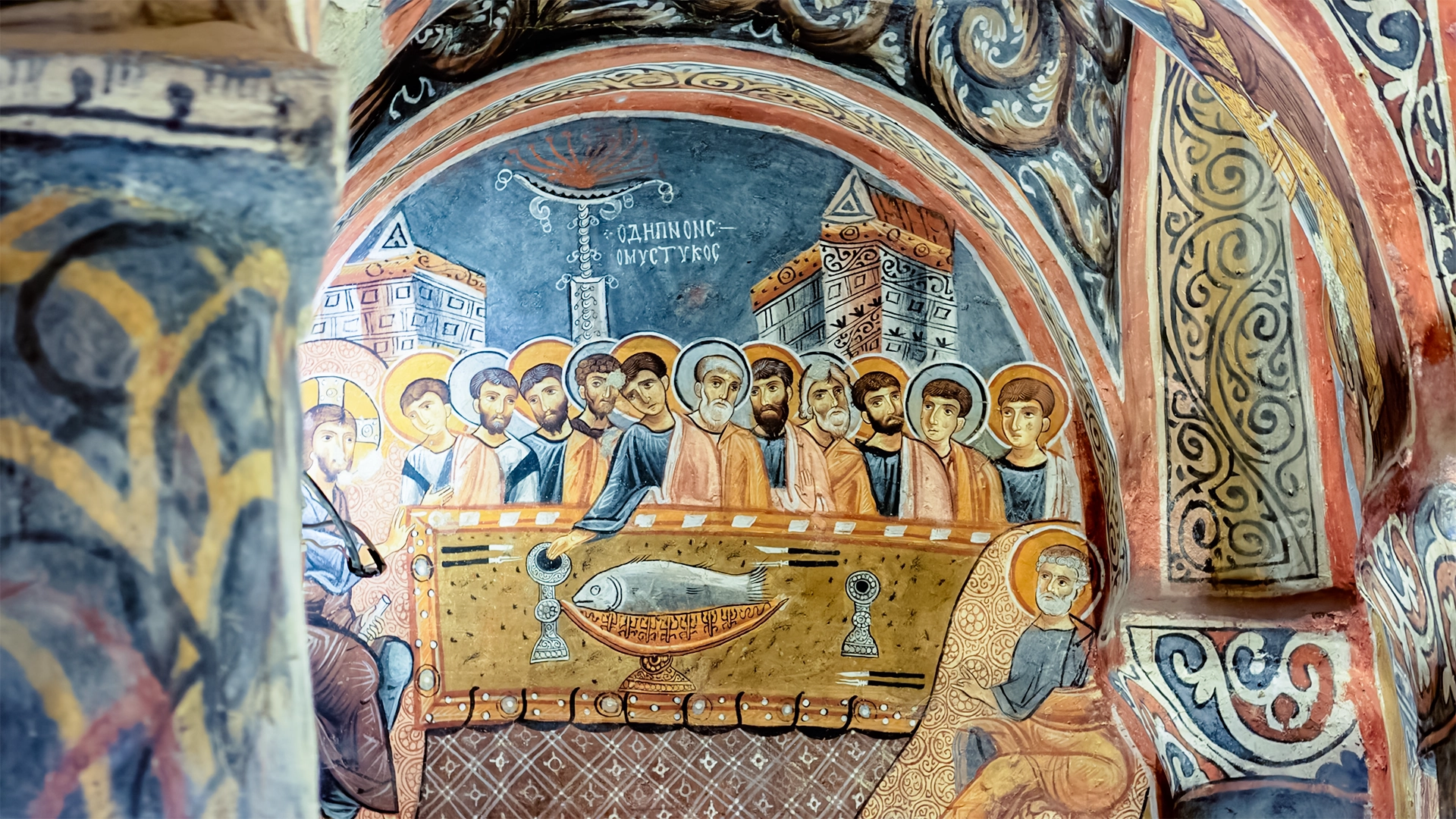
The Crucifixion scene echoes the Gospel of Luke’s portrayal of forgiveness at the cross:
“Father, forgive them, for they do not know what they are doing.”
— Luke 23:34
The Raising of Lazarus, also depicted in the church, follows the account given in the Gospel of John:
“Jesus said to her, ‘I am the resurrection and the life. The one who believes in me will live, even though they die.’”
— John 11:25
Karanlık Church is known for having some of the best-preserved frescoes in Göreme Open Air Museum. Its limited natural light helped protect the intensity of the paintings, allowing many of their colors and details to survive with remarkable clarity.
Entry to Karanlık Church requires a separate ticket from the main museum admission. As entrance fees may change, it is better to check the current price before visiting.
Çarıklı Church (Sandal Church)
Çarıklı Church shares structural and pictorial similarities with Karanlık and Elmalı Churches.
Its fresco program includes major Christological scenes such as the Ascension, Crucifixion, Transfiguration, and Entry into Jerusalem. Together, these scenes continue the visual narrative seen across the painted churches of Göreme Open Air Museum, where the life of Christ is presented through a structured sequence rather than isolated images.
One of the most distinctive features of Çarıklı Church lies beneath the main church itself. A refectory is carved into the rock with a long table and seating area, accompanied by a Last Supper fresco positioned within a niche.
This creates a direct connection between monastic daily life and sacred imagery. The space was not only used for communal meals; its decoration also linked the physical act of eating with one of Christianity’s central religious narratives.
Çarıklı Church therefore brings together two themes that define Göreme Open Air Museum: the painted theological world of the churches and the practical communal life of the monastery.

Tokalı Church (Buckle Church)
Tokalı Church is a complex formed through multiple phases, consisting of the Old Church, New Church, and additional sections.
At the entrance, the narrative begins as a continuous sequence, almost like a film strip, where scenes from the life of Christ are arranged step by step along the vault. This creates one of the clearest examples in Göreme of how frescoes were used not as isolated images, but as a connected visual narrative.
After this section, the space opens into the New Church, added around 990–1010 AD. Here, the narrative expands and is rendered in deeper red and especially blue tones, which distinguish Tokalı from the other churches in and around Göreme Open Air Museum.
The transition between these two spaces creates a strong experiential shift. As you pass from the entrance into the blue-toned section, it can feel almost like stepping into a different time.
The inner section has undergone restoration work carried out with international collaboration, including Tuscia University, while parts of the church remain accessible to visitors.
Tokalı Church stands as the most comprehensive and structurally layered church associated with Göreme Open Air Museum, bringing together architecture, narrative fresco cycles, and different phases of artistic development within a single complex.
How Should Göreme Open Air Museum Be Understood Today?
In simple terms, Göreme Open Air Museum is a monastic complex carved into volcanic rock, where Christian communities lived, prayed, worked, and organized their daily life within a structured system.
It should not be approached as a sequence of individual churches. The site is a connected landscape shaped by theology, discipline, architecture, and long-term communal life.
To understand it fully, it is necessary to look beyond isolated frescoes or individual spaces and consider how architecture, painting, worship, and daily life operate together. Each church and monastic space gains greater meaning when understood as part of the wider system around it.
The valley does not reveal itself immediately. It requires attention, context, and time.
Only then does Göreme Open Air Museum reveal its full significance.

Visiting Göreme Open Air Museum with Adventus
Göreme Open Air Museum can be visited independently, but much of its significance depends on understanding what the spaces were used for and how the frescoes relate to the wider monastic system.
For travelers considering a guided experience, visiting Göreme Open Air Museum through a private Cappadocia tour allows the churches, fresco programs, burial spaces, and communal structures to be interpreted within their historical and theological context.
A guided visit is therefore not simply about identifying individual churches. It helps connect the paintings with monastic life, Byzantine history, and the wider cultural landscape of Cappadocia.
Göreme Open Air Museum can also be included within our Highlights of Cappadocia Tour, where the site is experienced alongside other important landscapes and heritage areas of the region.
Travellers who want to place Göreme Open Air Museum within a broader journey across Turkey can also visit the site as part of the 15-Day Turkey Tour • Istanbul, Cappadocia & Mesopotamia. The itinerary allows four nights in Cappadocia, combining Göreme Open Air Museum with Kaymaklı Underground City, Red Valley, local food and wine experiences, and the southern Cappadocia landscapes before continuing overland toward Gaziantep and Southeastern Turkey.
Travellers who want Göreme Open Air Museum to form part of a more active Cappadocia itinerary can also visit the site within the Cappadocia Hiking Tour • Valleys & Local Experiences. The five-day route combines the museum with Kaymaklı Underground City and longer walks through Ihlara Valley, Red Valley, Swords Valley, Görkündere and Avla Canyon, allowing Cappadocia’s monastic heritage to be experienced alongside the landscapes that shaped it.
FAQ About Göreme Open Air Museum
What is Göreme Open Air Museum?
Göreme Open Air Museum is a rock-cut monastic complex in Cappadocia containing churches, chapels, refectories, living spaces, and frescoes. The site preserves evidence of monastic life from the 4th to the 13th centuries and forms part of the UNESCO-listed Göreme National Park and the Rock Sites of Cappadocia.
Why is Göreme Open Air Museum important?
Göreme Open Air Museum is important because it preserves both the physical structure of monastic life and an exceptional collection of Byzantine religious paintings. It shows how worship, communal life, architecture, and art developed together within Cappadocia’s volcanic landscape.
How long does it take to visit Göreme Open Air Museum?
Around 1.5 to 2 hours is sufficient for a standard visit. Travelers who want to examine the frescoes, visit Karanlık Church, and understand the monastic spaces in greater detail may prefer to allow closer to 2.5 or 3 hours.
Do you need a guide for Göreme Open Air Museum?
No, the museum can be visited independently. However, a knowledgeable guide can provide important historical and theological context, particularly for understanding the fresco cycles, monastic spaces, and connections between individual churches.
What are the main churches at Göreme Open Air Museum?
The principal churches include St. Basil Chapel, St. Barbara Chapel, Elmalı Church, Yılanlı Church, Karanlık Church, Çarıklı Church, and Tokalı Church. Each preserves a different combination of architecture, frescoes, and religious imagery.
Is there an extra fee for Karanlık Church?
Yes. Karanlık Church requires a separate admission ticket from the main Göreme Open Air Museum entrance. Because ticket prices and admission arrangements can change, the current information should be checked before visiting.
What is the best time to visit Göreme Open Air Museum?
Early morning is generally the best time for a quieter visit, particularly during the warmer and busier months. It also provides more time to explore the churches and frescoes without rushing through the site.
WRITTEN BY

Nisa Buket Dağdelen
Operations Director & Tour Guide
LinkedIn Profile

Hüseyin Pekgöz
Founder & Managing Partner
LinkedIn Profile
Adventus Travel Company


