

Cappadocia may be famous for hot air balloons, but the region becomes much more interesting once you begin exploring it from the ground.
Its valleys reveal millions of years of erosion alongside rock-cut churches, cave dwellings, vineyards and walking trails. Underground cities open another layer beneath the landscape, while pottery workshops, village kitchens, wine traditions and historic cave architecture show how communities adapted to this unusual environment over centuries.
The best things to do in Cappadocia therefore extend far beyond one sunrise flight. They involve walking through the landscape, entering the spaces carved into it, meeting people who continue regional traditions and understanding how geology, history and everyday life became interconnected.
For a broader introduction to the region, including where to stay, how many days to allow and how the main areas fit together, start with our Cappadocia Travel Guide.
Cappadocia Is More Than Hot Air Balloons
Hot air balloons have become the most recognisable modern image of Cappadocia, but they represent only one way of experiencing the region.
What makes Cappadocia internationally significant is the relationship between its natural landscape and the communities that adapted it over centuries. Erosion created valleys, ridges and fairy chimneys. People then carved the volcanic rock into churches, homes, settlements and underground spaces while cultivating the land between them.
This means the region works particularly well for travellers with very different interests.
You can spend a morning hiking through volcanic valleys, explore Byzantine churches before lunch, descend into an underground city in the afternoon and finish the day around a village table, pottery wheel or vineyard.
The experiences below have been selected because each reveals a different part of Cappadocia rather than simply another viewpoint of the same landscape.

Continue Exploring Cappadocia
These guides, experiences and private itineraries can help you plan the wider trip around the activities in this article.
Plan Your Cappadocia Trip
Explore Cappadocia’s Cultural Heritage
Suggested Private Tours
- Highlights of Cappadocia Tour
- 3 Days Cappadocia Tour
- 5 Days Cappadocia Tour
- Cappadocia Hiking Tour • Valleys & Local Experiences

1. Hike the Valleys of Cappadocia
One of the best ways to understand Cappadocia is to walk through it.
From a panoramic viewpoint, the valleys can appear almost like scenery. On foot, their scale becomes much clearer. Trails pass between eroded volcanic formations, rock-cut churches, dovecotes, vineyards, orchards and former dwellings that are easy to miss from the road.
Different valleys also provide very different experiences.
Red and Rose Valleys are particularly rewarding for longer walks, combining colourful volcanic ridges with rock-cut heritage and some of the region’s most dramatic late-afternoon light.
Love Valley is known for tall vertical formations and can be experienced either from a panoramic viewpoint or through a longer walk along the valley floor.
Zemi Valley provides a quieter route close to Göreme, while Ihlara Valley, further south, offers a completely different landscape where the Melendiz River runs beneath steep canyon walls lined with rock-cut churches.
The right valley therefore depends on what kind of walk you want.
For photography and sunset landscapes, Red and Rose valleys are difficult to beat.
For unusual fairy-chimney formations, Love Valley provides a stronger geological experience.
For a longer combination of nature and religious heritage, Ihlara offers something very different from the valleys around Göreme.
For a detailed comparison of walking routes, terrain and what distinguishes each area, continue with our Valleys of Cappadocia guide.
How Much Time Should You Allow for a Valley Walk?
A valley experience can range from a 20-minute panoramic stop to several hours of hiking.
If walking is one of your main reasons for visiting Cappadocia, avoid treating every valley as a quick photo stop. Choosing one substantial route and exploring it properly often provides more value than driving rapidly between several viewpoints.
Comfortable shoes with good grip are important because trails can include loose volcanic gravel, uneven rock and steep sections.
During warmer months, start longer walks earlier in the morning or later in the afternoon and carry enough water.
For travellers who want to combine important landscapes with cultural sites in one privately guided day, our Highlights of Cappadocia Tour provides a broader introduction to the region without reducing every stop to a viewpoint.
For travellers who want hiking to become the main structure of a multi-day Cappadocia stay, the Cappadocia Hiking Tour • Valleys & Local Experiences follows a five-day route built around longer walks through Ihlara Valley and Avla Canyon, together with Red, Swords and Görkündere valleys. Cultural sites such as Kaymaklı Underground City, Göreme Open Air Museum, Soğanlı Valley, Paşabağ and Zelve are integrated between the hiking days, so the trip remains connected to Cappadocia’s wider cultural landscape.
2. Explore Göreme Open Air Museum
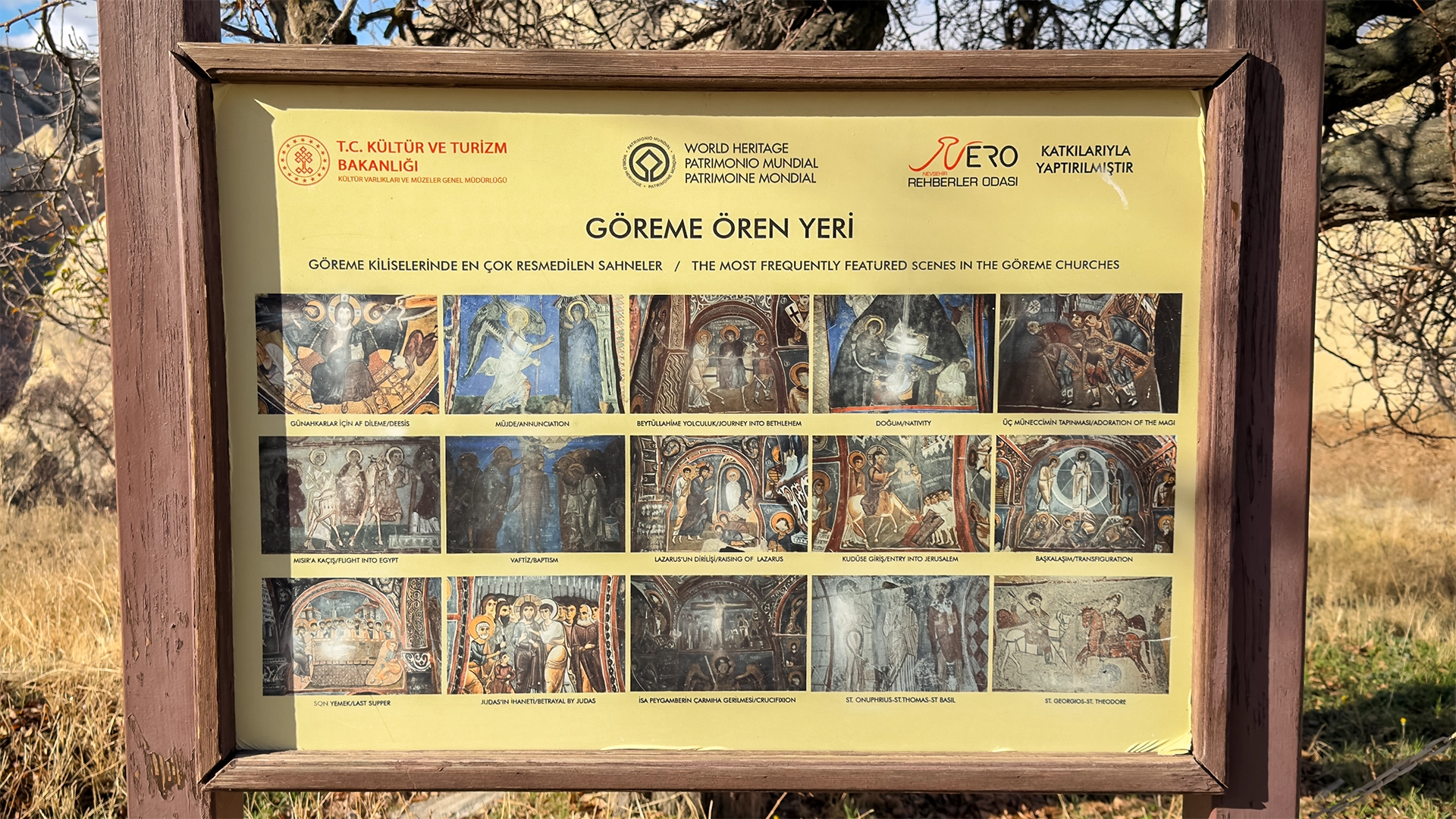
If you visit only one site to understand Cappadocia’s Byzantine heritage, Göreme Open Air Museum is one of the strongest choices.
The site brings together rock-cut churches, chapels, monastic spaces and communal buildings within a compact valley close to Göreme. Rather than seeing one isolated church, you can move through a landscape where religious architecture was excavated directly into the volcanic rock.
This is what makes the museum particularly valuable.
The geology and the history cannot be separated.
The same volcanic formations that shaped Cappadocia’s valleys became walls, ceilings, apses, refectories and places of worship.
Turkey’s Ministry of Culture and Tourism identifies churches including Karanlık, Elmalı, Yılanlı, St. Barbara, St. Basil, Çarıklı and Tokalı among the principal monuments associated with the site.

What Should You Focus On at Göreme Open Air Museum?
Do not try to treat every church as an item to complete.
Instead, look for three things.
First, notice how conventional church architecture was recreated by carving into rock rather than constructing with masonry.
Second, compare the decoration. Some spaces preserve relatively simple geometric or symbolic painting, while others contain much richer narrative scenes from the life of Christ and Christian tradition.
Third, pay attention to how churches, living spaces and communal areas occupy the same landscape. Göreme was not created as a collection of independent monuments for visitors. It belonged to a much larger religious and social environment.
UNESCO particularly emphasises the importance of Cappadocia’s post-Iconoclastic painted sanctuaries, including important churches in the Göreme Valley.
For the history of the site, its principal churches and what to notice inside each one, continue with our Göreme Open Air Museum guide.
How Much Time Should You Allow?
For most visitors, around 1.5 to 2 hours allows a more comfortable experience than rushing through the site.
Those with a particular interest in Byzantine art may want longer, especially if individual churches are open for detailed viewing.
Remember that the museum involves outdoor walking between rock-cut spaces, with slopes, steps and uneven surfaces in places.
Starting earlier in the day can also make the experience more comfortable during warmer months.
The objective should not be to enter the greatest possible number of churches.
It should be to leave understanding why Cappadocia became one of the most important surviving landscapes of rock-cut Byzantine religious architecture.
3. Descend Into an Underground City
Cappadocia changes completely when you go underground.
Below villages and agricultural land are multi-level complexes carved into the volcanic rock, with narrow tunnels connecting rooms used for storage, food preparation, animals, worship and shelter.
Kaymaklı and Derinkuyu are the two best-known examples and both form part of the UNESCO-listed Rock Sites of Cappadocia.
Their importance lies less in the idea of a mysterious lost underground civilisation and more in the practical problems these spaces helped communities solve.
The official museum descriptions emphasise security and refuge during periods of threat, while the underground environment also offered relatively stable temperatures compared with conditions above ground.

What Is It Like Inside an Underground City?
An underground-city visit is very different from entering a cave church or cave hotel.
Passages can be low and narrow.
Some sections require bending while walking.
Rooms appear at different levels.
Ventilation shafts connect spaces vertically, while stone doors and restricted passages reveal how movement through the complex could be controlled.
This physical experience is part of what makes the visit memorable.
You begin to understand that these places were not simply rooms carved beneath the ground. They were interconnected environments organised around movement, storage, ventilation, security and communal needs.
Visitors who are uncomfortable with enclosed or narrow spaces should consider this before entering.
Kaymaklı or Derinkuyu: Which Should You Visit?
Both are important, but they feel different.
Kaymaklı Underground City
Kaymaklı spreads through a dense network of rooms, galleries and narrow connections.
The official museum describes houses in the modern village as being associated with more than 100 tunnels leading into the underground complex, illustrating how closely the subterranean settlement remains connected with the inhabited landscape above.
For many visitors, Kaymaklı gives a particularly strong sense of moving horizontally through a labyrinth of interconnected spaces.
For a detailed explanation of its layout, history and visitor experience, see our Kaymaklı Underground City guide.

Derinkuyu Underground City
Derinkuyu is especially striking for its vertical scale.
The official museum gives the complex an approximate depth of 85 metres, although a visitor does not simply descend in a straight line to one enormous chamber. The experience involves moving between a sequence of excavated levels, passages and functional spaces.
Derinkuyu therefore gives a particularly strong impression of how deeply Cappadocian communities could extend architecture below the surface.
For its history, layout and the details worth noticing underground, continue with our Derinkuyu Underground City guide.
Were Underground Cities Built for People to Live Below Ground Permanently?
It is better not to imagine entire populations choosing permanent subterranean life as their normal everyday existence.
The evidence points strongly toward protection and refuge as an important reason these complexes developed and expanded.
UNESCO describes underground settlements such as Kaymaklı and Derinkuyu as places used for refuge during periods of insecurity, while Turkey’s official museum information similarly emphasises protection against threats and attacks.
At the same time, the spaces had to support people while they were below ground.
That explains the presence of storage areas, stables, kitchens, ventilation systems and religious spaces.
They were designed to make temporary or extended refuge possible, not simply to hide people for a few minutes.
Why an Underground City Belongs on a Cappadocia Itinerary
Fairy chimneys show what erosion created above ground.
An underground city shows what people created beneath it.
Seeing both is important because they come from the same geological opportunity.
Cappadocia’s volcanic rock could be carved into churches and houses in cliffs, but it could also be excavated downward into interconnected subterranean spaces.
This is one of the clearest examples of why Cappadocia is more than a scenic landscape.
Its geology repeatedly became architecture.
For a broader comparison of the region’s underground settlements, their development and how they functioned, continue with our Underground Cities of Cappadocia guide.
4. Discover Cappadocia’s Quieter Rock-Cut Heritage
Göreme Open Air Museum is essential for understanding Cappadocia’s Byzantine heritage, but it is not the only place where churches, settlements and daily life were carved into volcanic rock.
Travelling beyond the central Göreme area reveals sites with very different scales and atmospheres.
Soğanlı Valley, on the southern side of the wider Cappadocia region, combines rock-cut churches, dovecotes, caves, fairy chimneys and a living village within the same landscape. Turkey’s official museum records nearly 50 rock churches in the valley, although only a smaller group is currently accessible to visitors.
The experience is noticeably different from moving through one compact open-air museum.
You walk through a broader valley where religious architecture, former settlement spaces and agricultural life remain distributed across the landscape.

Why Visit Soğanlı Valley?
Soğanlı is particularly useful for travellers who want to understand how Cappadocia’s Christian heritage extended beyond Göreme.
Rock-cut churches developed here from Late Antiquity onward, while surviving frescoes in accessible churches largely belong to later Byzantine phases. The valley also preserves dovecotes, caves and shelters alongside its religious monuments.
One of its most distinctive features is the presence of domed rock-cut churches, which give parts of Soğanlı a different architectural character from the churches visitors encounter around Göreme. Turkey’s Culture Portal specifically identifies these domed forms as one of the valley’s notable differences.
The village is also associated with the handmade Soğanlı dolls, produced by local women and sold throughout the Cappadocia region. The official museum identifies this craft as an important source of local income.
Soğanlı therefore works particularly well for travellers interested in the relationship between Byzantine heritage and a village landscape that continued to develop around it.
Gümüşler Monastery: A Different Rock-Cut Monastic Experience
For travellers willing to explore beyond Cappadocia’s central sightseeing circuit, Gümüşler Monastery near Niğde offers another important example of rock-cut religious architecture.
The monastery was excavated into a substantial rock mass and preserves a church with extensive wall paintings, monastic spaces and associated underground structures. Turkey’s official museum describes it as one of the best-preserved examples of Byzantine rock-cut monastic architecture in Anatolia.
Its value is not that it replaces Göreme.
It shows another expression of the same broader Cappadocian tradition of turning volcanic rock into organised religious space.
The courtyard arrangement, church and surviving frescoes create a different experience from the valley-based monasteries and churches around Göreme or Soğanlı.
For a detailed look at its architecture, paintings and history, continue with our Gümüşler Monastery guide.

Should You Add These Sites to a First Cappadocia Trip?
That depends on how much time you have.
For a short first visit, Göreme Open Air Museum, one underground city and the major valleys should usually remain the priorities.
With three or more days, places such as Soğanlı begin to make more sense because they add contrast rather than simply another church.
The strongest reason to go further is therefore not to claim that these places are “hidden” or “undiscovered.”
It is to see how rock-cut architecture changed from one Cappadocian landscape to another.
Travellers interested in Soğanlı and the southern side of the region can also consider our Blue Tour Cappadocia, which approaches Cappadocia through a different route from the better-known northern sightseeing circuit.
Travellers who want to experience southern Cappadocia as part of a longer journey across Turkey can follow the 15-Day Turkey Tour • Istanbul, Cappadocia & Mesopotamia. Its four-night Cappadocia section includes Mustafapaşa, Cemil Church, Keşlik Monastery, Sobesos Ancient City and Soğanlı Valley before the route continues overland toward Gaziantep and Southeastern Turkey.
5. Try Pottery Making in Avanos
Cappadocia’s cultural landscape is not limited to ancient churches and archaeological sites.
In Avanos, pottery remains one of the region’s most recognisable living craft traditions.
The town stands beside the Kızılırmak River, and official cultural sources describe pottery production using clay gathered from the surrounding area and older river deposits. They also record the long-standing use of the potter’s wheel in Avanos and connect the tradition with much earlier Anatolian ceramic production.
For visitors, the value of a pottery workshop is not simply leaving with something handmade.
It is seeing how a material connected with the local landscape is transformed through skill, repetition and technique.

What Happens in an Avanos Pottery Workshop?
Traditional Avanos workshops use a foot-powered wheel, where the potter controls the rotation while shaping the clay by hand.
Watching an experienced artisan can make the process look simple.
Trying it yourself usually proves otherwise.
Keeping the clay centred, controlling pressure and creating a balanced form require coordination developed through practice.
That contrast between watching and doing is what makes a workshop worthwhile.
A short demonstration shows the technique.
Sitting at the wheel helps you understand the skill behind it.
Is Avanos Pottery Really an Ancient Tradition?
Pottery has a deep history across Central Anatolia, but simple statements such as “this exact workshop tradition has remained unchanged since the Hittites” should be treated carefully.
Turkey’s Culture Portal states that wheel-made pottery in Avanos has been practised since Hittite times and describes the craft as being transmitted across generations.
What can be observed more directly today is continuity of place, material and craft knowledge.
Pottery remains strongly associated with Avanos.
Traditional workshops continue to operate.
Foot-powered wheels remain part of the craft.
And ceramic production remains part of the town’s cultural identity.
That continuity is more useful to understand than trying to imagine every modern technique as unchanged for several thousand years.
Look Beyond the Demonstration
A good workshop visit should include more than watching someone rapidly make a pot for an audience.
Look at the different stages of production.
Clay has to be prepared before it reaches the wheel.
Forms need time to dry.
Decoration and glazing vary according to the type of ceramic being produced.
Pieces are then fired at high temperatures before they can be used or sold. Turkey’s official cultural description of Avanos pottery likewise records preparation, wheel shaping, drying and firing as distinct stages of production.
Understanding this process makes the finished ceramics easier to appreciate.
Pottery Is Only One Cappadocian Craft
Avanos is also associated historically with carpet and kilim weaving.
Official provincial cultural records describe weaving as another long-established local craft, traditionally using regional patterns and natural dye materials.
This does not mean every workshop or shop a visitor encounters represents the same level of craftsmanship.
If traditional crafts are an important part of your trip, spend time understanding what is actually being produced locally, how it is made and who is making it.
Our Workshops in Cappadocia Guide explores the region’s craft traditions in greater detail and helps distinguish a meaningful workshop visit from a simple shopping stop.
Try the Wheel Yourself
For travellers who prefer participation to observation, our Pottery Workshop in Cappadocia provides the opportunity to work directly with clay and experience the basic wheel technique rather than only watching a demonstration.
It is one of the simplest ways to add a hands-on experience to a Cappadocia itinerary.
After several days of viewing churches, valleys and archaeological sites, making something yourself creates a very different relationship with the region.
The experience is small in scale.
That is exactly why it works.
6. Cook and Eat With Local Traditions
Food offers one of the easiest ways to experience Cappadocia beyond its archaeological sites and landscapes.
The regional kitchen developed within an agricultural environment shaped by dry summers, cold winters, grain cultivation, vineyards, orchards and foods that could be stored or preserved across the seasons.
For visitors, the value lies less in trying to complete a checklist of famous dishes and more in understanding how everyday cooking reflects this environment.
A village meal, local market or hands-on cooking experience can reveal a side of Cappadocia that panoramic viewpoints cannot.
Start With Testi Kebabı, But Look Beyond the Presentation
Testi kebabı is Cappadocia’s most recognisable regional dish.
Meat, vegetables and seasonings are placed inside a clay vessel, sealed and cooked slowly before serving. Nevşehir Testi Kebabı is now protected by a Turkish geographical indication, and the registered preparation specifically uses pottery associated with Avanos.
That connection between food and pottery is more interesting than the dramatic restaurant presentation.
The dish brings together two regional traditions:
cooking and Avanos ceramics.
Turkey’s Culture Portal also notes that breaking the pot theatrically at the table is associated particularly with modern tourist restaurant presentation rather than being essential to the older preparation itself.
So if you try testi kebabı, pay attention to how it is cooked, not only to the moment the vessel is opened.

Cappadocian Food Goes Beyond Testi Kebabı
Nevşehir’s traditional cuisine includes a much wider repertoire than the dish most visitors recognise.
Official cultural records list foods such as tandır fasulyesi, düğü çorbası, Nevşehir mantısı, zerde pilavı and aside alongside testi kebabı.
These dishes reflect a cuisine based more on household cooking, grains, legumes, dairy products and seasonal ingredients than on restaurant spectacle.
This is why a simple home-style lunch can sometimes provide a better understanding of local food culture than choosing only dishes designed for visitors.
Join a Cooking Class
A cooking class adds something that a restaurant meal cannot.
You see how ingredients are prepared.
You learn why certain cooking techniques suit particular dishes.
And you spend enough time around the food for conversation, rather than treating the meal as another short stop between attractions.
Our Cooking Class in Cappadocia is designed around this more participatory approach, allowing travellers to prepare and share food rather than simply order it.
The value is not becoming an expert in Turkish cuisine during one afternoon.
It is gaining a better sense of how meals are assembled, served and shared.
Visit a Local Farmers Market
Food culture also becomes easier to understand before anything reaches the kitchen.
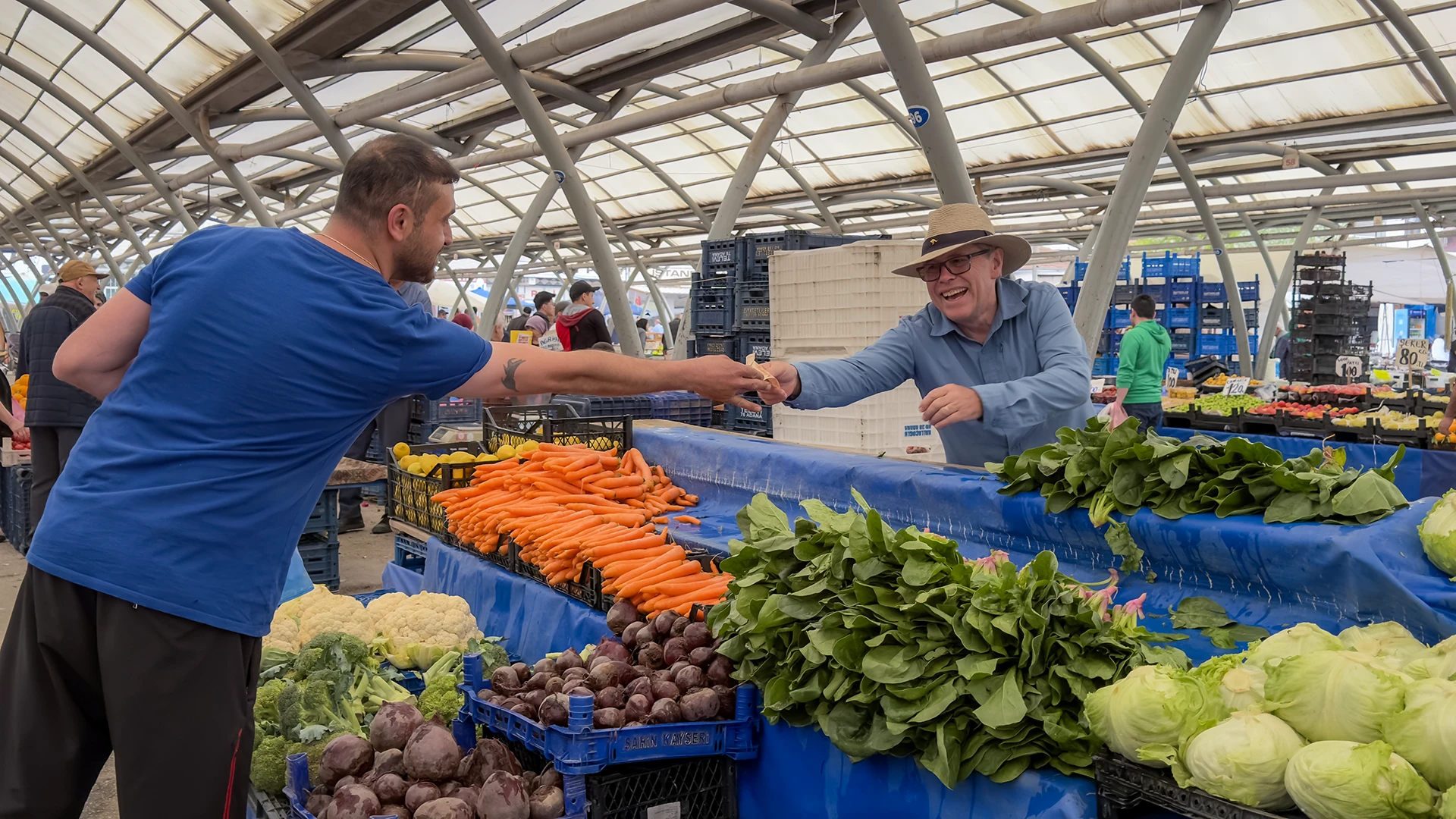
Weekly markets bring together vegetables, fruit, cheese, olives, grains, dried foods, herbs and other products used in everyday households.
What appears in the stalls changes with season, which makes a market particularly useful for seeing the difference between local food culture and a fixed restaurant menu.
For travellers interested in experiencing this side of regional life, our Farmers Markets in Cappadocia guide explains where and when local markets take place and what to expect when visiting.
A market does not need to become a major sightseeing activity.
Even a short visit can add useful context to a cooking class or village meal later in the day.
Food Is Part of the Landscape Too
Cappadocia’s cuisine should not be separated completely from the landscape explored elsewhere in this article.
Vineyards occupy volcanic valleys.
Fruit trees appear beside villages.
Rock-cut storage spaces helped preserve agricultural products.
Avanos pottery became connected with cooking as well as craft.
The same environment that shaped Cappadocia’s architecture also influenced how communities produced, stored and prepared food.
That relationship becomes particularly clear when you move from the kitchen to another long-established part of the region’s agricultural identity:
wine.
7. Discover Cappadocia’s Wine Culture
Cappadocia has a long-established viticulture tradition, and wine remains an important part of the region’s agricultural identity.
Vineyards grow across high-altitude terrain influenced by Cappadocia’s volcanic geology, while rock-cut spaces have historically provided naturally suitable environments for storage and wine cellars.
The region is particularly associated with Emir, a white grape variety closely identified with Cappadocia. Turkey’s official tourism platform highlights Emir as the principal local grape in Cappadocia’s wine identity and also notes the relationship between vineyards, volcanic terrain and rock-cut cellars.
Wine here therefore connects agriculture with another characteristic feature of Cappadocia:
people using volcanic rock for practical purposes.
What Is Emir Wine?
Emir is one of the grape varieties most strongly associated with Cappadocia.
It is used principally for white wine and has become an important expression of the region’s contemporary wine production.
For travellers unfamiliar with Turkish wine, starting with Emir makes sense because it provides something specific to the region rather than simply tasting international grape varieties that could be encountered elsewhere.
Local wineries also work with other Anatolian and international varieties, so a tasting can demonstrate that Cappadocia’s wine industry is broader than one grape alone. Turkey’s official vineyard route lists varieties including Emir, Narince, Kalecik Karası, Öküzgözü and Boğazkere alongside several international grapes.
Does Volcanic Soil Make Cappadocia Wine Different?
The volcanic character of Cappadocia is relevant, but it should not be reduced to a simple claim that “volcanic soil makes better wine.”
Wine is influenced by many variables:
grape variety, altitude, vineyard location, climate, cultivation, harvest decisions and winemaking technique all matter.
What can be said more confidently is that Cappadocia’s vineyards grow within a high-altitude volcanic landscape, and the official Turkish vineyard route identifies volcanic tuff as one of the characteristic elements of the region’s viticultural environment.
That is a more useful way to understand the relationship.
The geology contributes to the environment in which the vines grow.
It does not determine the quality of every bottle on its own.

Why Were Rock-Cut Spaces Useful for Wine?
Cappadocia’s soft volcanic rock offered another advantage after the grapes had been harvested.
Rock could be excavated into storage areas and cellars.
These spaces provide relatively stable underground conditions compared with the large temperature changes outside, making them naturally useful for storing wine.
The same geological characteristic therefore supported several different aspects of Cappadocian life:
people carved houses into it,
churches into it,
food-storage areas into it,
and wine cellars into it.
Wine culture belongs to the same broader story of human adaptation that runs throughout Cappadocia.
Wine Tasting or Vineyard Experience?
The two experiences answer different interests.
A structured tasting is useful if you want to compare grapes, styles and producers and better understand what distinguishes Cappadocian wines.
Our Wine Tasting Cappadocia experience is the more natural choice for travellers primarily interested in the wine itself.
An outdoor setting creates a different experience.
Our Outdoor Wine Experience in Cappadocia places wine within the landscape that produced it, making the valleys and volcanic terrain part of the experience rather than simply the background to a tasting room.
Neither approach is inherently better.
Choose according to whether your priority is learning about the wine or experiencing wine within the Cappadocian landscape.

Wine Is More Than an Evening Activity
Wine tasting is often treated as something to add after sightseeing.
It can be more meaningful when connected with the rest of the day.
A valley walk reveals vineyards.
Rock-cut spaces explain why cellar storage developed naturally.
A meal introduces regional food.
A tasting then connects those elements with one of Cappadocia’s continuing agricultural traditions.
That progression makes wine feel less like an optional luxury activity and more like another way of understanding how people have used the landscape.
8. Visit Local Markets and Village Communities
Some of the most useful glimpses of everyday Cappadocia happen away from archaeological entrances and panoramic viewpoints.
Weekly markets bring together fruit, vegetables, cheese, olives, grains, household goods and seasonal produce used by people living in the region. They are working parts of local life rather than attractions created specifically for visitors.
This makes them valuable for a different reason.
A market can show you what is in season, what families actually buy and how regional agriculture appears in everyday life.
You do not need to spend hours there.
Even a short visit can add context to the meals, vineyards, orchards and village landscapes encountered elsewhere in Cappadocia.
For current market locations, days and practical advice, use our Farmers Markets in Cappadocia guide.
Why Visit a Market in Cappadocia?
A restaurant menu presents food after it has already been selected and prepared.
A market shows the ingredients before that process begins.
Seasonal fruit changes throughout the year.
Fresh herbs and vegetables appear according to harvest cycles.
Cheese, dried foods, grains and pantry ingredients reflect household cooking rather than dishes designed primarily for visitors.
This makes markets particularly useful if food is one of your interests.
A cooking class becomes easier to understand after seeing the ingredients.
A vineyard visit connects more naturally with the agricultural landscape.
And a village meal feels less separate from the region around it.
Markets Are Not Staged Cultural Experiences
It is worth approaching local markets differently from museums or workshops.
People are there to shop, work and complete ordinary weekly routines.
Photography should therefore be considerate rather than automatic, particularly when photographing individuals at close range.
You do not need to turn every conversation into a cultural exchange or every stall into a photo opportunity.
Sometimes the most useful experience is simply observing how the market works.
That restraint generally creates a more respectful encounter with everyday life.
Spend Time Beyond Göreme’s Visitor Centre
Göreme is an excellent base for many travellers, but it represents only one part of Cappadocia.
Travelling through villages and smaller settlements reveals a region where agriculture, rock-cut architecture and contemporary life continue alongside tourism.
Around Cappadocia, you may encounter:
- vineyards and orchards beside village roads
- rock-cut storage spaces still incorporated into working properties
- traditional stone houses alongside newer construction
- small local bakeries and tea houses
- agricultural fields occupying the spaces between volcanic formations
- village workshops operating on a very different scale from large visitor-oriented centres
The point is not to search for a Cappadocia supposedly untouched by modern life.
Such a place does not exist.
It is to understand that Cappadocia is still a lived region rather than an archaeological landscape preserved only for visitors.
How to Experience Village Life Respectfully
Do not assume that a village itself is an attraction.
Historic houses are often private homes.
Agricultural land is working property.
Cave rooms may still be used for storage or other purposes even when they look abandoned from the road.
If an experience includes entering a family home, agricultural property or private workshop, it is better for that access to be invited or arranged rather than improvised.
This distinction matters particularly in Cappadocia because the boundary between heritage and everyday life is often difficult to see.
A rock-cut doorway may be historically interesting.
It may also simply belong to someone’s home.
Small Encounters Can Add More Than Another Viewpoint
Cappadocia’s major monuments deserve their reputation.
But once you have explored valleys, churches and underground cities, slowing the pace can add something different.
Drink tea.
Walk through a weekly market.
Stop in a village rather than only driving through it.
Notice where vineyards meet houses and where old rock-cut spaces remain part of contemporary properties.
These experiences are not dramatic.
That is precisely their value.
They help place Cappadocia’s celebrated heritage within the region where people still live.
9. Attend a Whirling Dervishes Ceremony
A Whirling Dervishes ceremony, or Mevlevi Sema, offers a very different experience from Cappadocia’s landscapes and archaeological sites.
It should also be understood differently from a conventional cultural performance.
Sema belongs to the Mevlevi Sufi tradition associated with Mevlana Jalal al-Din Rumi and the religious culture that developed around him in Konya. UNESCO inscribed the Mevlevi Sema ceremony on the Representative List of the Intangible Cultural Heritage of Humanity in 2008, following its earlier proclamation in 2005.
The ceremony combines music, movement and symbolic ritual within a structured spiritual tradition.
For visitors, understanding that context before attending changes the experience considerably.

What Happens During a Sema Ceremony?
Sema is not simply continuous whirling.
Turkey’s Ministry of Culture and Tourism describes a structured sequence that includes the naat, ney improvisation, peşrev, Devr-i Veledî and four selâm sections, accompanied by traditional Mevlevi music.
The clothing, music and movement also carry symbolic meanings within the ceremony.
The whirling itself is therefore one element within a much larger ritual structure.
If you arrive expecting only the visually famous turning movement, much of the ceremony can seem slow.
If you understand that the sequence is deliberate, the restraint becomes part of the experience.
What Is Cappadocia’s Connection With the Mevlevi Tradition?
The historical centre of the Mevlevi tradition is Konya, not Cappadocia.
UNESCO identifies Konya as the place from which the Mevleviye developed and later spread across the Ottoman world.
This distinction is important.
Attending a Sema ceremony in Cappadocia does not mean the ritual originated in the region.
Rather, Cappadocia offers visitors an opportunity to encounter a broader Anatolian spiritual tradition while travelling through central Turkey.
For travellers who want to explore that historical context more deeply, Konya provides the strongest connection with Rumi and the development of the Mevlevi tradition.
How Should You Approach a Whirling Dervishes Ceremony?
Treat it as a cultural and spiritual ceremony rather than as a dance show.
That means allowing the music and ritual sequence to unfold without expecting constant entertainment.
UNESCO specifically notes that some performances presented for tourism have been shortened or simplified, sometimes losing part of their original religious context.
For that reason, the quality of the setting and presentation matters.
Choose an experience that explains the tradition, preserves the ceremonial structure and treats the Sema with appropriate restraint.
Our Whirling Dervishes Ceremony in Cappadocia is the relevant option for travellers who want to include this experience within their stay.
Whirling Dervishes or Turkish Night?
These are not the same experience, and they should not be chosen for the same reason.
A Mevlevi Sema ceremony is contemplative, symbolic and connected with a Sufi spiritual tradition.
A Turkish Night is an entertainment-oriented evening built around folk dances, music and social atmosphere.
Neither needs to replace the other.
They simply answer different interests.
Choose the Whirling Dervishes Ceremony if you are interested in spirituality, ritual, music and the Mevlevi tradition.
Choose a Turkish Night Experience if you want a livelier evening centred on regional performance and entertainment.
Making that distinction before booking prevents one of the most common expectation mismatches between the two experiences.

Why Include Sema in a Cappadocia Trip?
Most of the experiences in Cappadocia are closely tied to the physical landscape.
You walk through valleys.
Enter rock-cut churches.
Descend underground.
Work with clay.
Taste wine produced from local vineyards.
Sema introduces something different.
Its connection is not geological but cultural.
It places Cappadocia within the wider traditions of Anatolia rather than treating the region as an isolated world of fairy chimneys and caves.
For travellers interested in more than scenery, that broader cultural context can be one of the most memorable parts of the trip.
10. Experience Cappadocia’s Cave Architecture
Staying in a cave hotel can be much more than an unusual accommodation choice.
At its best, it provides an opportunity to experience the same relationship between volcanic rock and human architecture that appears throughout Cappadocia’s churches, settlements and storage spaces.
Historic properties in places such as Göreme, Uçhisar and Ürgüp may combine rooms carved directly into the rock with later masonry additions built from local stone. Official cultural records from Nevşehir document historic houses where conventional stone-built rooms connect directly with rock-cut spaces, showing that the two forms often developed together rather than as completely separate architectural traditions.
This is why the phrase cave hotel can describe very different buildings.
Some properties incorporate genuinely historic rock-cut rooms.
Others combine old stone houses with excavated spaces.
And some modern accommodation simply uses a cave-inspired aesthetic.
Understanding the difference can make the experience considerably more meaningful.
What Is It Like to Stay in a Cave Room?
Rock-cut rooms generally respond more slowly to changes in outdoor temperature than conventional above-ground spaces.
They can feel cooler during warm days and more stable during Cappadocia’s colder seasons, although ventilation, humidity, room depth and modern climate-control systems all affect the actual experience.
The physical character is also different.
Walls may curve irregularly.
Small niches and carved surfaces can remain visible.
Rooms can extend deep into the rock or connect with later stone-built sections.
The best cave accommodation therefore does not need to disguise the historic structure beneath excessive decoration.
The architecture itself should be part of the experience.

Cave Hotels Are Part of a Longer Architectural Story
Modern tourism did not invent Cappadocia’s rock-cut architecture.
UNESCO identifies rock-hewn dwellings and troglodyte villages as fundamental components of the region’s cultural landscape and traces traditional habitation within the protected area back to Late Antiquity.
What tourism changed was the function of many surviving spaces.
Former houses, storage rooms and other historic structures were adapted for accommodation, restaurants and contemporary use. Official tourism material likewise notes that rock-carved spaces in Göreme and Ürgüp have been converted into modern accommodation.
That transformation creates both opportunity and responsibility.
A successful restoration needs modern plumbing, heating, ventilation, safety systems and structural intervention while still respecting historic fabric.
For a deeper explanation of how Cappadocia’s traditional houses became modern accommodation and what to look for when choosing one, continue with our Cappadocia Cave Hotels: History guide.
Do You Need to Stay in a Cave Hotel?
No.
A good Cappadocia trip does not depend on sleeping in a cave room.
The region’s architecture can already be experienced in villages, churches, monasteries and historic settlements.
A cave hotel becomes worthwhile when you want the accommodation itself to extend the cultural experience beyond sightseeing hours.
For some travellers, that is one of Cappadocia’s most memorable elements.
Others may prioritise location, terrace views, accessibility or conventional room layouts.
Choose the property according to how you travel rather than assuming a cave room is automatically the best option.
How Many of These 10 Experiences Can You Realistically Do?
You do not need to complete all ten activities for a successful Cappadocia trip.
In fact, trying to do so too quickly would undermine the point of this article.
With around three days, a strong first visit can usually combine major valleys, Göreme Open Air Museum, an underground city and one or two participatory experiences such as pottery, cooking or Sema.
With four or five days, there is much more room for longer hikes, Soğanlı or other outlying heritage sites, markets, wine experiences and slower time in villages.
The important distinction is between seeing more and experiencing more.
Cappadocia benefits from time.
A two-hour valley walk often adds more than three additional panoramic stops.
A cooking class can reveal more about local life than another quick monument.
And an evening spent understanding one cultural tradition is usually more memorable than compressing several unrelated activities into the same day.
Which Cappadocia Experiences Should You Prioritise?
For a first visit, build the itinerary around different dimensions of the region rather than choosing ten activities from the same category.
A balanced trip might include a substantial valley walk for the landscape, Göreme Open Air Museum for Byzantine heritage, an underground city for subterranean architecture, one hands-on experience such as pottery or cooking, and enough unscheduled time to experience the towns and valleys at a slower pace.
Then add wine, Sema, markets, Soğanlı or other experiences according to personal interests.
This is a better approach than assuming every traveller should follow exactly the same list.
Exploring Cappadocia Beyond the Checklist
The ten experiences in this guide are not intended as a challenge to complete.
They show how many different versions of Cappadocia exist within the same region.
There is geological Cappadocia.
Byzantine Cappadocia.
Agricultural Cappadocia.
Underground Cappadocia.
Cappadocia of pottery workshops, kitchens, vineyards and living communities.
A thoughtfully designed itinerary connects those layers rather than treating each experience as an independent attraction.
For travellers who want enough time to explore Cappadocia at that pace, our 5 Days Cappadocia Tour creates room for the major landscapes and historical sites while allowing additional experiences to be shaped around individual interests.
Frequently Asked Questions About Things to Do in Cappadocia Beyond Balloons
Is Cappadocia worth visiting if you do not take a hot air balloon?
Yes.
Ballooning provides an exceptional aerial perspective, but Cappadocia’s valleys, Byzantine churches, underground cities, rock-cut architecture, food traditions and craft culture can all be experienced independently of a flight.
How many days do you need in Cappadocia?
Three days provide a strong introduction to the principal landscapes and historical sites.
Four or five days allow more time for hiking, workshops, local food, wine, outlying heritage sites and a less rushed itinerary.
What are the best things to do in Cappadocia besides hot air balloons?
For a first visit, prioritise a valley hike, Göreme Open Air Museum, an underground city and at least one cultural or hands-on experience such as pottery, cooking or a Sema ceremony.
The best combination depends on whether your interests lean more toward archaeology, nature, food, crafts or local culture.
Can you explore Cappadocia without a tour?
Yes.
Many valleys, museums, towns and viewpoints can be explored independently.
A guide becomes particularly useful when historical interpretation, efficient routing or access to several geographically separated sites is important.
Is Cappadocia good for hiking?
Yes.
Red Valley, Rose Valley, Love Valley, Zemi Valley and Ihlara Valley offer very different walking experiences.
Trail length and difficulty vary, so choose routes according to fitness, weather and the amount of time available.
What can you do in Cappadocia at night?
Evenings can include a Whirling Dervishes ceremony, Turkish Night, wine tasting, dinner or simply time in Göreme, Uçhisar or Ürgüp.
Sema and Turkish Night should not be treated as interchangeable: one is a contemplative Mevlevi ceremony, while the other is entertainment centred on music and folk performance.
Is staying in a cave hotel worth it?
It can be, particularly if the property preserves genuine rock-cut or historic stone architecture.
A cave room is not essential to experiencing Cappadocia, however, and location, accessibility and overall accommodation quality should remain part of the decision.
Can you do these activities year-round?
Most can be experienced throughout the year, but weather changes how they feel.
Spring and autumn are particularly comfortable for hiking, summer requires more attention to heat and sun exposure, while winter can bring snow, ice and colder walking conditions.
WRITTEN BY

Nisa Buket Dağdelen
Operations Director & Tour Guide
LinkedIn Profile

Hüseyin Pekgöz
Founder & Managing Partner
LinkedIn Profile
Adventus Travel Company


